Bowden Mark G, Monsch Eric D, Middleton Addie, Daughtry Chris, Powell Troy, Kraft Sara V
Division of Physical Therapy, College of Health Professions, Medical University of South Carolina, Charleston, SC.
Ralph H. Johnson VA Medical Center, Charleston, SC.
Arch Rehabil Res Clin Transl. 2020 Apr 13;2(2):100052. doi: 10.1016/j.arrct.2020.100052. eCollection 2020 Jun.
The objective of this study was to determine the feasibility of a rehabilitation approach focusing on cardiovascular, strength, and gait training intensity in the inpatient rehabilitation setting after a new onset of stroke. We additionally aimed to determine the efficacy of this intensity-based program on rehabilitation outcomes compared with usual care.
Participants were pseudo-randomized to an intensity-based program focusing on gait, cardiovascular, and strength training or to usual care. Outcomes included FIM, 10-meter walk, 2-minute walk, timed Up and Go test, 5-time sit-to-stand test, and Tinetti balance assessment.
The intervention consisted of 6 20-minute sessions per week dedicated to intensity of activity: 2 each for walking, cardiovascular training, and strength training.
Patients (N=49) with new onset stroke admitted to inpatient rehabilitation over the course of 1 year.
Four inpatient rehabilitation facilities with comprehensive neurologic rehabilitation teams.
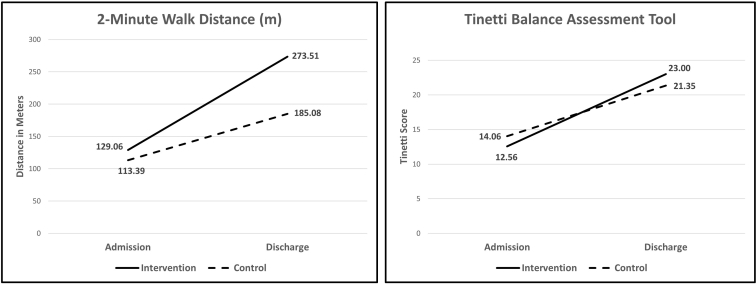
Thirty-five individuals (16 intervention, 19 controls) completed all testing. Subject compliance to the intensity intervention demonstrated completion of approximately half the prescribed sessions. All outcomes improved significantly from admission to discharge, and a significant interaction between treatment group and time was observed for the 2-minute walk and the Tinetti balance assessment. The 2-minute walk, Tinetti balance assessment, 10-meter walk, and FIM demonstrated between-group effect sizes greater than 0.60 in favor of the intervention group.
The intensity-based protocol was safe, and several measures demonstrated efficacy when compared with usual care. Results may have been limited by poor program compliance, showing a need to identify and ameliorate obstacles to integration of comprehensive intensity-based programs addressing endurance, strength, and gait training. Applying physiological principles of exercise to acute stroke rehabilitation demonstrates great promise for improving independent physical function.
本研究的目的是确定在中风初发后的住院康复环境中,以心血管、力量和步态训练强度为重点的康复方法的可行性。我们还旨在确定与常规护理相比,这种基于强度的方案对康复结果的疗效。
参与者被伪随机分配到以步态、心血管和力量训练为重点的基于强度的方案或常规护理组。结果包括功能独立性测量(FIM)、10米步行、2分钟步行、起立行走计时测试、5次坐立测试和Tinetti平衡评估。
干预包括每周6次,每次20分钟的活动强度训练:步行、心血管训练和力量训练各2次。
在1年期间入住住院康复科的中风初发患者(N = 49)。
四个配备全面神经康复团队的住院康复设施。
35名个体(16名干预组,19名对照组)完成了所有测试。受试者对强度干预的依从性表明完成了约一半的规定疗程。从入院到出院,所有结果均有显著改善,并且在2分钟步行和Tinetti平衡评估中观察到治疗组与时间之间存在显著交互作用。2分钟步行、Tinetti平衡评估、10米步行和FIM显示组间效应大小大于0.60,有利于干预组。
基于强度的方案是安全的,与常规护理相比,多项指标显示出疗效。结果可能受到方案依从性差的限制,表明需要识别并改善整合基于强度的全面方案(涉及耐力、力量和步态训练)的障碍。将运动的生理原理应用于急性中风康复显示出改善独立身体功能的巨大潜力。