Medical Department I, University Medical Center Schleswig Holstein, Kiel, Germany.
Department of Medicine I, University Medical Center Dresden, and Center for Regenerative Therapies Dresden [CRTD], Dresden, Germany.
J Crohns Colitis. 2021 Aug 2;15(8):1339-1345. doi: 10.1093/ecco-jcc/jjab024.
Increased mortality from respiratory diseases was observed in epidemiological studies of patients with ulcerative colitis [UC] as a potentially underestimated extraintestinal manifestation. We therefore investigated the presence of pulmonary manifestations of inflammatory bowel disease [IBD] and the potential effect of tumour necrosis factor alpha [TNF-α] inhibitors on pulmonary function tests [PFT] in a prospective, longitudinal study.
In all, 92 consecutive patients with IBD (49 Crohn´s disease [CD], 43 UC) and 20 healthy controls were recruited. Fifty patients with IBD were in remission, and 42 had active disease with 22 of these being examined before and 6 weeks after initiating anti-TNF therapy. Pulmonary function tests [PFT] were evaluated using the Medical Research Council [MRC] dyspnoea index and a standardized body plethysmography. IBD activity was assessed using Harvey-Bradshaw index for CD and partial Mayo score for UC. Data are presented as mean ± standard error of the mean [SEM].
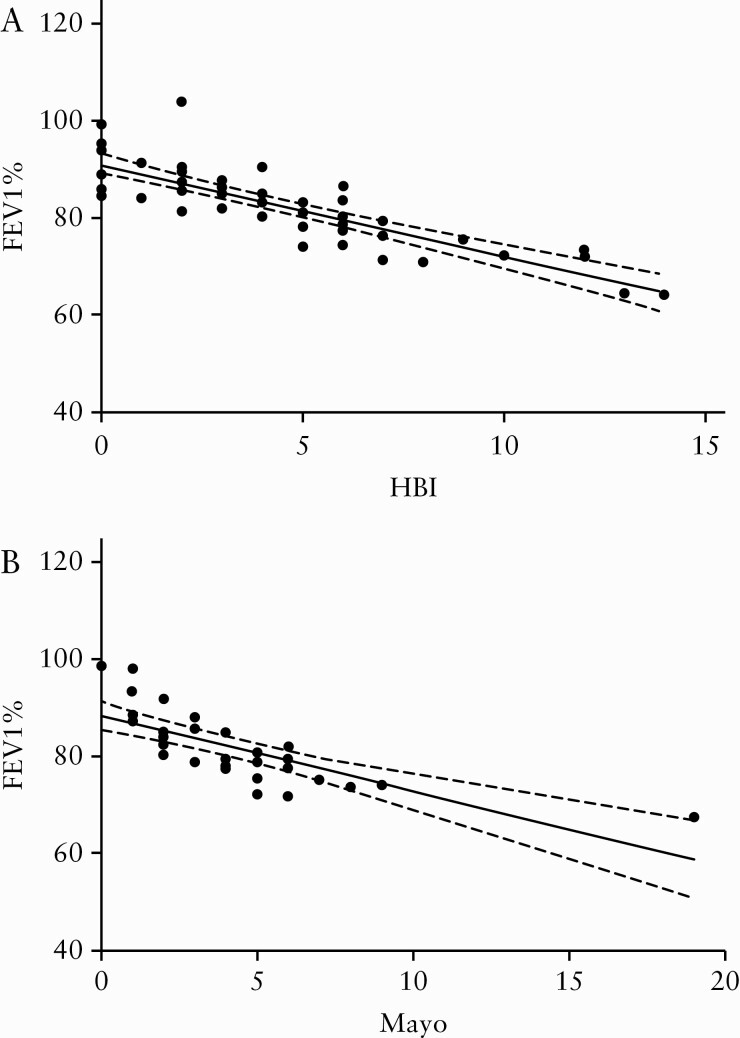
Patients with active IBD showed significant reduction of PFT. Forced expiration [Tiffeneau index] values [FEV1%] were significantly reduced in IBD patients with active disease [78.8 ± 1.1] compared with remission [86.1 ± 0.9; p = 0.0002] and with controls [87.3 ± 1.3; p = 0.001]. Treatment with anti-TNF induced a significant relief in obstruction [p = 0.003 for FEV1% in comparison with baseline levels]. The level of pulmonary obstruction significantly correlated with clinical inflammation scores [HBI or Mayo].
PATIENTS: with active IBD present with significant obstructive abnormalities in their PFTs. Obstruction is related to inflammatory activity, with anti-TNF improving PFTs. Pulmonary obstruction and possibly chronic bronchopulmonary inflammation is an overlooked problem in active IBD that is probably obscured by intestinal symptoms.
溃疡性结肠炎 [UC] 患者的流行病学研究表明,其死于呼吸系统疾病的风险增加,这可能是一种被低估的肠外表现。因此,我们在一项前瞻性、纵向研究中调查了炎症性肠病 [IBD] 的肺部表现以及肿瘤坏死因子-α [TNF-α] 抑制剂对肺功能测试 [PFT] 的潜在影响。
共招募了 92 例连续的 IBD 患者(49 例克罗恩病 [CD],43 例 UC)和 20 例健康对照者。50 例 IBD 患者处于缓解期,42 例患者处于活动期,其中 22 例在开始抗 TNF 治疗前和 6 周后进行了检查。采用医学研究委员会 [MRC] 呼吸困难指数和标准化体描法评估肺功能测试 [PFT]。使用 Harvey-Bradshaw 指数评估 CD 的 IBD 活动,使用部分 Mayo 评分评估 UC 的 IBD 活动。数据以平均值 ± 均数标准误 [SEM] 表示。
活动期 IBD 患者的 PFT 显著降低。与缓解期[86.1 ± 0.9;p = 0.0002]和对照组[87.3 ± 1.3;p = 0.001]相比,活动期 IBD 患者的用力呼气 [Tiffeneau 指数] 值 [FEV1%]显著降低[78.8 ± 1.1]。抗 TNF 治疗诱导阻塞显著缓解 [与基线相比,FEV1%的 p = 0.003]。肺阻塞程度与临床炎症评分 [HBI 或 Mayo]显著相关。
患有活动期 IBD 的患者的 PFT 存在显著的阻塞性异常。阻塞与炎症活动有关,抗 TNF 可改善 PFT。肺阻塞和可能的慢性支气管肺炎症是活动期 IBD 中被忽视的问题,可能被肠道症状所掩盖。