Wang Qiang, Yildirim Timur M, Schickhardt Sonja K, Łabuz Grzegorz, Khoramnia Ramin, Merz Patrick R, Son Hyeck-Soo, Munro Donald J, Friedmann Elfriede, Auffarth Gerd U
David J. Apple International Laboratory for Ocular Pathology, Department of Ophthalmology, University of Heidelberg, Heidelberg, Germany.
Department of Ophthalmology, Third Affiliated Hospital, Wenzhou Medical University, Ruian, Zhejiang, China.
Ophthalmol Ther. 2021 Mar;10(1):165-174. doi: 10.1007/s40123-020-00329-8. Epub 2021 Feb 5.
Foldable hydrophobic acrylic intraocular lenses (IOLs) are prone to develop a long-term postoperative material change called glistenings. The aim of this study was to investigate the changes in the predisposition for glistening formation in one type of hydrophobic acrylic IOL material from its introduction to the present day.
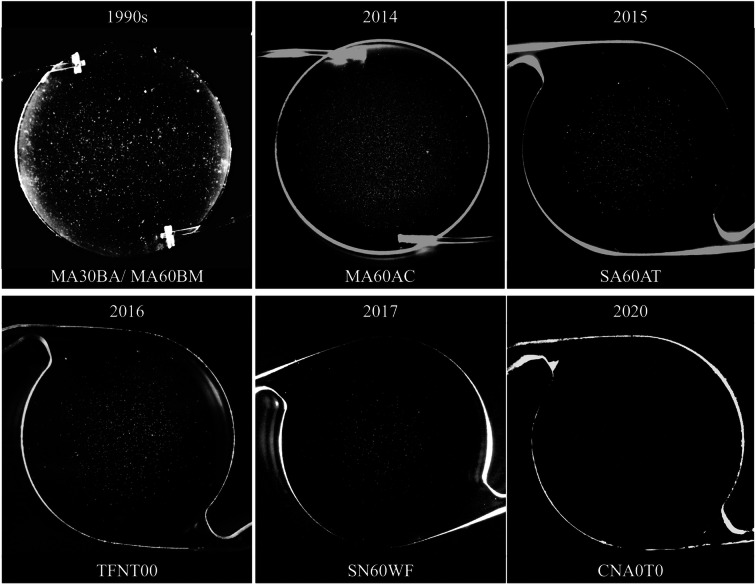
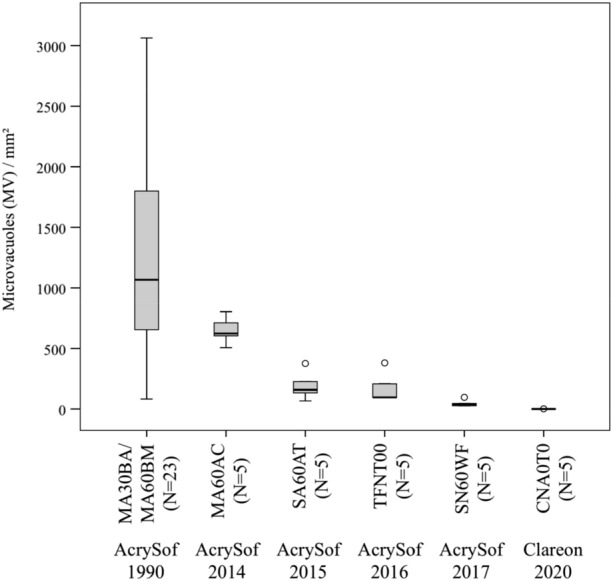
In a laboratory setup, an in vitro model was used to induce glistenings in hydrophobic acrylic IOLs manufactured by one company (Alcon, Fort Worth, TX, USA) in different years: 23 1990s-manufacture hydrophobic acrylic three-piece IOLs (MA30BA/MA60AC) that were explanted in 1996 and 1997, and five of each of the newer AcrySof IOL models (MA60AC, SA60AT, TFNT00 and SN60WF) from 2014 to 2017. Furthermore, five Clareon (SY60WF) IOLs were put through the same accelerated aging procedure. The number of microvacuoles per square millimeter (MV/mm) was determined in the central part of each IOL optic and compared between the groups.
The mean number of MV was highest in the 1990s-manufacture Alcon acrylic IOLs, with 1289 (± 738) MV/mm. The number decreased to 650 (± 101), 192 (± 105), 175 (± 112) and 47 (± 26) for MA60AC, SA60AT, TFNT00 and SN60WF, respectively. The lowest count was obtained in the Clareon group, with 1 (± 1) MV/mm.
A high number of glistenings was induced in the explanted IOLs from the 1990s. The propensity for glistening formation decreased considerably after that decade and now in current use. Even though in vitro glistening formation in today's AcrySof material was low, the Clareon material was essentially glistenings-free.
可折叠疏水性丙烯酸人工晶状体(IOL)在术后长期容易出现一种称为“闪辉”的材料变化。本研究的目的是调查一种疏水性丙烯酸IOL材料从引入至今闪辉形成倾向的变化。
在实验室环境中,使用体外模型在不同年份由一家公司(美国德克萨斯州沃思堡的爱尔康公司)生产的疏水性丙烯酸IOL中诱导闪辉:23枚20世纪90年代生产的疏水性丙烯酸三片式IOL(MA30BA/MA60AC),于1996年和1997年被取出,以及2014年至2017年生产的每种新型AcrySof IOL型号(MA60AC、SA60AT、TFNT00和SN60WF)各5枚。此外,5枚Clareon(SY60WF)IOL也经过相同的加速老化程序。测定每个IOL光学部中央每平方毫米的微泡数量(MV/mm),并在各实验组之间进行比较。
20世纪90年代生产的爱尔康丙烯酸IOL的MV平均数最高,为1289(±738)MV/mm。MA60AC、SA60AT、TFNT00和SN60WF的MV数量分别降至650(±101)、192(±105)、175(±112)和47(±26)。Clareon组的MV数量最低,为1(±1)MV/mm。
20世纪90年代取出的IOL诱导出大量闪辉。在那个十年之后以及目前使用的IOL中,闪辉形成的倾向大幅降低。尽管当今AcrySof材料的体外闪辉形成率较低,但Clareon材料基本无闪辉。