Thomes Brett E, Callaghan Thomas A
Alcon Research Ltd (A Novartis Company), Fort Worth, TX, USA.
Clin Ophthalmol. 2013;7:1529-34. doi: 10.2147/OPTH.S44208. Epub 2013 Jul 25.
To evaluate the impact of continuous manufacturing process improvements on glistening formation in AcrySof hydrophobic acrylic intraocular lenses (IOLs) by comparing lenses manufactured in 2003 with lenses manufactured in 2012.
Glistenings were experimentally created as aqueous-filled microvacuoles utilizing an accelerated laboratory method by immersing the lens in water at 45°C for 24 hours and then reducing the temperature to 37°C for 2.5 hours. To determine the impact of continuous improvements on glistening formation, AcrySof IOLs (Alcon Laboratories, Inc) Model SB30 AL manufactured in 2003 were compared with AcrySof IOLs Model SN60 WF manufactured in 2012.
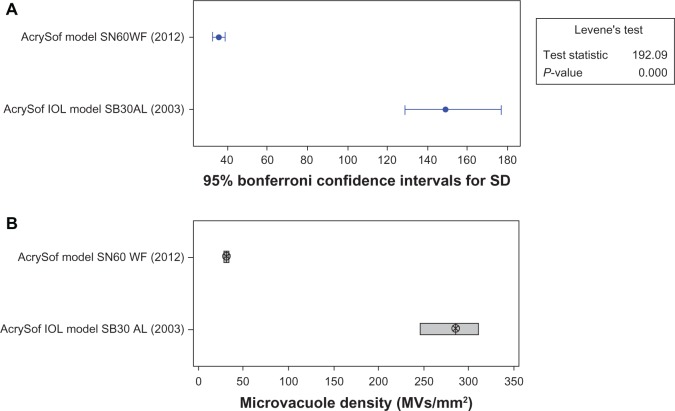
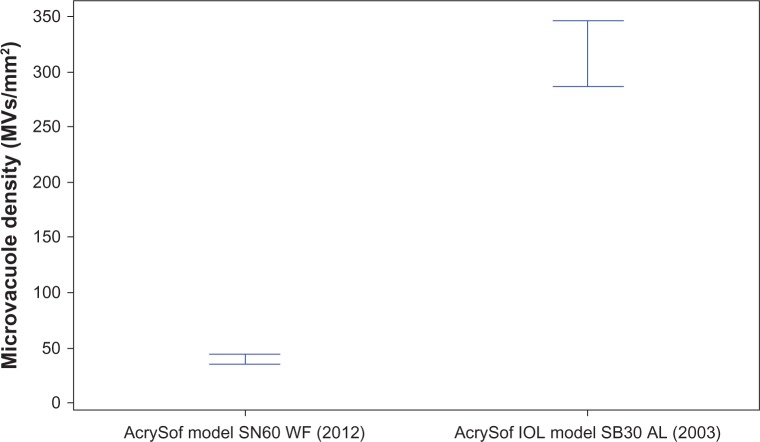
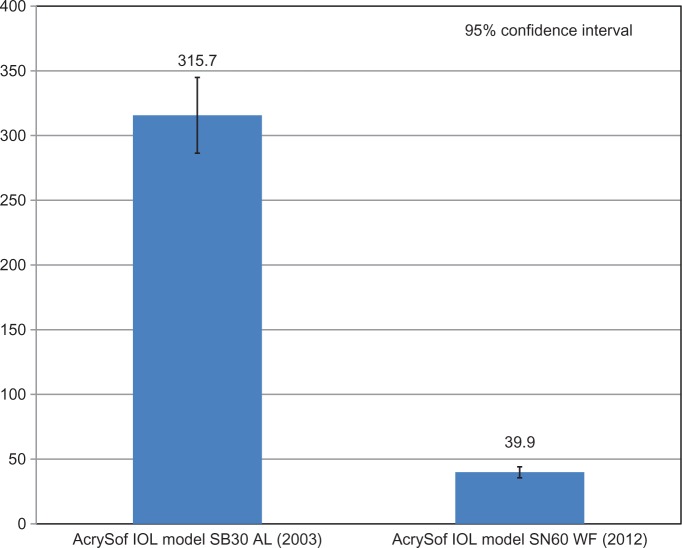
Glistenings were present in all lenses after the accelerated microvacuole test method. The mean microvacuole density for IOLs manufactured in 2003 was 315.7 microvacuoles per square millimeter (MVs/mm(2)) with a glistening severity less than 100 MVs/mm(2) in 1.0% of the IOLs. The mean microvacuole density for IOLs manufactured in 2012 was 39.9 MVs/mm(2) with a glistening severity less than 100 MVs/mm(2) in 95.2% of the IOLs. Laboratory-induced microvacuole density was significantly lower in IOLs manufactured in 2012 (mean 39.9 MVs/mm(2)) relative to IOLs manufactured in 2003 (mean 315.7 MVs/mm(2)) as indicated by the Wilcoxon test of significance (P < 0.0005).
AcrySof IOLs recently manufactured in 2012 demonstrated a significant reduction in glistening density (87% reduction in mean density) as a result of continuous manufacturing process improvements compared with IOLs manufactured in 2003.
通过比较2003年生产的晶状体与2012年生产的晶状体,评估连续制造工艺改进对AcrySof疏水丙烯酸人工晶状体(IOL)中闪烁形成的影响。
采用加速实验室方法,将晶状体置于45°C水中浸泡24小时,然后将温度降至37°C持续2.5小时,通过这种方式将闪烁实验性地诱导为充满水的微泡。为了确定连续改进对闪烁形成的影响,将2003年生产的AcrySof IOL(爱尔康实验室公司)SB30 AL型号与2012年生产的AcrySof IOL SN60 WF型号进行比较。
在加速微泡测试方法后,所有晶状体中均出现了闪烁。2003年生产的IOL的平均微泡密度为每平方毫米315.7个微泡(MVs/mm²),1.0%的IOL的闪烁严重程度低于100 MVs/mm²。2012年生产的IOL的平均微泡密度为39.9 MVs/mm²,95.2%的IOL的闪烁严重程度低于100 MVs/mm²。如Wilcoxon显著性检验所示(P < 0.0005),2012年生产的IOL的实验室诱导微泡密度(平均39.9 MVs/mm²)相对于2003年生产的IOL(平均315.7 MVs/mm²)显著更低。
与2003年生产的IOL相比,2012年近期生产的AcrySof IOL由于连续制造工艺改进,闪烁密度显著降低(平均密度降低87%)。