Department of Otolaryngology, Massachusetts Eye and Ear Infirmary, Boston, Massachusetts, United States of America.
Harvard Medical School, Boston, Massachusetts, United States of America.
PLoS One. 2021 Feb 5;16(2):e0244127. doi: 10.1371/journal.pone.0244127. eCollection 2021.
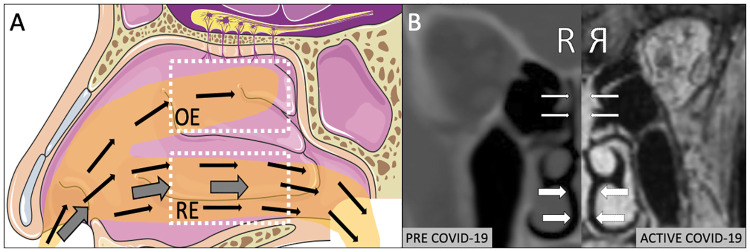
Olfactory dysfunction (OD) affects a majority of COVID-19 patients, is atypical in duration and recovery, and is associated with focal opacification and inflammation of the olfactory epithelium. Given recent increased emphasis on airborne transmission of SARS-CoV-2, the purpose of the present study was to experimentally characterize aerosol dispersion within olfactory epithelium (OE) and respiratory epithelium (RE) in human subjects, to determine if small (sub 5μm) airborne aerosols selectively deposit in the OE.
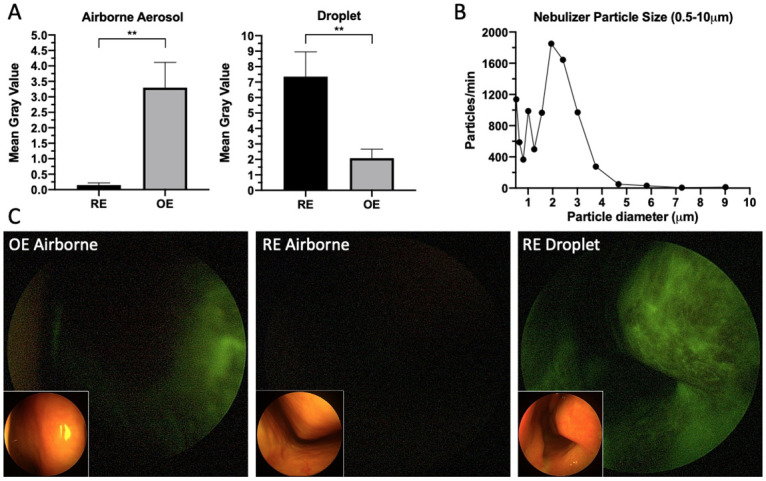
Healthy adult volunteers inhaled fluorescein-labeled nebulized 0.5-5μm airborne aerosol or atomized larger aerosolized droplets (30-100μm). Particulate deposition in the OE and RE was assessed by blue-light filter modified rigid endoscopic evaluation with subsequent image randomization, processing and quantification by a blinded reviewer.
0.5-5μm airborne aerosol deposition, as assessed by fluorescence gray value, was significantly higher in the OE than the RE bilaterally, with minimal to no deposition observed in the RE (maximum fluorescence: OE 19.5(IQR 22.5), RE 1(IQR 3.2), p<0.001; average fluorescence: OE 2.3(IQR 4.5), RE 0.1(IQR 0.2), p<0.01). Conversely, larger 30-100μm aerosolized droplet deposition was significantly greater in the RE than the OE (maximum fluorescence: OE 13(IQR 14.3), RE 38(IQR 45.5), p<0.01; average fluorescence: OE 1.9(IQR 2.1), RE 5.9(IQR 5.9), p<0.01).
Our data experimentally confirm that despite bypassing the majority of the upper airway, small-sized (0.5-5μm) airborne aerosols differentially deposit in significant concentrations within the olfactory epithelium. This provides a compelling aerodynamic mechanism to explain atypical OD in COVID-19.
嗅觉功能障碍(OD)影响了大多数 COVID-19 患者,其持续时间和恢复情况不同寻常,且与嗅觉上皮的局灶性混浊和炎症有关。鉴于最近对 SARS-CoV-2 空气传播的重视,本研究的目的是在人体中实验性地描述嗅觉上皮(OE)和呼吸上皮(RE)内的气溶胶分散情况,以确定是否小(小于 5μm)的空气传播气溶胶会选择性地沉积在 OE 中。
健康成年志愿者吸入荧光素标记的雾化 0.5-5μm 空气传播气溶胶或雾化较大的气溶胶液滴(30-100μm)。通过使用蓝光滤光片修改刚性内窥镜评估,随后由盲法审阅者对图像进行随机化、处理和量化,来评估 OE 和 RE 中的颗粒沉积。
通过荧光灰度值评估,0.5-5μm 空气传播气溶胶沉积在 OE 中的量明显高于双侧 RE,RE 中的沉积量最小或没有(最大荧光:OE 19.5(IQR 22.5),RE 1(IQR 3.2),p<0.001;平均荧光:OE 2.3(IQR 4.5),RE 0.1(IQR 0.2),p<0.01)。相反,30-100μm 雾化液滴的沉积在 RE 中的量明显大于 OE(最大荧光:OE 13(IQR 14.3),RE 38(IQR 45.5),p<0.01;平均荧光:OE 1.9(IQR 2.1),RE 5.9(IQR 5.9),p<0.01)。
我们的数据通过实验证实,尽管小尺寸(0.5-5μm)的空气传播气溶胶绕过了大部分上呼吸道,但仍会以显著浓度在嗅觉上皮内沉积。这为解释 COVID-19 中不同寻常的 OD 提供了一个有说服力的空气动力学机制。