Richardson Jennifer R, Schöllhorn Anna, Gouttefangeas Cécile, Schuhmacher Juliane
Department of Immunology, Institute for Cell Biology, University of Tübingen, 72076 Tübingen, Germany.
Cluster of Excellence iFIT (EXC2180) "Image-Guided and Functionally Instructed Tumor Therapies", University of Tübingen, 72076 Tübingen, Germany.
Cancers (Basel). 2021 Feb 3;13(4):596. doi: 10.3390/cancers13040596.
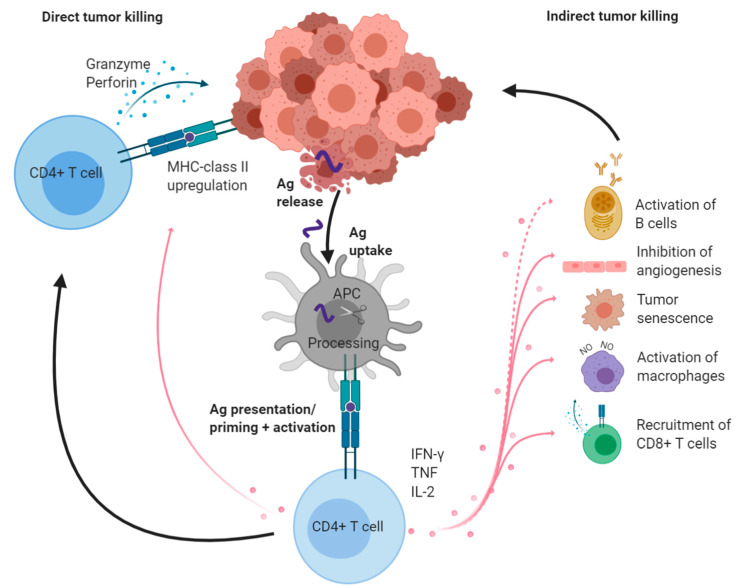
Cancer immunotherapy activates the immune system to specifically target malignant cells. Research has often focused on CD8+ cytotoxic T cells, as those have the capacity to eliminate tumor cells after specific recognition upon TCR-MHC class I interaction. However, CD4+ T cells have gained attention in the field, as they are not only essential to promote help to CD8+ T cells, but are also able to kill tumor cells directly (via MHC-class II dependent recognition) or indirectly (e.g., via the activation of other immune cells like macrophages). Therefore, immunotherapy approaches have shifted from only stimulating CD8+ T cells to targeting and assessing both, CD4+ and CD8+ T cell subsets. Here, we discuss the various subsets of CD4+ T cells, their plasticity and functionality, their relevance in the antitumor immune response in patients affected by cancer, and their ever-growing role in therapeutic approaches for human cancer.
癌症免疫疗法激活免疫系统以特异性靶向恶性细胞。研究通常聚焦于CD8+细胞毒性T细胞,因为这些细胞在通过TCR-MHC I类相互作用进行特异性识别后具有消除肿瘤细胞的能力。然而,CD4+ T细胞在该领域已受到关注,因为它们不仅对于促进对CD8+ T细胞的辅助至关重要,而且还能够直接(通过MHC-II类依赖性识别)或间接(例如,通过激活巨噬细胞等其他免疫细胞)杀死肿瘤细胞。因此,免疫疗法已从仅刺激CD8+ T细胞转变为靶向和评估CD4+和CD8+ T细胞亚群。在此,我们讨论CD4+ T细胞的各种亚群、它们的可塑性和功能、它们在癌症患者抗肿瘤免疫反应中的相关性以及它们在人类癌症治疗方法中日益重要的作用。