Department of Sociology, West University of Timișoara, 300223 Timisoara, Romania.
Department of Geography, Stefan cel Mare University of Suceava, 720229 Suceava, Romania.
Int J Environ Res Public Health. 2021 Feb 3;18(4):1406. doi: 10.3390/ijerph18041406.
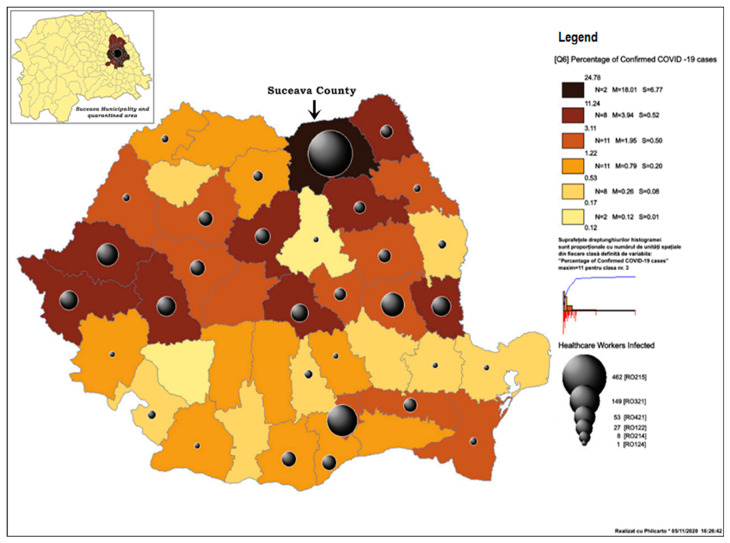
The first months of 2020 were marked by the rapid spread of the acute respiratory disease, which swiftly reached the proportions of a pandemic. The city and county of Suceava, Romania, faced an unprecedented crisis in March and April 2020, triggered not only by the highest number of infections nationwide but also by the highest number of infected health professionals (47.1% of the infected medical staff nationwide, in April 2020). Why did Suceava reach the peak number of COVID-19 cases in Romania? What were the vulnerability factors that led to the outbreak, the closure of the city of Suceava and neighboring localities, and the impossibility of managing the crisis with local resources? What is the relationship between the population's lack of confidence in the authorities' ability to solve the crisis, and their attitude towards the imposed measures? The present article aims to provide answers to the above questions by examining the attitudes of the public towards the causes that have led to the outbreak of an epidemiological crisis, systemic health problems, and the capacity of decision makers to intervene both at local and national level. The research is based on an online survey, conducted between April and May 2020, resulting in a sample of 1231 people from Suceava County. The results highlight that the development of the largest COVID-19 outbreak in Romania is, without a doubt, the result of a combination of factors, related to the medical field, decision makers, and the particularities of the population's behavior.
2020 年头几个月,急性呼吸道疾病迅速蔓延,迅速蔓延到大流行的程度。罗马尼亚苏恰瓦市和苏恰瓦县在 2020 年 3 月和 4 月面临着前所未有的危机,不仅是因为全国感染人数最多,还因为受感染的卫生专业人员人数最多(2020 年 4 月,全国受感染医务人员的 47.1%)。为什么苏恰瓦达到罗马尼亚 COVID-19 病例的高峰?导致疫情爆发、苏恰瓦市和周边地区关闭以及无法利用当地资源应对危机的脆弱因素是什么?公众对当局解决危机能力缺乏信心与他们对实施措施的态度之间有什么关系?本文旨在通过考察公众对导致疫情爆发、系统性卫生问题以及决策者在地方和国家层面进行干预的能力的原因的态度,来回答上述问题。这项研究基于 2020 年 4 月至 5 月期间进行的在线调查,对苏恰瓦县的 1231 人进行了抽样调查。结果表明,罗马尼亚最大的 COVID-19 疫情的发展无疑是多种因素共同作用的结果,这些因素与医疗领域、决策者以及人口行为的特殊性有关。