Key Laboratory of National Forestry and Grassland Administration/Beijing for Bamboo & Rattan Science and Technology, Beijing, China.
Institute of Gene Science and Industrialization for Bamboo and Rattan Resources, International Center for Bamboo and Rattan, Beijing, China.
BMC Plant Biol. 2021 Feb 5;21(1):76. doi: 10.1186/s12870-020-02779-5.
The subfamily Bambusoideae belongs to the grass family Poaceae and has significant roles in culture, economy, and ecology. However, the phylogenetic relationships based on large-scale chloroplast genomes (CpGenomes) were elusive. Moreover, most of the chloroplast DNA sequencing methods cannot meet the requirements of large-scale CpGenome sequencing, which greatly limits and impedes the in-depth research of plant genetics and evolution.
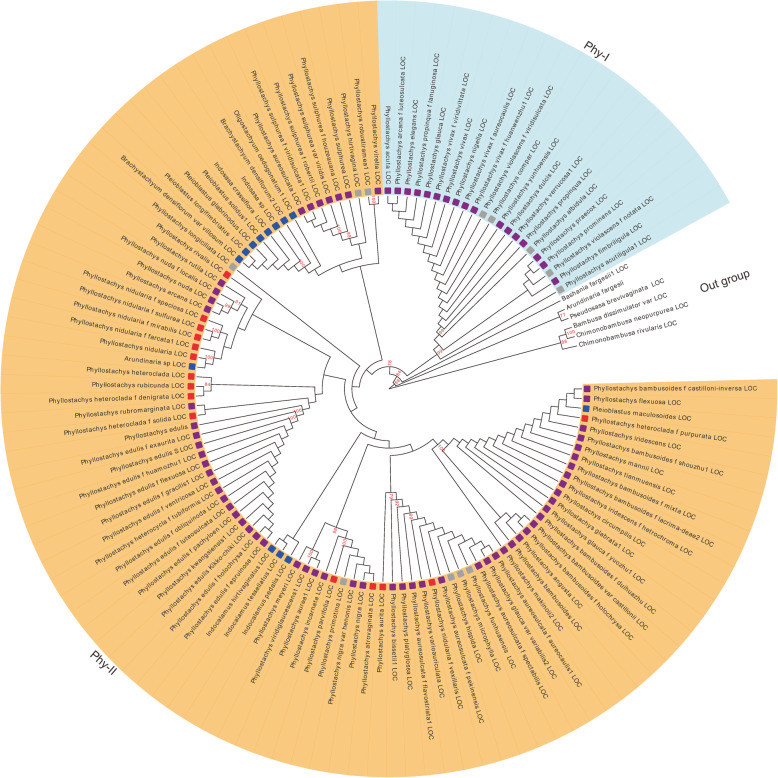
To develop a set of bamboo probes, we used 99 high-quality CpGenomes with 6 bamboo CpGenomes as representative species for the probe design, and assembled 15 M unique sequences as the final pan-chloroplast genome. A total of 180,519 probes for chloroplast DNA fragments were designed and synthesized by a novel hybridization-based targeted enrichment approach. Another 468 CpGenomes were selected as test data to verify the quality of the newly synthesized probes and the efficiency of the probes for chloroplast capture. We then successfully applied the probes to synthesize, enrich, and assemble 358 non-redundant CpGenomes of woody bamboo in China. Evaluation analysis showed the probes may be applicable to chloroplasts in Magnoliales, Pinales, Poales et al. Moreover, we reconstructed a phylogenetic tree of 412 bamboos (358 in-house and 54 published), supporting a non-monophyletic lineage of the genus Phyllostachys. Additionally, we shared our data by uploading a dataset of bamboo CpGenome into CNGB ( https://db.cngb.org/search/project/CNP0000502/ ) to enrich resources and promote the development of bamboo phylogenetics.
The development of the CpGenome enrichment pipeline and its performance on bamboos recommended an inexpensive, high-throughput, time-saving and efficient CpGenome sequencing strategy, which can be applied to facilitate the phylogenetics analysis of most green plants.
竹亚科隶属于禾本科,在文化、经济和生态方面具有重要作用。然而,基于大规模叶绿体基因组(CpGenomes)的系统发育关系仍难以捉摸。此外,大多数叶绿体 DNA 测序方法无法满足大规模 CpGenome 测序的要求,这极大地限制和阻碍了植物遗传学和进化的深入研究。
为了开发一套竹类探针,我们使用了 99 个高质量的 CpGenomes,其中 6 个 CpGenomes 作为代表物种进行探针设计,并组装了 1500 万个独特序列作为最终的泛叶绿体基因组。通过一种新的基于杂交的靶向富集方法,共设计和合成了 180519 个叶绿体 DNA 片段探针。另外选择了 468 个 CpGenomes 作为测试数据,以验证新合成探针的质量和探针对叶绿体捕获的效率。然后,我们成功地应用这些探针合成、富集和组装了中国 358 种非冗余木本竹类的 CpGenomes。评估分析表明,这些探针可能适用于木兰目、松目、禾本科等植物的叶绿体。此外,我们构建了一个 412 种竹子(358 个内部和 54 个已发表)的系统发育树,支持刚竹属的非单系谱系。此外,我们通过将竹子 CpGenome 数据集上传到 CNGB(https://db.cngb.org/search/project/CNP0000502/),共享了我们的数据,以丰富资源并促进竹子系统发育学的发展。
CpGenome 富集管道的开发及其在竹子上的表现推荐了一种廉价、高通量、省时高效的 CpGenome 测序策略,可应用于促进大多数绿色植物的系统发育分析。