Sint Maartenskliniek Research, PO Box 9011, 6500 GM, Nijmegen, The Netherlands.
Donders Institute for Brain, Cognition and Behaviour, Department of Rehabilitation, Radboud University Medical Center, Nijmegen, The Netherlands.
J Neuroeng Rehabil. 2021 Feb 5;18(1):26. doi: 10.1186/s12984-020-00800-4.
Regaining gait capacity is an important rehabilitation goal post stroke. Compared to clinically available robotic gait trainers, robots with an assist-as-needed approach and multiple degrees of freedom (AAN) are expected to support motor learning, and might improve the post-stroke gait pattern. However, their benefits compared to conventional gait training have not yet been shown in a randomized controlled trial (RCT). The aim of this two-center, assessor-blinded, RCT was to compare the effect of AAN robotic to conventional training on the gait pattern and functional gait tasks during post-stroke inpatient rehabilitation.
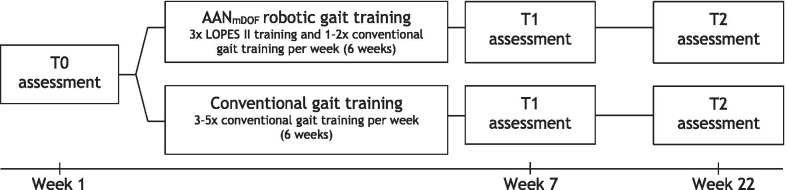
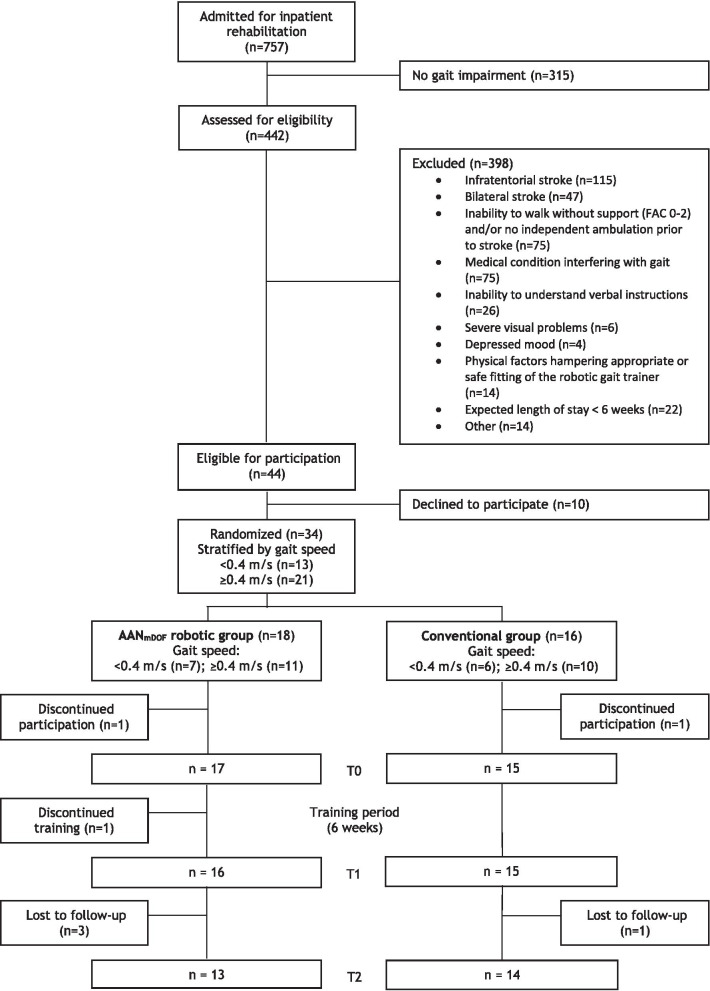
Thirty-four participants with unilateral, supratentorial stroke were enrolled (< 10 weeks post onset, Functional Ambulation Categories 3-5) and randomly assigned to six weeks of AAN robotic (combination of training in LOPES-II and conventional gait training) or conventional gait training (30 min, 3-5 times a week), focused on pre-defined training goals. Randomization and allocation to training group were carried out by an independent researcher. External mechanical work (W), spatiotemporal gait parameters, gait kinematics related to pre-defined training goals, and functional gait tasks were assessed before training (T0), after training (T1), and at 4-months follow-up (T2).
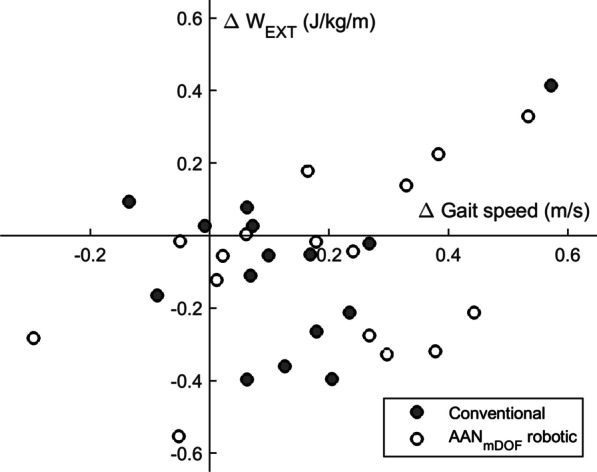
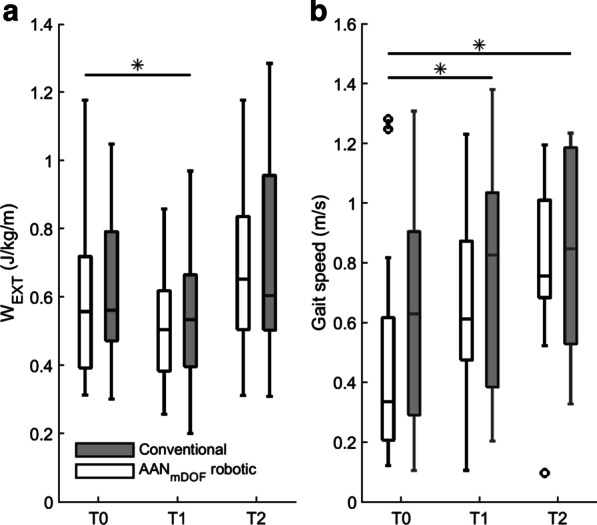
Two participants, one in each group, were excluded from analysis because of discontinued participation after T0, leaving 32 participants (AAN robotic n = 17; conventional n = 15) for intention-to-treat analysis. In both groups, W had decreased at T1 and had become similar to baseline at T2, while gait speed had increased at both assessments. In both groups, most spatiotemporal gait parameters and functional gait tasks had improved at T1 and T2. Except for step width (T0-T1) and paretic step length (T0-T2), there were no significant group differences at T1 or T2 compared to T0. In participants with a pre-defined goal aimed at foot clearance, paretic knee flexion improved more in the AAN robotic group compared to the conventional group (T0-T2).
Generally, AAN robotic training was not superior to conventional training for improving gait pattern in subacute stroke survivors. Both groups improved their mechanical gait efficiency. Yet, AAN robotic training might be more effective to improve specific post-stroke gait abnormalities such as reduced knee flexion during swing. Trial registration Registry number Netherlands Trial Register ( www.trialregister.nl ): NTR5060. Registered 13 February 2015.
恢复步行能力是中风后康复的一个重要目标。与临床可用的机器人步态训练器相比,具有按需辅助和多个自由度(AAN)的机器人有望支持运动学习,并可能改善中风后的步态模式。然而,它们与传统步态训练相比的益处尚未在随机对照试验(RCT)中得到证明。本项双中心、评估者盲法、RCT 的目的是比较 AAN 机器人与常规训练对中风后住院康复期间步态模式和功能性步态任务的影响。
34 名单侧、幕上卒中患者(发病后<10 周,功能步行分类 3-5 级)被纳入研究,并随机分配到 6 周的 AAN 机器人(LOPES-II 训练与常规步态训练相结合)或常规步态训练(30 分钟,每周 3-5 次),重点是预先设定的训练目标。随机分组和分配到训练组由一名独立的研究人员进行。外部机械功(W)、时空步态参数、与预先设定的训练目标相关的步态运动学以及功能性步态任务在训练前(T0)、训练后(T1)和 4 个月随访(T2)进行评估。
由于 T0 后参与中断,每组有 2 名参与者(各 1 名)被排除在分析之外,最终有 32 名参与者(AAN 机器人组 n=17;常规组 n=15)进行意向治疗分析。在两组中,W 在 T1 时降低,并在 T2 时恢复到基线水平,而步行速度在两次评估时均增加。在两组中,大多数时空步态参数和功能性步态任务在 T1 和 T2 时都有所改善。除步宽(T0-T1)和患侧步长(T0-T2)外,与 T0 相比,T1 或 T2 时两组间无显著差异。在以提高足廓清能力为目标的参与者中,与常规组相比,AAN 机器人组的患侧膝关节屈曲在 T0-T2 时改善更明显。
一般来说,AAN 机器人训练在改善亚急性卒中幸存者的步态模式方面并不优于常规训练。两组均提高了机械步态效率。然而,AAN 机器人训练可能更有效地改善特定的中风后步态异常,如摆动时膝关节屈曲减少。
荷兰试验注册中心(www.trialregister.nl):NTR5060。注册日期:2015 年 2 月 13 日。