Meester M, Tobias T J, Bouwknegt M, Kusters N E, Stegeman J A, van der Poel W H M
Farm Animal Health unit, Department of Population Health Sciences, Faculty of Veterinary Medicine, Utrecht University, Utrecht, the Netherlands.
Vion Food Group, Boxtel, the Netherlands.
Porcine Health Manag. 2021 Feb 5;7(1):16. doi: 10.1186/s40813-021-00189-z.
Hepatitis E virus (HEV) genotype 3 and 4 is a zoonosis that causes hepatitis in humans. Humans can become infected by consumption of pork or contact with pigs. Pigs are the main reservoir of the virus worldwide and the virus is present on most pig farms.
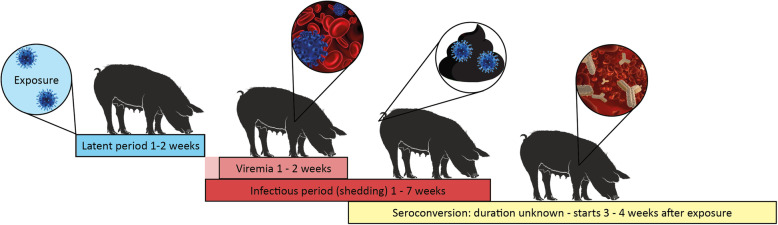
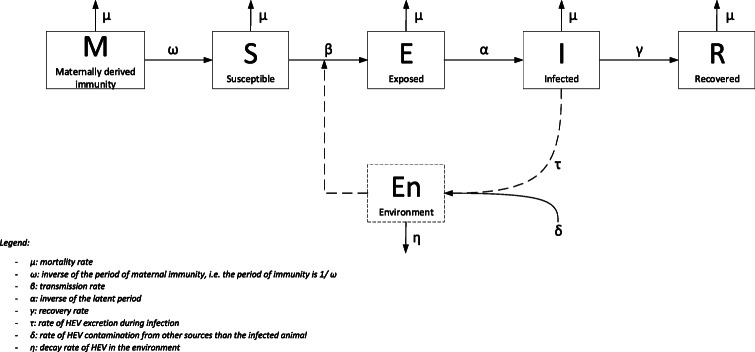
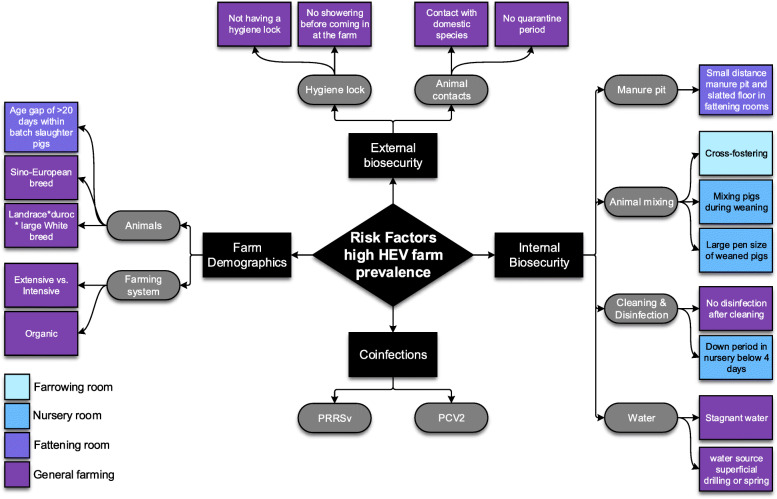
Though HEV is present on most farms, the proportion of infected pigs at slaughter and thus the level of exposure to consumers differs between farms and countries. Understanding the cause of that difference is necessary to install effective measures to lower HEV in pigs at slaughter. Here, HEV studies are reviewed that include infection dynamics of HEV in pigs and on farms, risk factors for HEV farm prevalence, and that describe mechanisms and sources that could generate persistence on farms. Most pigs become infected after maternal immunity has waned, at the end of the nursing or beginning of the fattening phase. Risk factors increasing the likelihood of a high farm prevalence or proportion of actively infected slaughter pigs comprise of factors such as farm demographics, internal and external biosecurity and immunomodulating coinfections. On-farm persistence of HEV is plausible, because of a high transmission rate and a constant influx of susceptible pigs. Environmental sources of HEV that enhance persistence are contaminated manure storages, water and fomites.
As HEV is persistently present on most pig farms, current risk mitigation should focus on lowering transmission within farms, especially between farm compartments. Yet, one should be aware of the paradox of increasing the proportion of actively infected pigs at slaughter by reducing transmission insufficiently. Vaccination of pigs may aid HEV control in the future.
戊型肝炎病毒(HEV)基因型3和4是一种人畜共患病,可导致人类肝炎。人类可通过食用猪肉或接触猪而感染。猪是全球该病毒的主要宿主,大多数养猪场都存在该病毒。
尽管大多数养猪场都存在HEV,但不同农场和国家之间,屠宰时受感染猪的比例以及消费者的接触水平有所不同。了解这种差异的原因对于采取有效措施降低屠宰时猪体内的HEV水平至关重要。在此,对HEV的研究进行综述,这些研究包括HEV在猪和农场中的感染动态、HEV在农场流行的风险因素,以及描述可能导致病毒在农场持续存在的机制和来源。大多数猪在母源免疫力减弱后,即在哺乳期末或育肥期开始时被感染。增加农场高流行率或活跃感染屠宰猪比例可能性的风险因素包括农场人口统计学、内部和外部生物安全以及免疫调节性混合感染等因素。由于传播率高和易感猪不断涌入,HEV在农场持续存在是合理的。增强病毒持续存在的HEV环境来源包括受污染的粪便储存设施、水和污染物。
由于大多数养猪场持续存在HEV,当前的风险缓解措施应侧重于降低农场内的传播,特别是农场不同区域之间的传播。然而,人们应该意识到,如果传播减少不足,可能会出现屠宰时活跃感染猪比例增加的矛盾情况。给猪接种疫苗可能有助于未来控制HEV。