Meenakshi Khapre, Vinteshwari Nautiyal, Minaxi Jagzape, Vartika Saxena
Department of Community and Family Medicine, AIIMS Rishikesh, Rishikesh, Uttarakhand, 249203, India.
Department of Ayush, AIIMS Rishikesh, Rishikesh, Uttarakhand, 249203, India.
J Ayurveda Integr Med. 2021 Jan-Mar;12(1):87-92. doi: 10.1016/j.jaim.2020.12.004. Epub 2021 Feb 3.
Dyspepsia (Amlapitta) is the commonest ailment found in the present time. Nowadays due to unawareness about Prakriti (psychosomatic constitution) people are practising inappropriate diet and lifestyle which leads to disturbances in digestive system. Due to this pitta is imbalanced and common consequences are Amlapitta. If this pitta takes an upward course, then it is called Urdhwaga Amlapitta.
This study was conducted to assess the effectiveness of Ayurveda treatment for UrdhwagaAmlapitta in terms of improvement in symptoms, cure rate, satisfaction and side effects if any.
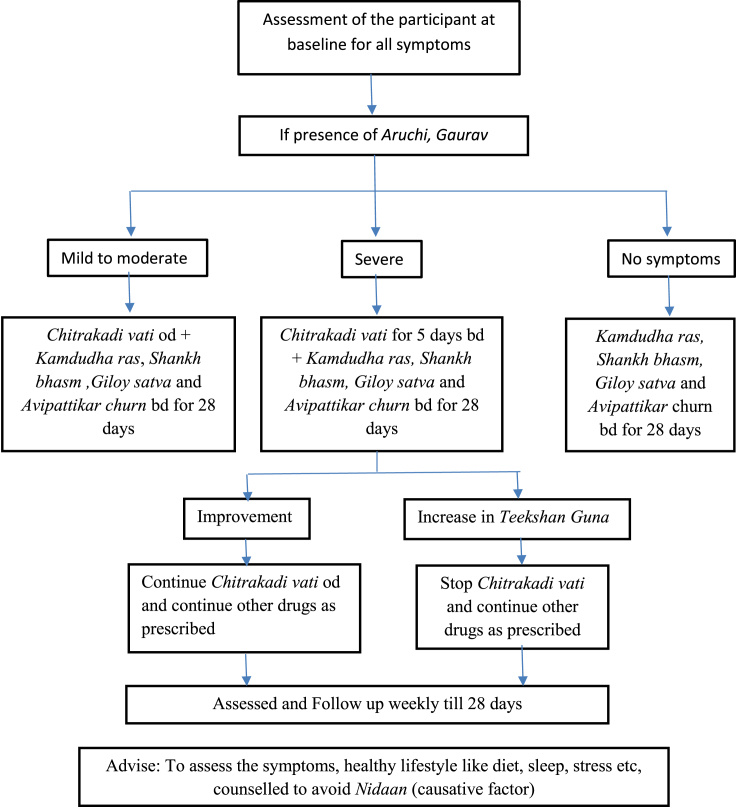
This was a single-arm exploratory open-label clinical trial. Patient with symptom of Urdhwaga Amlapitta were diagnosed as per Rome IV criteria and were further assessed as per eligibility criteria. Thirty patients were enrolled. They were given different herbo-mineral preparation as per ones Prakriti. These drugs were given for 28 days and patients were followed weekly in OPD for assessment of their symptom severity scores.
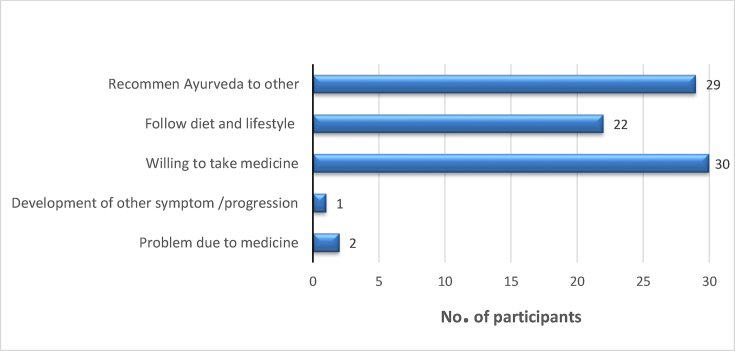
Tiktamlodgar (acid eructation) and Gurukoshthatva (heaviness in abdomen) was the most commonly occurring symptom in 93% (n = 28) of participants. Seventy Percent (n = 21) of participants had Avipak severity of grade 2 or 3 followed by Gaurav in 50%. The patient was symptomatically relieved by all the symptoms of Urdhwaga Amlapitta by 3rd visit (21st day) and the difference in score was statistically significant. All participants express willingness take Ayurveda medicine in future.
Combination of Ayurveda drugs as per ones Prakriti and severity of symptoms, given to the patient of Urdhwaga Amlapitta was found to effectively cure patients within 28 days. These drugs were found to be well-tolerated, safe and acceptable.
消化不良(阿马拉皮塔)是当下最常见的疾病。如今,由于人们对体质(身心体质)缺乏认识,饮食习惯和生活方式不当,导致消化系统紊乱。由此,皮塔失衡,常见的后果就是阿马拉皮塔。如果这种皮塔向上发展,就称为上行性阿马拉皮塔。
本研究旨在评估阿育吠陀疗法对上行性阿马拉皮塔的治疗效果,包括症状改善情况、治愈率、满意度以及是否有副作用。
这是一项单臂探索性开放标签临床试验。根据罗马IV标准对有上行性阿马拉皮塔症状的患者进行诊断,并根据纳入标准进一步评估。招募了30名患者。根据他们的体质给予不同的草药矿物制剂。这些药物服用28天,患者每周在门诊接受随访,以评估其症状严重程度评分。
93%(n = 28)的参与者中,最常见的症状是酸嗳气(提克塔姆洛德加尔)和腹部沉重感(古鲁科什塔瓦)。70%(n = 21)的参与者阿维帕克严重程度为2级或3级,其次是50%的参与者有高拉夫症状。到第三次就诊(第21天)时,上行性阿马拉皮塔的所有症状在症状上都得到了缓解,评分差异具有统计学意义。所有参与者都表示愿意在未来服用阿育吠陀药物。
根据患者的体质和症状严重程度,给予上行性阿马拉皮塔患者阿育吠陀药物组合,发现能在28天内有效治愈患者。这些药物耐受性良好、安全且可接受。