Dipartimento di Medicina e Scienze della Salute "Vincenzo Tiberio", Universita degli Studi del Molise, Campobasso, Italy.
Skeletal Biology and Engineering Research Centre, Catholic University College Leuven Department of Development and Regeneration, Leuven, Belgium.
RMD Open. 2021 Feb;7(1). doi: 10.1136/rmdopen-2020-001480.
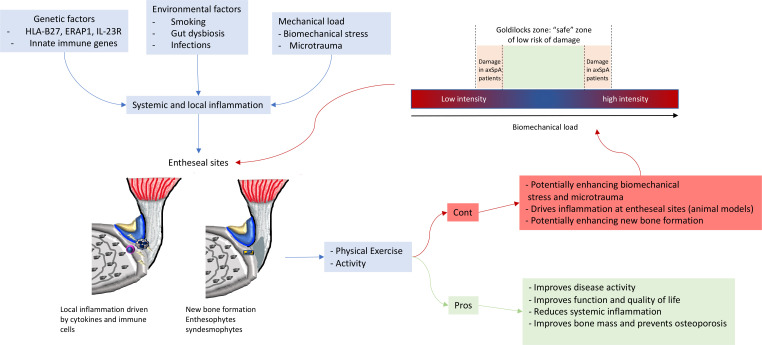
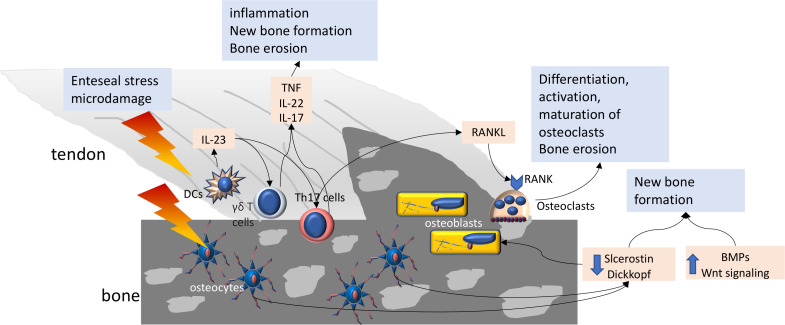
In the last years, new researches focused on the role of biomechanical stress and microdamage in the pathogenesis of inflammatory arthritis and, in particular, in axial spondyloarthritis (axSpA). Animal models showed how entheseal stress and physical exercise could contribute to the development of inflammation and new bone formation at entheseal and articular sites, by activating innate immune system and the release of cytokines. Furthermore, clues of the involvement of biomechanical stress in the development of axSpA are present in clinical experiences. However, rehabilitation and exercise programmes are the cornerstone of treatment for axSpA, reducing disease activity and improving spinal function and quality of life. The concept of mechanical stress as a contributor to disease development and progression represents, potentially, a conceptual challenge for this approach. The aim of this review is to discuss the current evidence on the intriguing contribution of the biomechanical stress to the pathogenesis of inflammation and new bone formation and to evaluate and reflect on the role of exercise in the treatment and in the management of the disease, considering both the beneficial effects and its possible paradoxical action.
在过去的几年中,新的研究集中在生物力学应激和微损伤在炎症性关节炎发病机制中的作用,特别是在轴性脊柱关节炎(axSpA)中。动物模型表明,附着点的生物力学应力和体育锻炼如何通过激活先天免疫系统和细胞因子的释放,有助于附着点和关节部位的炎症和新骨形成。此外,在临床经验中也有生物力学应激参与 axSpA 发展的线索。然而,康复和运动方案是 axSpA 治疗的基石,可降低疾病活动度,改善脊柱功能和生活质量。机械应力作为疾病发展和进展的一个促成因素的概念,可能对这种方法提出了概念上的挑战。本综述的目的是讨论生物力学应激对炎症和新骨形成发病机制的有趣贡献的现有证据,并评估和反思运动在疾病治疗和管理中的作用,同时考虑到其有益作用及其可能的矛盾作用。