Department of Meiosis, Max Planck Institute for Biophysical Chemistry, Göttingen, Germany.
School of Biochemistry, University of Bristol, Bristol, UK.
Nat Commun. 2021 Feb 5;12(1):841. doi: 10.1038/s41467-021-21020-x.
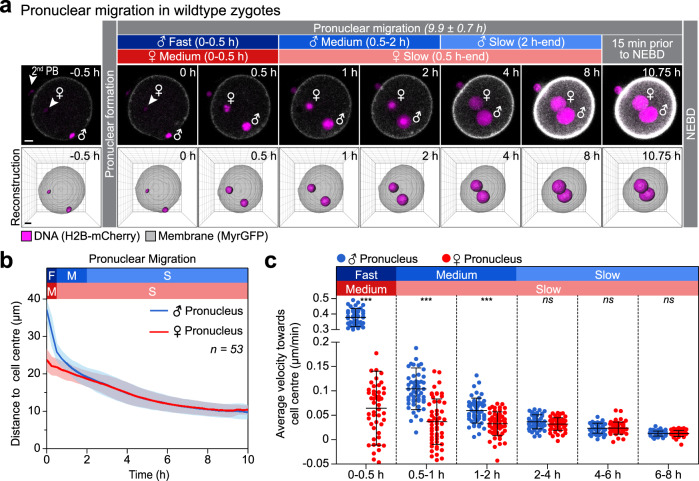
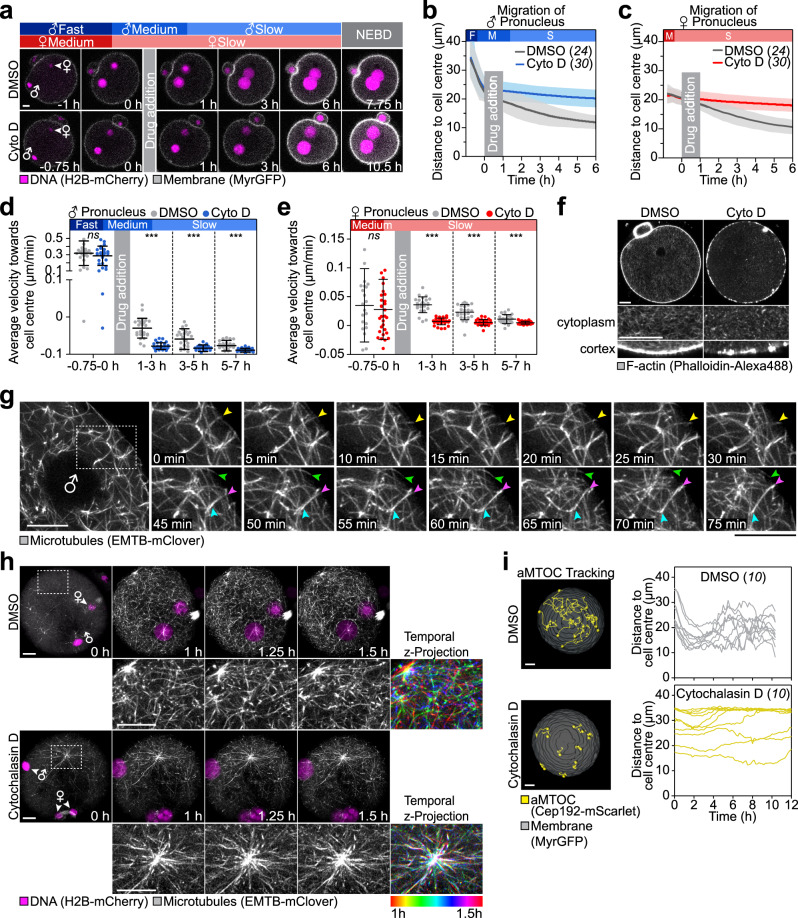
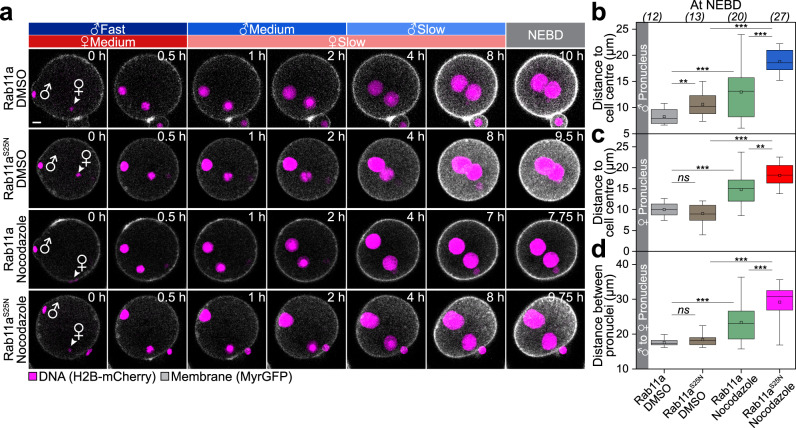
A new life begins with the unification of the maternal and paternal chromosomes upon fertilization. The parental chromosomes first become enclosed in two separate pronuclei near the surface of the fertilized egg. The mechanisms that then move the pronuclei inwards for their unification are only poorly understood in mammals. Here, we report two mechanisms that act in concert to unite the parental genomes in fertilized mouse eggs. The male pronucleus assembles within the fertilization cone and is rapidly moved inwards by the flattening cone. Rab11a recruits the actin nucleation factors Spire and Formin-2 into the fertilization cone, where they locally nucleate actin and further accelerate the pronucleus inwards. In parallel, a dynamic network of microtubules assembles that slowly moves the male and female pronuclei towards the cell centre in a dynein-dependent manner. Both mechanisms are partially redundant and act in concert to unite the parental pronuclei in the zygote's centre.
新的生命始于受精时母源和父源染色体的融合。双亲染色体最初在受精卵表面附近被包裹在两个独立的原核中。在哺乳动物中,将原核向内移动以实现融合的机制还知之甚少。在这里,我们报告了两种协同作用的机制,它们共同作用将双亲基因组在受精的小鼠卵中融合。雄性原核在受精锥内组装,并被逐渐变平的锥体迅速向内移动。Rab11a 将肌动蛋白成核因子 Spire 和 Formin-2 招募到受精锥中,在那里它们局部成核肌动蛋白,并进一步加速原核向内移动。与此同时,一个动态的微管网络组装起来,以依赖于动力蛋白的方式缓慢地将雄性和雌性原核向细胞中心移动。这两种机制部分冗余,协同作用将双亲原核在受精卵的中心融合。