Organs-on-Chip Technologies Laboratory, ARTORG Center, University of Bern, Bern, Switzerland.
AlveoliX AG, Bern, Switzerland.
Commun Biol. 2021 Feb 5;4(1):168. doi: 10.1038/s42003-021-01695-0.
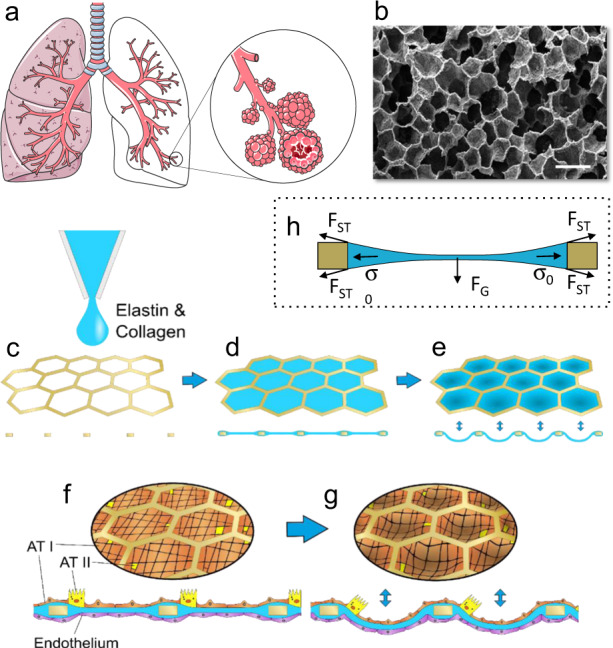
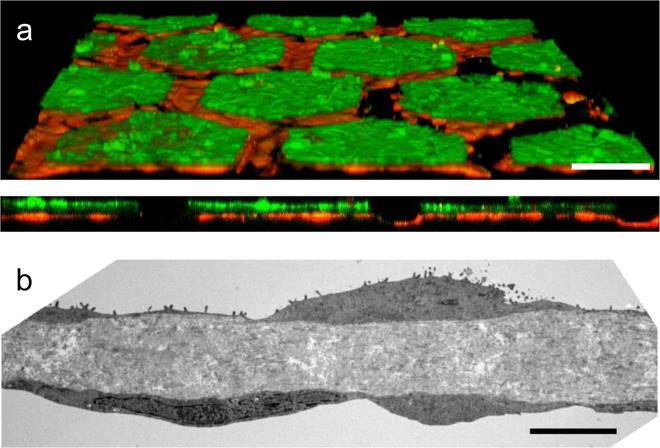
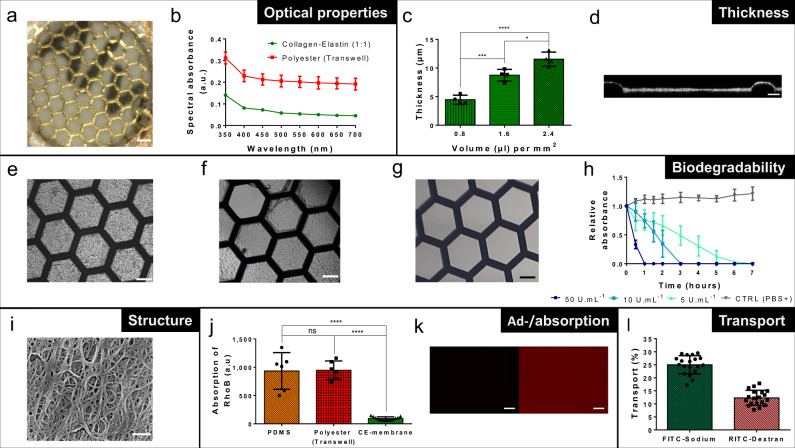
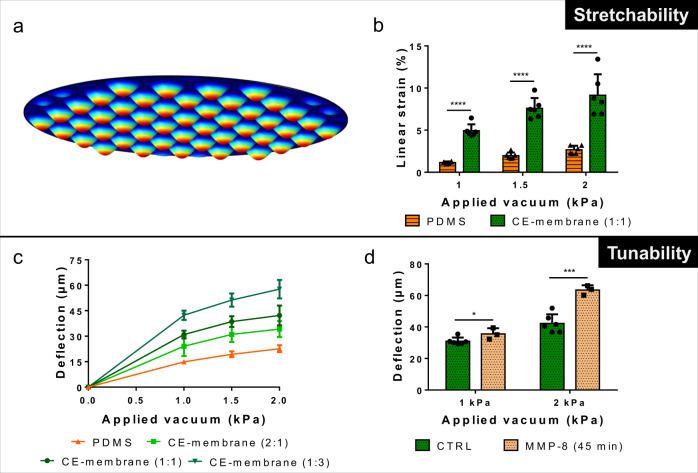
The air-blood barrier with its complex architecture and dynamic environment is difficult to mimic in vitro. Lung-on-a-chips enable mimicking the breathing movements using a thin, stretchable PDMS membrane. However, they fail to reproduce the characteristic alveoli network as well as the biochemical and physical properties of the alveolar basal membrane. Here, we present a lung-on-a-chip, based on a biological, stretchable and biodegradable membrane made of collagen and elastin, that emulates an array of tiny alveoli with in vivo-like dimensions. This membrane outperforms PDMS in many ways: it does not absorb rhodamine-B, is biodegradable, is created by a simple method, and can easily be tuned to modify its thickness, composition and stiffness. The air-blood barrier is reconstituted using primary lung alveolar epithelial cells from patients and primary lung endothelial cells. Typical alveolar epithelial cell markers are expressed, while the barrier properties are preserved for up to 3 weeks.
气-血屏障具有复杂的结构和动态的环境,因此很难在体外进行模拟。肺芯片能够通过使用薄的、可拉伸的 PDMS 膜来模拟呼吸运动。然而,它们无法复制特征性的肺泡网络以及肺泡基底膜的生化和物理特性。在这里,我们提出了一种基于胶原蛋白和弹性蛋白的生物可拉伸和可生物降解膜的肺芯片,该芯片模拟了具有体内样尺寸的微小肺泡阵列。与 PDMS 相比,这种膜在许多方面都表现出色:它不吸收罗丹明 B,可生物降解,通过简单的方法制造,并且可以轻松调节其厚度、组成和弹性。使用来自患者的原代肺肺泡上皮细胞和原代肺内皮细胞重建气-血屏障。表达了典型的肺泡上皮细胞标志物,并且屏障特性可以保持长达 3 周。