Division of Quantitative Methods and Modeling (DQMM), Office of Research and Standards (ORS), Office of Generic Drugs (OGD), Center for Drug Evaluation and Research (CDER), US Food and Drug Administration (FDA), Silver Spring, Maryland, USA.
CPT Pharmacometrics Syst Pharmacol. 2021 May;10(5):399-411. doi: 10.1002/psp4.12600. Epub 2021 Mar 9.
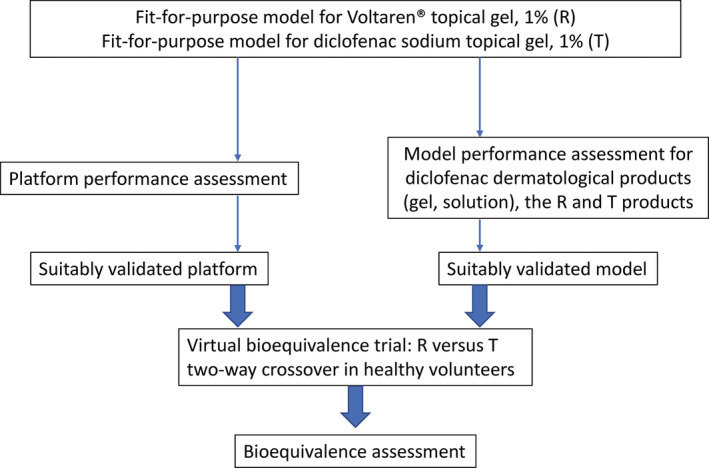
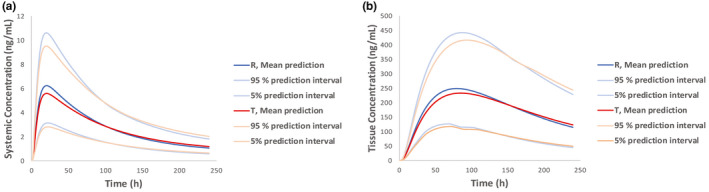
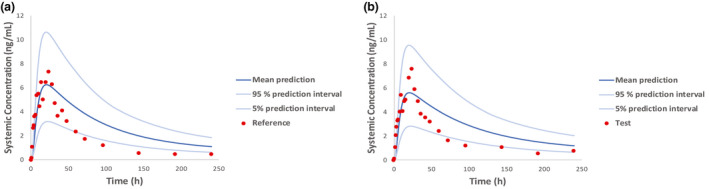
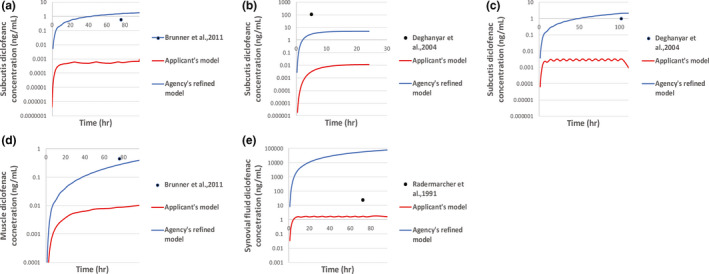
Establishing bioequivalence (BE) for dermatological drug products by conducting comparative clinical end point studies can be costly and the studies may not be sufficiently sensitive to detect certain formulation differences. Quantitative methods and modeling, such as physiologically-based pharmacokinetic (PBPK) modeling, can support alternative BE approaches with reduced or no human testing. To enable PBPK modeling for regulatory decision making, models should be sufficiently verified and validated (V&V) for the intended purpose. This report illustrates the US Food and Drug Administration (FDA) approval of a generic diclofenac sodium topical gel that was based on a totality of evidence, including qualitative and quantitative sameness and physical and structural similarity to the reference product, an in vivo BE study with PK end points, and, more importantly, for the purposes of this report, a virtual BE assessment leveraging dermal PBPK modeling and simulation instead of a comparative clinical end point study in patients. The modeling approach characterized the relationship between systemic (plasma) and local (skin and synovial fluid) diclofenac exposure and demonstrated BE between the generic and reference products at the presumed site of action. Based on the fit-for-purpose modeling principle, the V&V process involved assessing observed data of diclofenac concentrations in skin tissues and plasma, and the overall performance of the modeling platform for relevant products. Using this case as an example, this report provides current scientific considerations on good practices for model V&V and the establishment of BE for dermatological drug products when leveraging PBPK modeling and simulation for regulatory decision making.
通过开展比较临床终点研究来确定皮肤科药物产品的生物等效性(BE)可能代价高昂,并且这些研究可能无法充分敏感地检测到某些制剂差异。定量方法和建模,如基于生理的药代动力学(PBPK)建模,可以支持具有减少或无需人体测试的替代 BE 方法。为了使 PBPK 建模能够用于监管决策,模型应针对预期目的进行充分验证和确认(V&V)。本报告说明了美国食品和药物管理局(FDA)批准的一种通用双氯芬酸钠外用凝胶,该批准基于全面的证据,包括定性和定量的相同性以及与参比产品的物理和结构相似性、基于 PK 终点的体内 BE 研究,以及更重要的是,就本报告而言,利用皮肤 PBPK 建模和模拟而不是患者比较临床终点研究来进行虚拟 BE 评估。该建模方法描述了全身(血浆)和局部(皮肤和滑液)双氯芬酸暴露之间的关系,并证明了在假定作用部位,仿制药与参比产品之间具有 BE。基于适合目的的建模原则,V&V 过程涉及评估皮肤组织和血浆中双氯芬酸浓度的观察数据,以及建模平台在相关产品中的整体性能。本报告以该案例为例,提供了在利用 PBPK 建模和模拟进行监管决策时,针对皮肤科药物产品进行模型 V&V 和建立 BE 的当前科学考虑因素。