Department of Information Engineering, Electronics and Telecommunications (DIET), University of Rome "La Sapienza", Via Eudossiana 18, 00184, Rome, Italy.
Department of Biomedical Engineering, College of Engineering, Shantou University, Shantou, 515063, China.
Med Biol Eng Comput. 2021 Mar;59(3):535-546. doi: 10.1007/s11517-020-02295-6. Epub 2021 Feb 6.
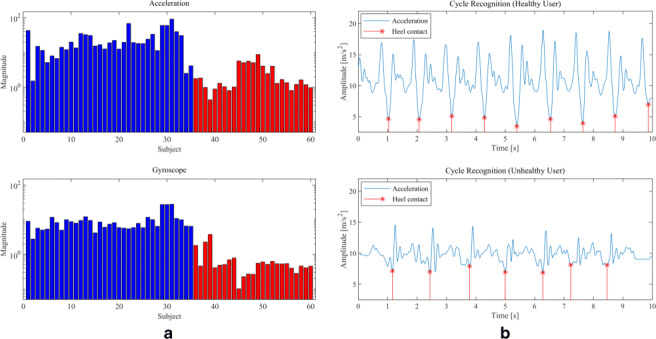
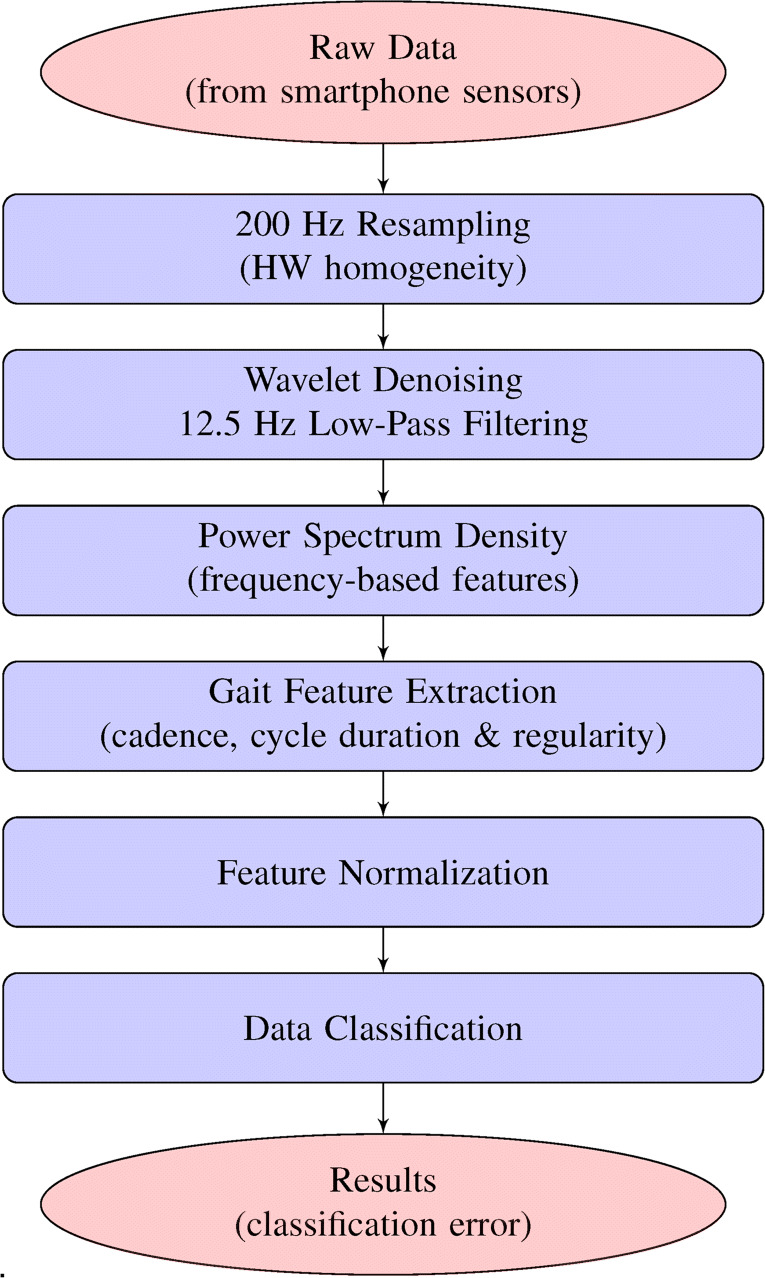
This paper proposes a reliable monitoring scheme that can assist medical specialists in watching over the patient's condition. Although several technologies are traditionally used to acquire motion data of patients, the high costs as well as the large spaces they require make them difficult to be applied in a home context for rehabilitation. A reliable patient monitoring technique, which can automatically record and classify patient movements, is mandatory for a telemedicine protocol. In this paper, a comparison of several state-of-the-art machine learning classifiers is proposed, where stride data are collected by using a smartphone. The main goal is to identify a robust methodology able to assure a suited classification of gait movements, in order to allow the monitoring of patients in time as well as to discriminate among a pathological and physiological gait. Additionally, the advantages of smartphones of being compact, cost-effective and relatively easy to operate make these devices particularly suited for home-based rehabilitation programs. Graphical Abstract. This paper proposes a reliable monitoring scheme that can assist medical specialists in watching over the patient's condition. Although several technologies are traditionally used to acquire motion data of patients, the high costs as well as the large spaces they require make them difficult to be applied in a home context for rehabilitation. A reliable patient monitoring technique, which can automatically record and classify patient movements, is mandatory for a telemedicine protocol. In this paper, a comparison of several state-of-the-art machine learning classifiers is proposed, where stride data are collected and processed by using a smartphone(see figure). The main goal is to identify a robust methodology able to assure a suited classification of gait movements, in order to allow the monitoring of patients in time as well as to discriminate among a pathological and physiological gait. Additionally, the advantages of smartphones of being compact, cost-effective and relatively easy to operate make these devices particularly suited for home-based rehabilitation programs.
本文提出了一种可靠的监测方案,可以协助医学专家监测患者的病情。虽然传统上有几种技术可用于获取患者的运动数据,但由于成本高以及所需的空间大,这些技术难以在家庭康复环境中应用。可靠的患者监测技术,能够自动记录和分类患者的运动,这对远程医疗协议是强制性的。在本文中,提出了几种最先进的机器学习分类器的比较,其中步幅数据是使用智能手机收集的。主要目标是确定一种稳健的方法,能够确保步态运动的适当分类,以便及时监测患者,并区分病理性和生理性步态。此外,智能手机具有体积小、成本效益高、操作相对简单等优点,非常适合家庭康复计划。