National Research Centre for the Working Environment, Lersø Parkallé 105, DK-2100, Copenhagen, Denmark.
Department of Health Technology, Technical University of Denmark, DK-2800, Kgs Lyngby, Denmark.
Environ Health. 2021 Feb 6;20(1):10. doi: 10.1186/s12940-020-00690-y.
Airport personnel are at risk of occupational exposure to jet engine emissions, which similarly to diesel exhaust emissions include volatile organic compounds and particulate matter consisting of an inorganic carbon core with associated polycyclic aromatic hydrocarbons, and metals. Diesel exhaust is classified as carcinogenic and the particulate fraction has in itself been linked to several adverse health effects including cancer.
In this review, we summarize the available scientific literature covering human health effects of exposure to airport emissions, both in occupational settings and for residents living close to airports. We also report the findings from the limited scientific mechanistic studies of jet engine emissions in animal and cell models.
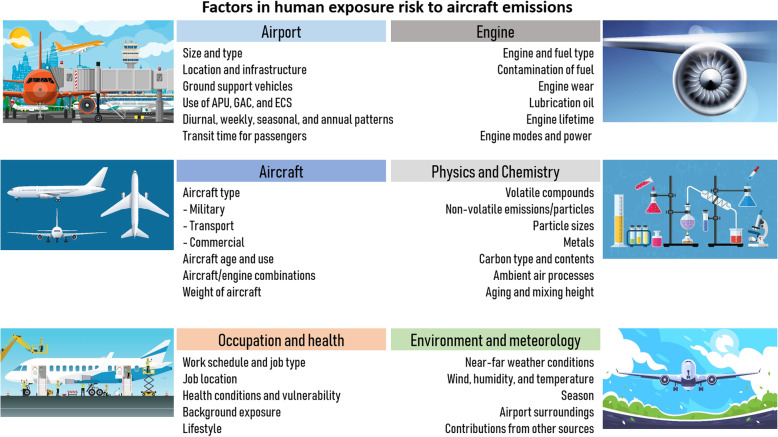
Jet engine emissions contain large amounts of nano-sized particles, which are particularly prone to reach the lower airways upon inhalation. Size of particles and emission levels depend on type of aircraft, engine conditions, and fuel type, as well as on operation modes. Exposure to jet engine emissions is reported to be associated with biomarkers of exposure as well as biomarkers of effect among airport personnel, especially in ground-support functions. Proximity to running jet engines or to the airport as such for residential areas is associated with increased exposure and with increased risk of disease, increased hospital admissions and self-reported lung symptoms.
We conclude that though the literature is scarce and with low consistency in methods and measured biomarkers, there is evidence that jet engine emissions have physicochemical properties similar to diesel exhaust particles, and that exposure to jet engine emissions is associated with similar adverse health effects as exposure to diesel exhaust particles and other traffic emissions.
机场工作人员面临职业性接触喷气发动机排放物的风险,这些排放物与柴油废气排放物类似,包括挥发性有机化合物和颗粒物,其由无机碳核以及多环芳烃和金属组成。柴油废气被归类为致癌物质,而颗粒物本身已与多种不良健康影响相关,包括癌症。
在这篇综述中,我们总结了涵盖机场排放物对职业暴露和机场附近居民健康影响的现有科学文献。我们还报告了在动物和细胞模型中对喷气发动机排放物进行的有限科学机制研究的结果。
喷气发动机排放物含有大量纳米级颗粒,这些颗粒在吸入时特别容易到达下呼吸道。颗粒的大小和排放水平取决于飞机类型、发动机状况和燃料类型,以及操作模式。据报道,机场工作人员接触喷气发动机排放物与接触生物标志物以及效应生物标志物有关,尤其是在地面支持功能中。居住在靠近运行的喷气发动机或机场的地区与接触增加以及疾病风险增加、住院增加和自我报告的肺部症状有关。
尽管文献稀少,且方法和测量的生物标志物一致性低,但有证据表明,喷气发动机排放物具有与柴油废气颗粒相似的物理化学特性,并且接触喷气发动机排放物与接触柴油废气颗粒和其他交通排放物相似的不良健康影响有关。