ICAP at Columbia University, Mailman School of Public Health, New York, USA.
Department of Epidemiology, Mailman School of Public Health, Columbia University, New York, USA.
Malar J. 2021 Feb 6;20(1):74. doi: 10.1186/s12936-021-03615-3.
Intermittent preventive treatment of malaria in infants (IPTi) with sulfadoxine-pyrimethamine (SP) is a proven strategy to protect infants against malaria. Sierra Leone is the first country to implement IPTi nationwide. IPTi implementation was evaluated in Kambia, one of two initial pilot districts, to assess quality and coverage of IPTi services.
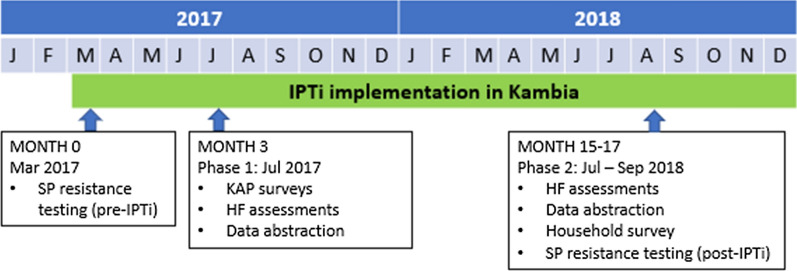
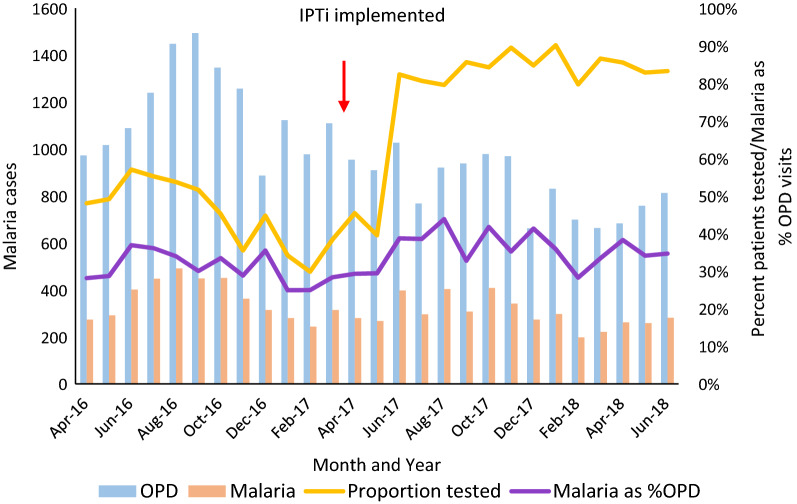
This mixed-methods evaluation had two phases, conducted 3 (phase 1) and 15-17 months (phase 2) after IPTi implementation. Methods included: assessments of 18 health facilities (HF), including register data abstraction (phases 1 and 2); a knowledge, attitudes and practices survey with 20 health workers (HWs) in phase 1; second-generation sequencing of SP resistance markers (pre-IPTi and phase 2); and a cluster-sample household survey among caregivers of children aged 3-15 months (phase 2). IPTi and vaccination coverage from the household survey were calculated from child health cards and maternal recall and weighted for the complex sampling design. Interrupted time series analysis using a Poisson regression model was used to assess changes in malaria cases at HF before and after IPTi implementation.
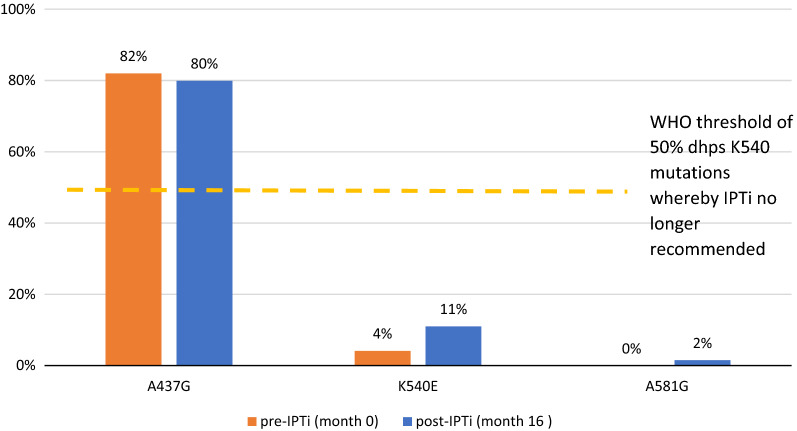
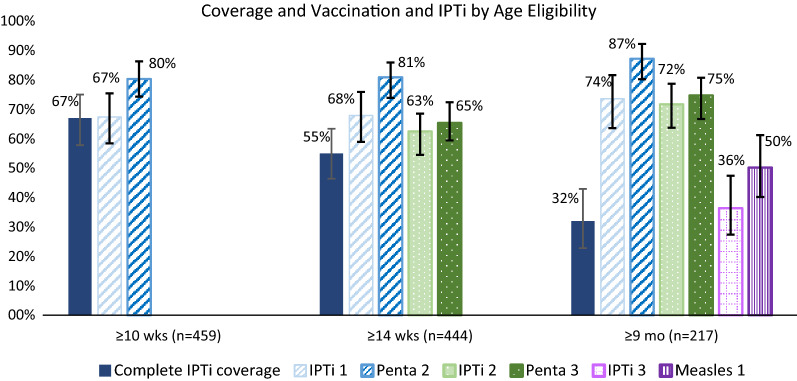
Most HWs (19/20) interviewed had been trained on IPTi; 16/19 reported feeling well prepared to administer it. Nearly all HFs (17/18 in phase 1; 18/18 in phase 2) had SP for IPTi in stock. The proportion of parasite alleles with dhps K540E mutations increased but remained below the 50% WHO-recommended threshold for IPTi (4.1% pre-IPTi [95%CI 2-7%]; 11% post-IPTi [95%CI 8-15%], p < 0.01). From the household survey, 299/459 (67.4%) children ≥ 10 weeks old received the first dose of IPTi (versus 80.4% for second pentavalent vaccine, given simultaneously); 274/444 (62.5%) children ≥ 14 weeks old received the second IPTi dose (versus 65.4% for third pentavalent vaccine); and 83/217 (36.4%) children ≥ 9 months old received the third IPTi dose (versus 52.2% for first measles vaccine dose). HF register data indicated no change in confirmed malaria cases among infants after IPTi implementation.
Kambia district was able to scale up IPTi swiftly and provide necessary health systems support. The gaps between IPTi and childhood vaccine coverage need to be further investigated and addressed to optimize the success of the national IPTi programme.
在婴儿中间歇性预防疟疾治疗(IPTi)中使用磺胺多辛-乙胺嘧啶(SP)是保护婴儿免受疟疾的有效策略。塞拉利昂是第一个在全国范围内实施 IPTi 的国家。在两个初始试点地区之一的坎比亚进行了 IPTi 实施情况评估,以评估 IPTi 服务的质量和覆盖范围。
这项混合方法评估分为两个阶段,在 IPTi 实施后 3 个月(第 1 阶段)和 15-17 个月(第 2 阶段)进行。方法包括:对 18 个卫生设施(HF)进行评估,包括登记数据提取(第 1 阶段和第 2 阶段);在第 1 阶段对 20 名卫生工作者(HWs)进行知识、态度和实践调查;对磺胺多辛耐药标记物(第 1 阶段和第 2 阶段)进行第二代测序;在 3-15 个月大的儿童的照顾者中进行集群抽样家庭调查(第 2 阶段)。从家庭调查中计算了 IPTi 和疫苗接种覆盖率,这些数据来自儿童健康卡和母亲回忆,并根据复杂的抽样设计进行了加权。使用泊松回归模型进行中断时间序列分析,以评估 HF 中疟疾病例在 IPTi 实施前后的变化。
接受访谈的大多数 HWs(20 名中的 19 名)都接受过 IPTi 培训;19 名中有 16 名表示对实施 IPTi 准备充分。几乎所有 HF(第 1 阶段的 17/18;第 2 阶段的 18/18)都有 SP 用于 IPTi。dhps K540E 突变寄生虫等位基因的比例增加,但仍低于世卫组织推荐的 50% IPTi 阈值(第 1 阶段为 4.1% [95%CI 2-7%];第 2 阶段为 11% [95%CI 8-15%],p<0.01)。从家庭调查中,459 名/459 名(67.4%)≥10 周大的儿童接受了第一剂 IPTi(而同时接受的第三剂五价疫苗为 80.4%);444 名/444 名(62.5%)≥14 周大的儿童接受了第二剂 IPTi(而同时接受的第四剂五价疫苗为 65.4%);217 名/217 名(36.4%)≥9 个月大的儿童接受了第三剂 IPTi(而同时接受的第一剂麻疹疫苗为 52.2%)。HF 登记数据表明,IPTi 实施后婴儿确诊疟疾病例没有变化。
坎比亚地区能够迅速扩大 IPTi 的规模,并提供必要的卫生系统支持。需要进一步调查和解决 IPTi 和儿童疫苗覆盖率之间的差距,以优化国家 IPTi 计划的成功。