Department of Epidemiology and Biostatistics, University of California San Francisco, San Francisco, California, USA.
Public Health Sciences, University of California Davis, Davis, California, USA.
BMJ Open. 2021 Feb 5;11(2):e042125. doi: 10.1136/bmjopen-2020-042125.
Evidence on adverse childhood experiences (ACEs) and late-life cognitive outcomes is inconsistent, with little research among diverse racial/ethnic groups. We investigated whether ACE exposures were associated with worse late-life cognition for all racial/ethnic groups and at different ages of exposure.
Covariate-adjusted mixed-effects linear regression models estimated associations of: (1) total number of ACEs experienced, (2) earliest age when ACE occurred and (3) type of ACE with overall cognition.
Kaiser Permanente Northern California members aged 65 years and older, living in Northern California.
Kaiser Healthy Aging and Diverse Life Experiences study baseline participants, aged 65 years and older (n=1661; including 403 Asian-American, 338 Latino, 427 Black and 493 white participants).
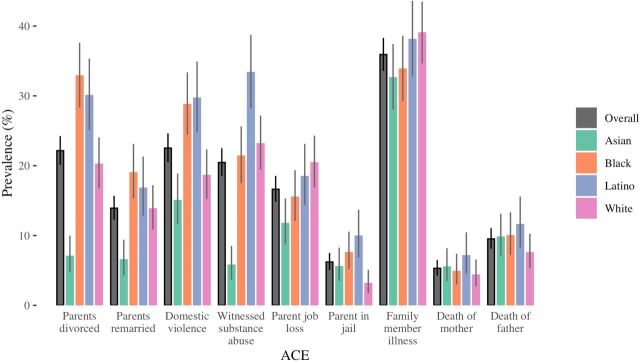
Most respondents (69%) reported one or more ACE, most frequently family illness (36%), domestic violence (23%) and parental divorce (22%). ACE count was not adversely associated with cognition overall (β=0.01; 95% CI -0.01 to 0.03), in any racial/ethnic group or for any age category of exposure. Pooling across all race/ethnicities, parent's remarriage (β=-0.11; 95% CI -0.20 to -0.03), mother's death (β=-0.18; 95% CI -0.30 to -0.07) and father's death (β=-0.11; 95% CI -0.20 to -0.01) were associated with worse cognition.
Adverse childhood exposures overall were not associated with worse cognition in older adults in a diverse sample, although three ACEs were associated with worse cognitive outcomes.
关于不良童年经历(ACEs)与晚年认知结果的证据不一致,且在不同种族/族裔群体中的研究较少。我们研究了 ACE 暴露是否与所有种族/族裔群体以及不同暴露年龄的晚年认知能力下降有关。
协变量调整的混合效应线性回归模型估计了以下因素与整体认知的关联:(1)经历的 ACE 总数,(2)最早发生 ACE 的年龄,以及(3)ACE 的类型。
加利福尼亚州北部凯萨永久医疗保健系统的 65 岁及以上的成员,居住在加利福尼亚州北部。
年龄在 65 岁及以上的凯萨健康老龄化和多样化生活经历研究的基线参与者(n=1661;包括 403 名亚裔美国人、338 名拉丁裔、427 名非裔和 493 名白人参与者)。
大多数受访者(69%)报告了一种或多种 ACE,最常见的是家庭疾病(36%)、家庭暴力(23%)和父母离婚(22%)。ACE 计数与认知能力总体上没有负相关(β=0.01;95%CI-0.01 至 0.03),在任何种族/族裔群体或任何暴露年龄组中均如此。在所有种族/族裔中,父母再婚(β=-0.11;95%CI-0.20 至-0.03)、母亲去世(β=-0.18;95%CI-0.30 至-0.07)和父亲去世(β=-0.11;95%CI-0.20 至-0.01)与认知能力下降有关。
在一个多样化的样本中,总体上不良的儿童期暴露与老年人的认知能力下降无关,尽管有三种 ACE 与认知结果较差有关。