Dong Yimin, Wu Wei, Kang Honglei, Xiong Wei, Ye Dawei, Fang Zhong, Guan Hanfeng, Liao Hui, Li Feng
Department of Orthopedics, Tongji Hospital, Tongji Medical College, Huazhong University of Science and Technology, Wuhan, China.
Cancer Center, Tongji Hospital, Tongji Medical college, Huazhong University of Science and Technology, Wuhan, China.
Ann Transl Med. 2021 Jan;9(1):48. doi: 10.21037/atm-20-4681.
Regional lymph node metastasis (RLNM) has been reported to be a prognostic factor for poor survival outcomes of bone sarcoma. However, studies about risk factors for RLNM of bone sarcoma are extremely rare, and the outcome of such patients remains to be explored. We aimed to identify risk factors for RLNM of bone sarcoma and conduct survival analysis for patients with bone sarcoma with RLNM.
A total of 10,641 patients confirmed of malignant bone sarcomas from 1983 to 2014 were identified from the Surveillance, Epidemiology, and End Results (SEER) database, with 311 being regional lymph node positive. Logistic regression analysis was used to identify risk factors for RLNM, while the Cox proportional hazards model and the Fine and Gray's regression model were used for survival analysis.
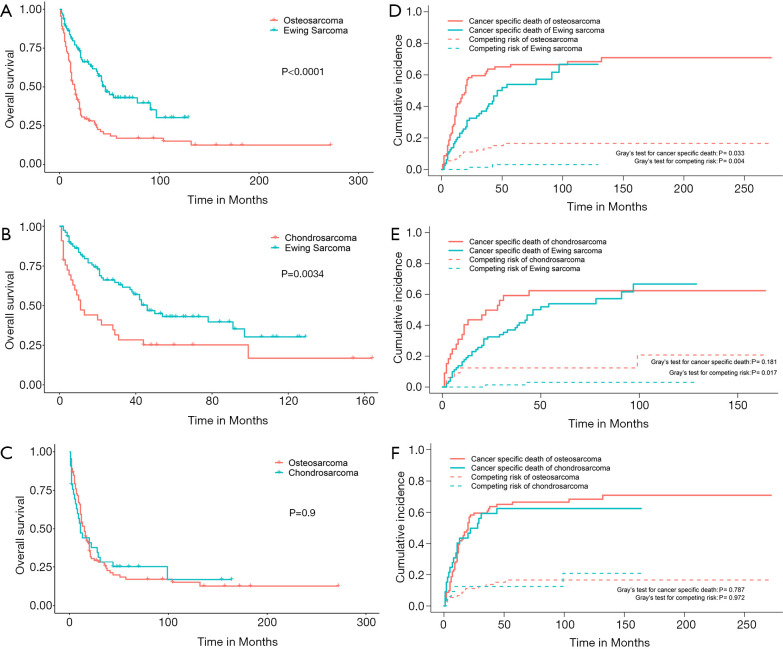
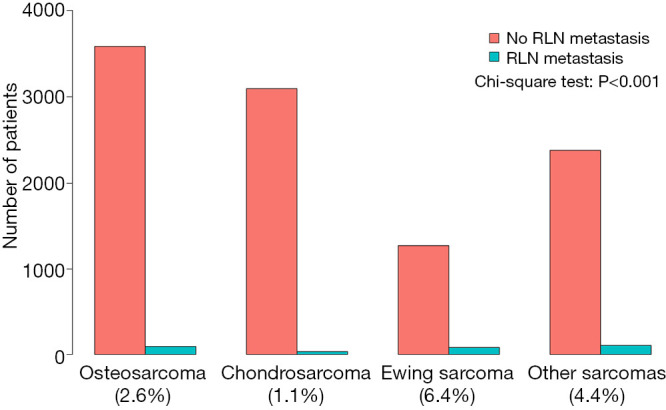
The proportion of RLNM was 6.0% in Ewing sarcoma, 2.5% in osteosarcoma and 1.1% in chondrosarcoma. Other bone tumors together had a RLNM rate of 4.2%. Risk factors identified by the logistic regression analysis for RLNM were male patients, primary tumor site, tumor type and size. The multivariate Cox regression analysis suggested age, race, distant metastasis, tumor type and surgical treatment to be prognostic factors for the overall survival of patients with RLNM. Taking non-cancer-specific death as a competing risk, however, we found only age between 30-60 years [sub-distribution hazard ratio (SHR), 1.528, 95% CI, 1.028-2.271; P=0.02], distant metastasis (SHR, 2.418, 95% CI, 1.682-3.474; P<0.001) and surgery treatment (SHR, 0.493, 95% CI, 0.339-0.718; P<0.001) remained significant for the cancer-specific survival in the Fine and Gray's regression model.
Predictive factors for RLNM of bone sarcoma are sex, tumor site, type and size. In the presence of RKNM, only age, distant metastasis and surgery treatment are prognostic factors for the outcome of patients with bone sarcoma.
区域淋巴结转移(RLNM)已被报道为骨肉瘤患者生存预后不良的一个因素。然而,关于骨肉瘤区域淋巴结转移危险因素的研究极为罕见,此类患者的预后情况仍有待探索。我们旨在确定骨肉瘤区域淋巴结转移的危险因素,并对发生区域淋巴结转移的骨肉瘤患者进行生存分析。
从监测、流行病学和最终结果(SEER)数据库中确定了1983年至2014年期间确诊的10641例恶性骨肉瘤患者,其中311例区域淋巴结阳性。采用逻辑回归分析确定区域淋巴结转移的危险因素,同时使用Cox比例风险模型和Fine和Gray回归模型进行生存分析。
尤因肉瘤的区域淋巴结转移比例为6.0%,骨肉瘤为2.5%,软骨肉瘤为1.1%。其他骨肿瘤的区域淋巴结转移率为4.2%。逻辑回归分析确定的区域淋巴结转移危险因素为男性患者、原发肿瘤部位、肿瘤类型和大小。多变量Cox回归分析表明,年龄、种族、远处转移、肿瘤类型和手术治疗是区域淋巴结转移患者总生存的预后因素。然而,如果将非癌症特异性死亡作为竞争风险,我们发现在Fine和Gray回归模型中,仅30至60岁的年龄[亚分布风险比(SHR)为1.528,95%可信区间为1.028至2.271;P=0.02]、远处转移(SHR为2.418,95%可信区间为1.682至3.474;P<0.001)和手术治疗(SHR为0.493,95%可信区间为0.339至0.718;P<0.001)对癌症特异性生存仍具有显著意义。
骨肉瘤区域淋巴结转移的预测因素为性别、肿瘤部位、类型和大小。存在区域淋巴结转移时,仅年龄、远处转移和手术治疗是骨肉瘤患者预后的预后因素。