Seshadri Dhruv R, Thom Mitchell L, Harlow Ethan R, Gabbett Tim J, Geletka Benjamin J, Hsu Jeffrey J, Drummond Colin K, Phelan Dermot M, Voos James E
Department of Biomedical Engineering, Case Western Reserve University, Cleveland, OH, United States.
Case Western Reserve University School of Medicine, Cleveland, OH, United States.
Front Sports Act Living. 2021 Jan 21;2:630576. doi: 10.3389/fspor.2020.630576. eCollection 2020.
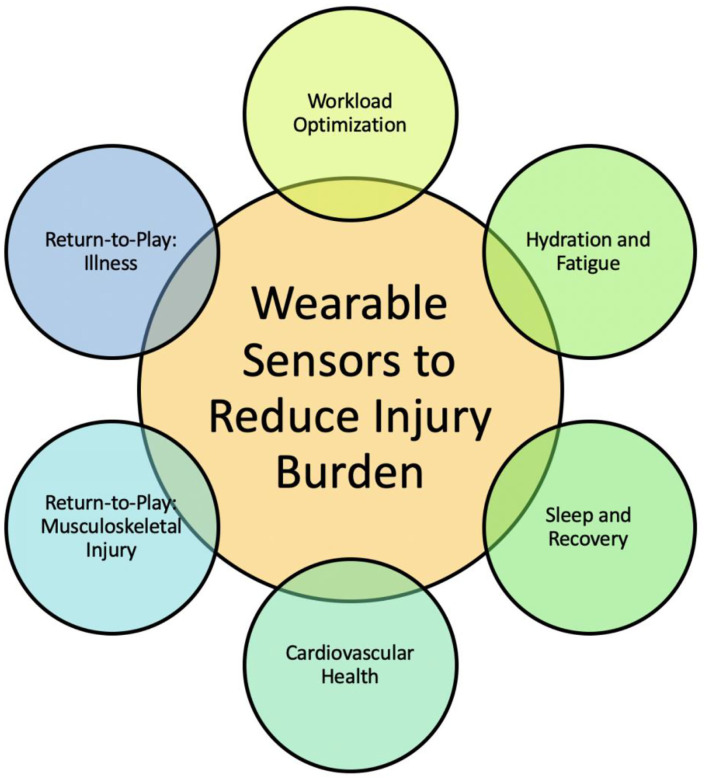
Wearable sensors enable the real-time and non-invasive monitoring of biomechanical, physiological, or biochemical parameters pertinent to the performance of athletes. Sports medicine researchers compile datasets involving a multitude of parameters that can often be time consuming to analyze in order to create value in an expeditious and accurate manner. Machine learning and artificial intelligence models may aid in the clinical decision-making process for sports scientists, team physicians, and athletic trainers in translating the data acquired from wearable sensors to accurately and efficiently make decisions regarding the health, safety, and performance of athletes. This narrative review discusses the application of commercial sensors utilized by sports teams today and the emergence of descriptive analytics to monitor the internal and external workload, hydration status, sleep, cardiovascular health, and return-to-sport status of athletes. This review is written for those who are interested in the application of wearable sensor data and data science to enhance performance and reduce injury burden in athletes of all ages.
可穿戴传感器能够对与运动员表现相关的生物力学、生理或生化参数进行实时、无创监测。运动医学研究人员收集了包含众多参数的数据集,为了快速、准确地创造价值,分析这些数据集往往很耗时。机器学习和人工智能模型可能有助于运动科学家、队医和运动训练师在临床决策过程中,将从可穿戴传感器获取的数据进行转化,从而就运动员的健康、安全和表现准确、高效地做出决策。这篇叙述性综述讨论了如今运动队使用的商用传感器的应用,以及描述性分析的出现,以监测运动员的内部和外部工作量、水合状态、睡眠、心血管健康以及恢复运动状态。这篇综述是为那些对应用可穿戴传感器数据和数据科学以提高各年龄段运动员的表现和减轻伤病负担感兴趣的人而撰写的。