Hong Yili, Wang Zening, Barrow Colin J, Dunshea Frank R, Suleria Hafiz A R
School of Agriculture and Food, Faculty of Veterinary and Agricultural Sciences, The University of Melbourne, Parkville, VIC 3010, Australia.
Centre for Chemistry and Biotechnology, School of Life and Environmental Sciences, Deakin University, Waurn Ponds, VIC 3217, Australia.
Antioxidants (Basel). 2021 Feb 4;10(2):234. doi: 10.3390/antiox10020234.
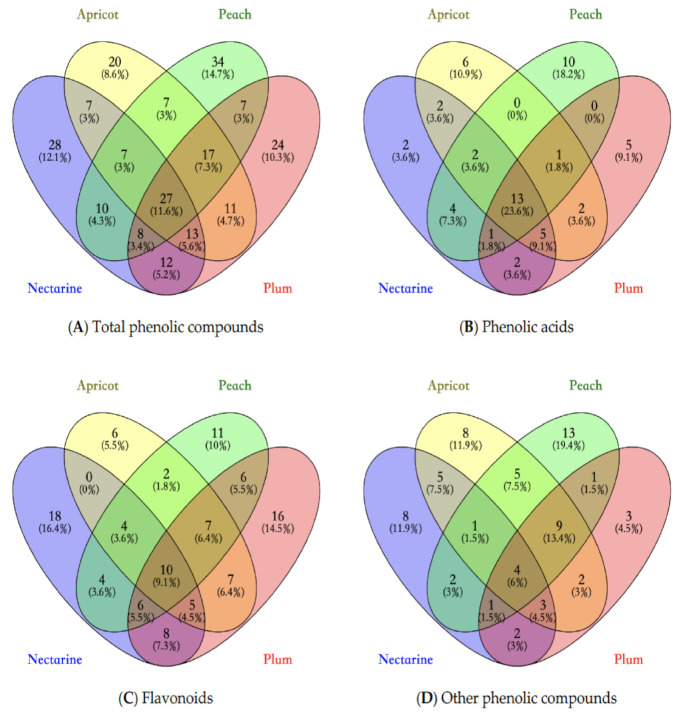
Stone fruits, including peach ( L.), nectarine ( L.), plum ( L.) and apricot ( L.) are common commercial fruits in the market. However, a huge amount of stone fruits waste is produced throughout the food supply chain during picking, handling, processing, packaging, storage, transportation, retailing and final consumption. These stone fruits waste contain high phenolic content which are the main contributors to the antioxidant potential and associated health benefits. The antioxidant results showed that plum waste contained higher concentrations of total phenolic content (TPC) (0.94 ± 0.07 mg gallic acid equivalents (GAE)/g) and total flavonoid content (TFC) (0.34 ± 0.01 mg quercetin equivalents (QE)/g), while apricot waste contained a higher concentration of total tannin content (TTC) (0.19 ± 0.03 mg catechin equivalents (CE)/g) and DPPH activity (1.47 ± 0.12 mg ascorbic acid equivalents (AAE)/g). However, nectarine waste had higher antioxidant capacity in ferric reducing-antioxidant power (FRAP) (0.98 ± 0.02 mg AAE/g) and total antioxidant capacity (TAC) (0.91 ± 0.09 mg AAE/g) assays, while peach waste showed higher antioxidant capacity in 2,2'-azino-bis-(3-ethylbenzothiazoline-6-sulfonic acid (ABTS) assay (0.43 ± 0.09 mg AAE/g) as compared to other stone fruits waste. Qualitative and quantitative phenolic analysis of Australian grown stone fruits waste were conducted by liquid chromatography coupled with electrospray-ionization quadrupole time-of-flight mass spectrometry (LC-ESI-QTOF-MS/MS) and HPLC-photodiode array detection (PDA). The LC-ESI-QTOF-MS/MS result indicates that 59 phenolic compounds were tentatively characterized in peach (33 compounds), nectarine (28), plum (38) and apricot (23). The HPLC-PDA indicated that -hydroxybenzoic acid (18.64 ± 1.30 mg/g) was detected to be the most dominant phenolic acid and quercetin (19.68 ± 1.38 mg/g) was the most significant flavonoid in stone fruits waste. Hence, it could be concluded that stone fruit waste contains various phenolic compounds and have antioxidant potential. The results could support the applications of these stone fruit wastes in other food, feed, nutraceutical and pharmaceutical industries.
核果,包括桃(蔷薇科桃属)、油桃(蔷薇科桃属)、李(蔷薇科李属)和杏(蔷薇科杏属)是市场上常见的商业水果。然而,在采摘、处理、加工、包装、储存、运输、零售和最终消费的整个食品供应链中,会产生大量的核果废弃物。这些核果废弃物含有高酚含量,这是其抗氧化潜力和相关健康益处的主要贡献者。抗氧化结果表明,李废弃物中总酚含量(TPC)(0.94±0.07毫克没食子酸当量(GAE)/克)和总黄酮含量(TFC)(0.34±0.01毫克槲皮素当量(QE)/克)浓度较高,而杏废弃物中总单宁含量(TTC)(0.19±0.03毫克儿茶素当量(CE)/克)和DPPH活性(1.47±0.12毫克抗坏血酸当量(AAE)/克)浓度较高。然而,油桃废弃物在铁还原抗氧化能力(FRAP)(0.98±0.02毫克AAE/克)和总抗氧化能力(TAC)(0.91±0.09毫克AAE/克)测定中具有较高的抗氧化能力,而桃废弃物在2,2'-联氮-双-(3-乙基苯并噻唑啉-6-磺酸)(ABTS)测定(0.43±0.09毫克AAE/克)中显示出比其他核果废弃物更高的抗氧化能力。采用液相色谱-电喷雾电离四极杆飞行时间质谱联用(LC-ESI-QTOF-MS/MS)和高效液相色谱-光电二极管阵列检测(HPLC-PDA)对澳大利亚种植的核果废弃物进行了定性和定量酚类分析。LC-ESI-QTOF-MS/MS结果表明,在桃(33种化合物)、油桃(28种)、李(38种)和杏(23种)中初步鉴定出59种酚类化合物。HPLC-PDA表明,对羟基苯甲酸(18.64±1.30毫克/克)是核果废弃物中检测到的最主要酚酸,槲皮素(19.68±1.38毫克/克)是最主要的黄酮类化合物。因此,可以得出结论,核果废弃物含有多种酚类化合物并具有抗氧化潜力。这些结果可为这些核果废弃物在其他食品、饲料、营养保健品和制药行业的应用提供支持。