Intensive Cardiological Care Division, Louis Pradel Hospital, Hospices Civils de Lyon, Bron, France.
INSERM U1060, CarMeN Laboratory, University of Lyon, Groupement Hospitalier Est, Bron, France.
Immun Inflamm Dis. 2021 Jun;9(2):493-501. doi: 10.1002/iid3.409. Epub 2021 Feb 8.
Soluble vascular cell adhesion molecule-1 (sVCAM-1) is a biomarker of endothelial activation and inflammation. There is still controversy as to whether it can predict clinical outcome after ST-elevation myocardial infarction (STEMI). Our aim was to assess the sVCAM-1 kinetics and to evaluate its prognostic predictive value.
We prospectively enrolled 251 consecutive STEMI patients who underwent coronary revascularization in our university hospital. Blood samples were collected at admission, 4, 24, 48 h and 1 month after admission. sVCAM-1 serum level was assessed using ELISA assay. All patients had cardiac magnetic resonance imaging at 1-month for infarct size (IS) and left ventricular ejection fraction (LVEF) assessment. Clinical outcomes were recorded over 12 months after STEMI.
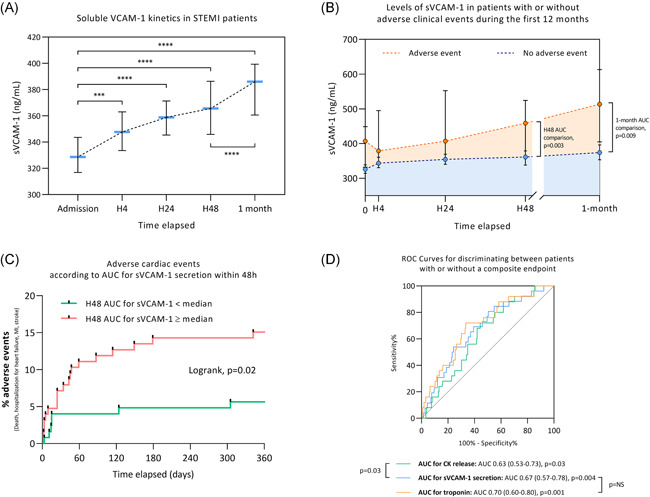
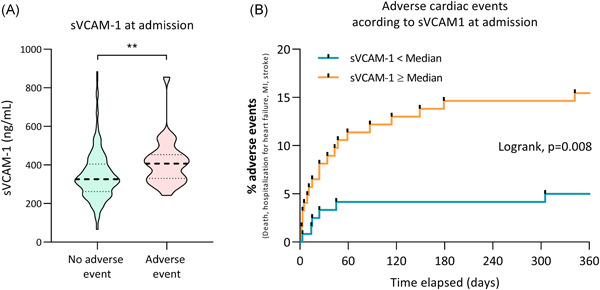
sVCAM-1 levels significantly increased from admission up to 1 month and were significantly correlated with IS, LVEF, and LV end-systolic and diastolic volume. (H48 area under curve (AUC) ≥ H48 median) were associated with an increased risk of adverse clinical events during the 12-month follow-up period with a hazard ratio (HR) = 2.6 (95% confidence interval [CI] of ratio = 1.2-5.6, p = .02). The ability of H48 AUC for sVCAM-1 to discriminate between patients with or without the composite endpoint was evaluated using receiver operating characteristics with an AUC at 0.67 (0.57-0.78, p = .004). This ability was significantly superior to H48 AUC creatine kinase (p = .03).
In STEMI patients, high sVCAM-1 levels are associated with a poor clinical outcome. sVCAM-1 is an early postmyocardial infarction biomarker and might be an interesting target for the development of future therapeutic strategies.
可溶性血管细胞黏附分子-1(sVCAM-1)是内皮细胞激活和炎症的生物标志物。关于 sVCAM-1 是否能预测 ST 段抬高型心肌梗死(STEMI)后的临床结局仍存在争议。我们的目的是评估 sVCAM-1 的动力学并评估其预后预测价值。
我们前瞻性纳入了 251 例连续 STEMI 患者,这些患者在我们的大学医院接受了冠状动脉血运重建。在入院时、入院后 4、24、48 小时和 1 个月时采集血样。采用 ELISA 法检测 sVCAM-1 血清水平。所有患者在 STEMI 后 1 个月行心脏磁共振成像,以评估梗死面积(IS)和左心室射血分数(LVEF)。记录 STEMI 后 12 个月的临床结局。
sVCAM-1 水平从入院时开始持续升高,直至 1 个月,且与 IS、LVEF 以及左心室收缩末期和舒张末期容积显著相关。(H48 曲线下面积(AUC)≥H48 中位数)与 12 个月随访期间不良临床事件的风险增加相关,风险比(HR)=2.6(比值 95%置信区间为 1.2-5.6,p=0.02)。使用接受者操作特征曲线评估 H48 AUC 对 sVCAM-1 区分有或无复合终点患者的能力,AUC 为 0.67(0.57-0.78,p=0.004)。这种能力明显优于 H48 AUC 肌酸激酶(p=0.03)。
在 STEMI 患者中,高 sVCAM-1 水平与不良临床结局相关。sVCAM-1 是心肌梗死后的早期生物标志物,可能是未来治疗策略的一个有前途的靶点。