Paccalet Alexandre, Badawi Sally, Pillot Bruno, Augeul Lionel, Mechtouff Laura, Harhous Zeina, Gouriou Yves, Paillard Mélanie, Breuilly Marine, Amaz Camille, Varillon Yvonne, Leboube Simon, Brun Camille, Prieur Cyril, Rioufol Gilles, Mewton Nathan, Ovize Michel, Bidaux Gabriel, Bochaton Thomas, Crola Da Silva Claire
Laboratoire CarMeN-IRIS Team, INSERM, INRA, Université Claude Bernard Lyon-1, INSA-Lyon, University of Lyon, Bron, France.
CIQLE, LyMIC, LABEX CORTEX, Université Claude Bernard Lyon 1, Structure Fédérative de Recherche santé Lyon-Est CNRS UAR3453/Inserm US7, Lyon, France.
JACC Basic Transl Sci. 2024 Apr 24;9(5):593-604. doi: 10.1016/j.jacbts.2024.01.019. eCollection 2024 May.
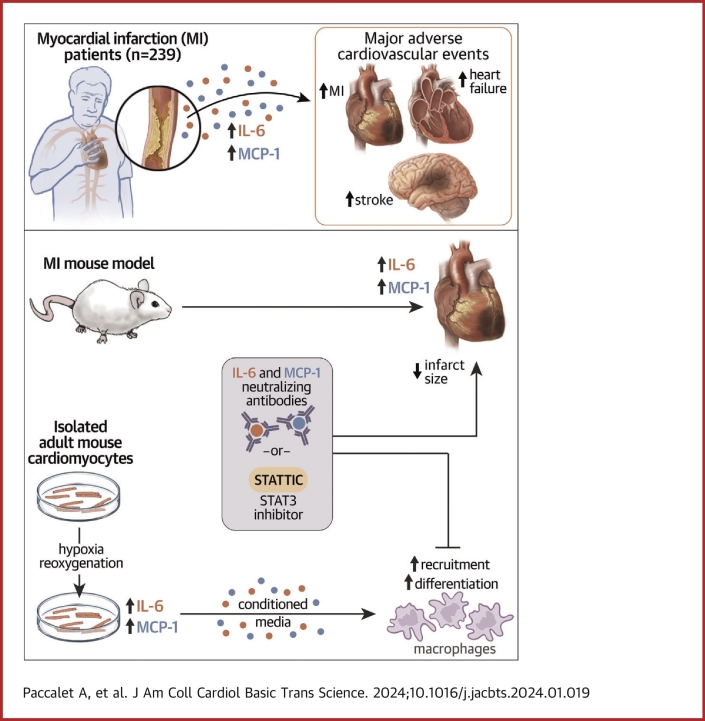
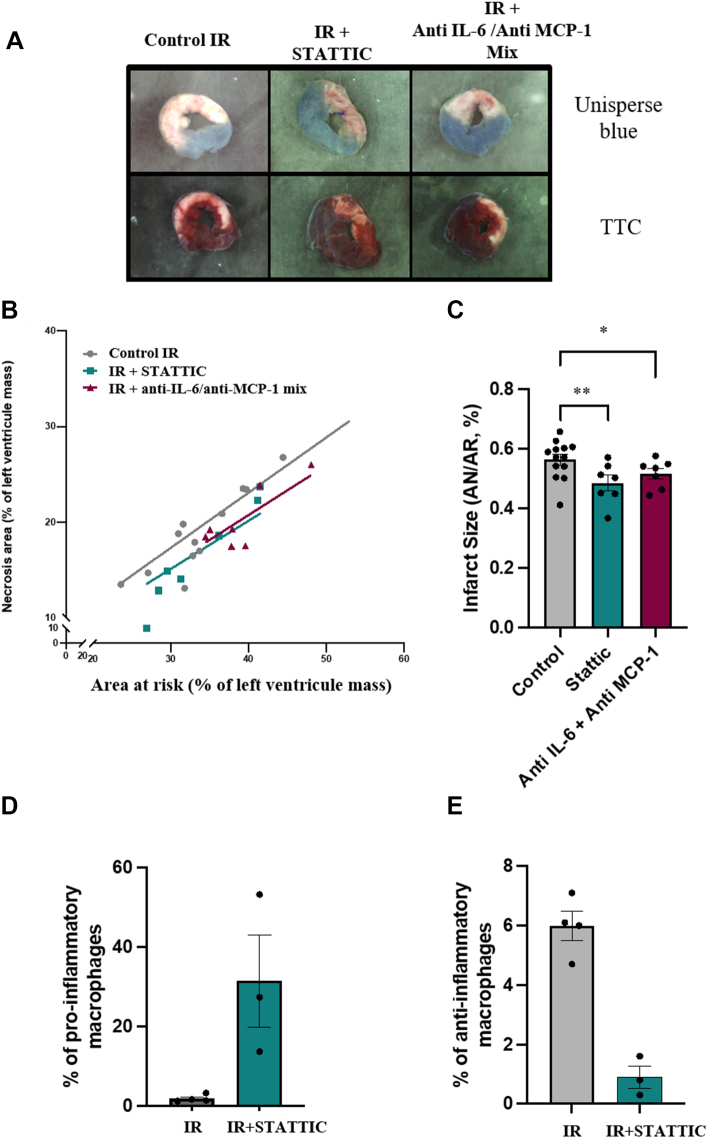
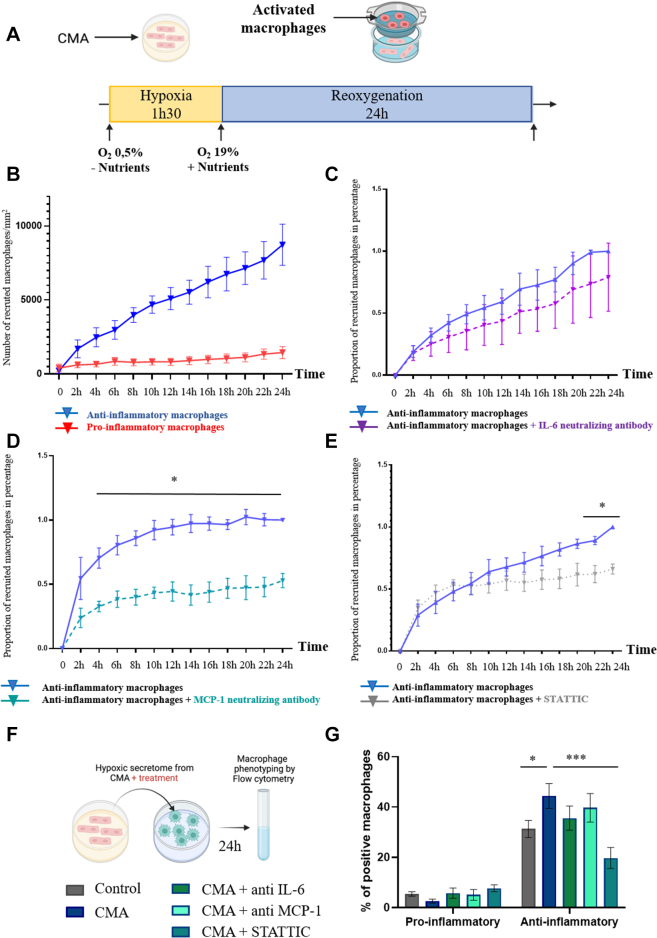
Using a translational approach with an ST-segment myocardial infarction (STEMI) cohort and mouse model of myocardial infarction, we highlighted the role of the secreted IL-6 and MCP-1 cytokines and the STAT3 pathway in heart macrophage recruitment and activation. Cardiac myocytes secrete IL-6 and MCP-1 in response to hypoxic stress, leading to a recruitment and/or polarization of anti-inflammatory macrophages via the STAT3 pathway. In our preclinical model of myocardial infarction, neutralization of IL-6 and MCP-1 or STAT3 pathway reduced infarct size. Together, our data demonstrate that anti-inflammatory macrophages can be deleterious in the acute phase of STEMI.
通过对ST段抬高型心肌梗死(STEMI)队列和心肌梗死小鼠模型采用转化研究方法,我们强调了分泌的白细胞介素-6(IL-6)和单核细胞趋化蛋白-1(MCP-1)细胞因子以及信号转导和转录激活因子3(STAT3)通路在心脏巨噬细胞募集和激活中的作用。心肌细胞在缺氧应激下分泌IL-6和MCP-1,通过STAT3通路导致抗炎巨噬细胞的募集和/或极化。在我们的心肌梗死临床前模型中,中和IL-6和MCP-1或STAT3通路可减小梗死面积。总之,我们的数据表明抗炎巨噬细胞在STEMI急性期可能是有害的。