Wilfrid Laurier University, Waterloo, Ontario, Canada.
University of Waterloo, Waterloo, Ontario, Canada.
Neurorehabil Neural Repair. 2021 Mar;35(3):290-299. doi: 10.1177/1545968321992331. Epub 2021 Feb 9.
Freezing of gait (FOG) is arguably the most disabling motor symptom experienced with Parkinson's disease (PD), but treatments are extremely limited due to our poor understanding of the underlying mechanisms. Three cortical domains are postulated in recent research (ie, the cognitive, limbic, and sensorimotor domains), thus, treatments targeting these mechanisms of FOG may potentially be effective. Cognitive training, cognitive behavioral therapy (CBT, a well-known anxiety intervention), and proprioceptive training may address the cognitive, limbic, and sensorimotor domains, respectively.
To investigate whether these 3 treatments could improve functional outcomes of FOG.
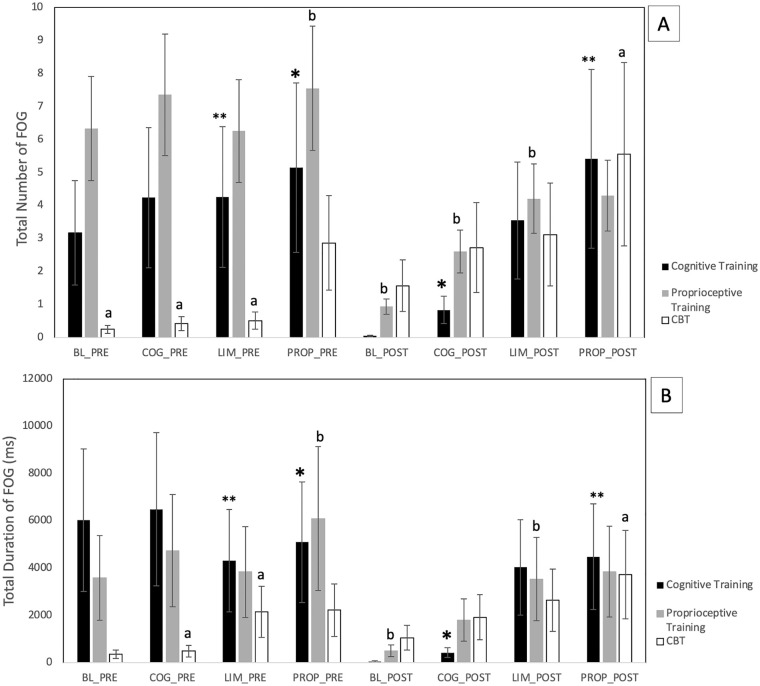
In a single-blind, randomized crossover design, 15 individuals with PD and FOG were randomized into different, counterbalanced orders of receiving the interventions. Each consisted of eight 1-hour sessions, twice weekly for 4 weeks. FOG severity was assessed as the primary outcome using a novel gait paradigm that was aimed at evoking FOG when the cognitive, limbic, or sensorimotor domains were independently challenged.
FOG severity significantly improved after the cognitive intervention, with strong trends toward improvement specifically in the baseline and cognitive-challenge assessment conditions. CBT, as the anxiety intervention, resulted in significantly worse FOG severity. In contrast, proprioceptive training significantly improved FOG severity, with consistent trends across all conditions.
The cognitive and proprioceptive treatments appeared to improve different aspects of FOG. Thus, either of these interventions could potentially be a viable treatment for FOG. However, although the results were statistically significant, they could be sensitive to the relatively small number of participants in the study. Considering the significant results together with nonsignificant trends in both FOG and gait measures, and given equal time for each intervention, proprioceptive training produced the most consistent indications of benefits in this study. (clinicaltrials.gov NCT03065127).
冻结步态(FOG)可说是帕金森病(PD)患者最致残的运动症状,但由于我们对潜在机制的了解有限,治疗方法极为有限。最近的研究提出了三个皮质域(即认知域、边缘域和感觉运动域),因此,针对这些 FOG 机制的治疗方法可能具有潜在的有效性。认知训练、认知行为疗法(CBT,一种广为人知的焦虑干预措施)和本体感觉训练分别可能针对认知域、边缘域和感觉运动域。
研究这 3 种治疗方法是否可以改善 FOG 的功能结果。
采用单盲、随机交叉设计,将 15 名 PD 伴 FOG 患者随机分为不同的、平衡的干预顺序。每个顺序包括 8 次 1 小时的治疗,每周 2 次,持续 4 周。FOG 严重程度是使用一种新的步态范式作为主要结局评估的,该范式旨在在认知、边缘或感觉运动域独立受到挑战时诱发 FOG。
认知干预后 FOG 严重程度显著改善,在基线和认知挑战评估条件下有明显改善的趋势。CBT 作为焦虑干预措施,导致 FOG 严重程度明显恶化。相比之下,本体感觉训练显著改善了 FOG 严重程度,在所有条件下均呈现出一致的趋势。
认知和本体感觉治疗似乎改善了 FOG 的不同方面。因此,这些干预措施中的任何一种都可能成为 FOG 的可行治疗方法。然而,尽管结果具有统计学意义,但它们可能对研究中参与者数量相对较少敏感。考虑到研究中每项干预措施的结果都具有统计学意义,同时 FOG 和步态测量结果也呈现出一定的趋势,且每项干预措施的时间相等,因此本体感觉训练在本研究中最能持续地显示出其益处。(clinicaltrials.gov NCT03065127)