Obesity Research Unit, Research Program for Clinical and Molecular Metabolism, Faculty of Medicine, University of Helsinki, Finland.
Institute of Public Health and Clinical Nutrition, University of Eastern Finland, Kuopio, Finland.
J Clin Endocrinol Metab. 2021 Apr 23;106(5):1312-1324. doi: 10.1210/clinem/dgab072.
Mitochondria are essential for cellular energy homeostasis, yet their role in subcutaneous adipose tissue (SAT) during different types of weight-loss interventions remains unknown.
To investigate how SAT mitochondria change following diet-induced and bariatric surgery-induced weight-loss interventions in 4 independent weight-loss studies.
The DiOGenes study is a European multicenter dietary intervention with an 8-week low caloric diet (LCD; 800 kcal/d; n = 261) and 6-month weight-maintenance (n = 121) period. The Kuopio Obesity Surgery study (KOBS) is a Roux-en-Y gastric bypass (RYGB) surgery study (n = 172) with a 1-year follow-up. We associated weight-loss percentage with global and 2210 mitochondria-related RNA transcripts in linear regression analysis adjusted for age and sex. We repeated these analyses in 2 studies. The Finnish CRYO study has a 6-week LCD (800-1000 kcal/d; n = 19) and a 10.5-month follow-up. The Swedish DEOSH study is a RYGB surgery study with a 2-year (n = 49) and 5-year (n = 37) follow-up.
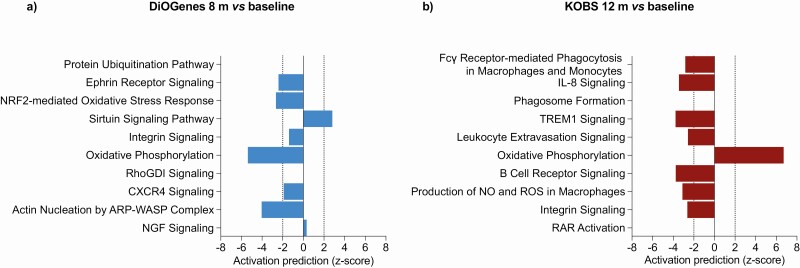
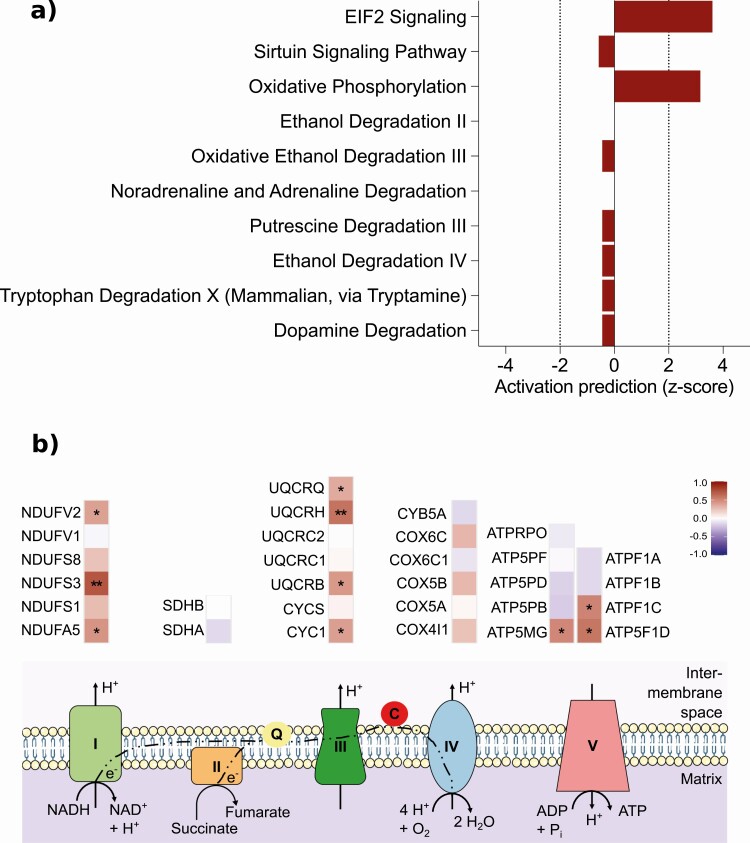
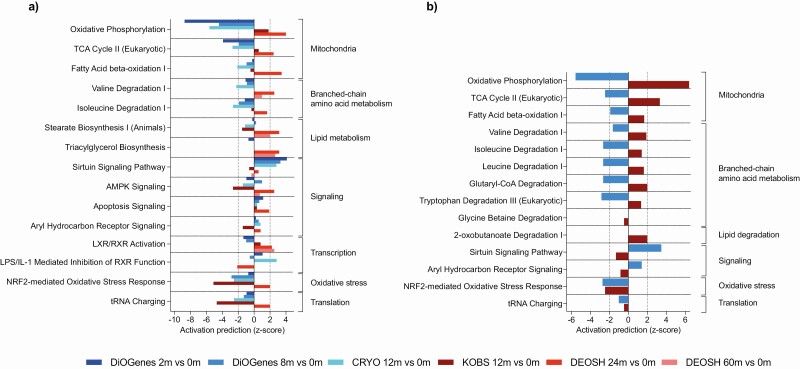
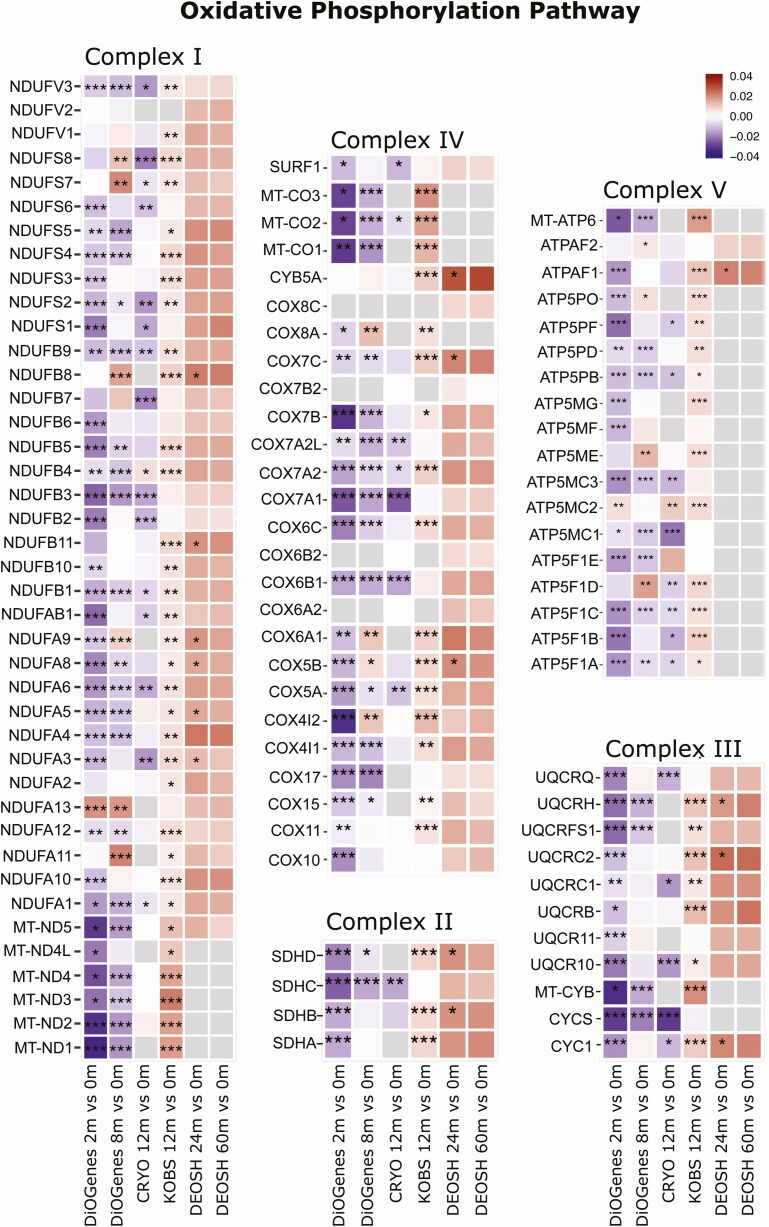
Diet-induced weight loss led to a significant transcriptional downregulation of oxidative phosphorylation (DiOGenes; ingenuity pathway analysis [IPA] z-scores: -8.7 following LCD, -4.4 following weight maintenance; CRYO: IPA z-score: -5.6, all P < 0.001), while upregulation followed surgery-induced weight loss (KOBS: IPA z-score: 1.8, P < 0.001; in DEOSH: IPA z-scores: 4.0 following 2 years, 0.0 following 5 years). We confirmed an upregulated oxidative phosphorylation at the proteomics level following surgery (IPA z-score: 3.2, P < 0.001).
Differentially regulated SAT mitochondria-related gene expressions suggest qualitative alterations between weight-loss interventions, providing insights into the potential molecular mechanistic targets for weight-loss success.
线粒体对于细胞能量稳态至关重要,但它们在不同类型的减肥干预措施下在皮下脂肪组织 (SAT) 中的作用仍不清楚。
在四项独立的减肥研究中,研究 SAT 线粒体在饮食诱导和减肥手术诱导的减肥干预后的变化。
DiOGenes 研究是一项欧洲多中心饮食干预研究,采用 8 周低热量饮食(LCD;800 卡路里/天;n = 261)和 6 个月体重维持(n = 121)期。Kuopio 肥胖手术研究(KOBS)是一项 Roux-en-Y 胃旁路(RYGB)手术研究(n = 172),随访时间为 1 年。我们将体重减轻百分比与全球和 2210 个线粒体相关 RNA 转录物进行线性回归分析,同时调整年龄和性别。我们在另外两项研究中重复了这些分析。芬兰 CRYO 研究采用 6 周 LCD(800-1000 卡路里/天;n = 19)和 10.5 个月的随访。瑞典 DEOSH 研究是一项 RYGB 手术研究,随访时间为 2 年(n = 49)和 5 年(n = 37)。
饮食诱导的体重减轻导致氧化磷酸化的显著转录下调(DiOGenes;Ingenuity 通路分析 [IPA] z 分数:LCD 后为-8.7,维持体重后为-4.4;CRYO:IPA z 分数:-5.6,均 P < 0.001),而手术诱导的体重减轻后则上调(KOBS:IPA z 分数:1.8,P < 0.001;DEOSH:IPA z 分数:2 年后为 4.0,5 年后为 0.0)。我们在蛋白质组学水平上证实了手术后氧化磷酸化的上调(IPA z 分数:3.2,P < 0.001)。
SAT 线粒体相关基因表达的差异调节表明减肥干预之间存在定性改变,为减肥成功的潜在分子机制靶点提供了见解。