Research Institute for Bioresources and Biotechnology, Ishikawa Prefectural University, Nonoichi 921-8836, Ishikawa, Japan.
Faculty of Biology-Oriented Science and Technology, Kindai University, Kinokawa, Wakayama 649-6493, Japan.
Med Sci (Basel). 2021 Feb 5;9(1):8. doi: 10.3390/medsci9010008.
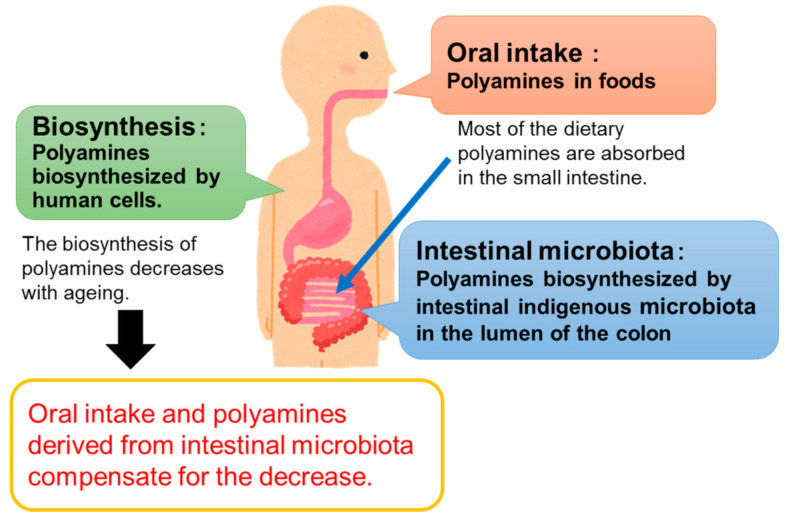
The purpose of this paper is to summarize the latest information on the various aspects of polyamines and their health benefits. In recent years, attempts to treat cancer by reducing elevated polyamines levels in cancer cells have been made, with some advancing to clinical trials. However, it has been reported since 2009 that polyamines extend the healthy life span of animals by inducing autophagy, protecting the kidneys and liver, improving cognitive function, and inhibiting the progression of heart diseases. As such, there is conflicting information regarding the relationship between polyamines and health. However, attempts to treat cancer by decreasing intracellular polyamines levels are a coping strategy to suppress the proliferation-promoting effects of polyamines, and a consensus is being reached that polyamine intake does not induce cancer in healthy individuals. To provide further scientific evidence for the health-promoting effects of polyamines, large-scale clinical studies involving multiple groups are expected in the future. It is also important to promote basic research on polyamine intake in animals, including elucidation of the polyamine balance between food, intestinal bacteria, and biosynthesis.
本文旨在综述多胺及其对健康益处的各个方面的最新信息。近年来,人们试图通过降低癌细胞中升高的多胺水平来治疗癌症,其中一些已进入临床试验。然而,自 2009 年以来有报道称,多胺通过诱导自噬、保护肾脏和肝脏、改善认知功能和抑制心脏病进展来延长动物的健康寿命。因此,关于多胺与健康之间的关系存在相互矛盾的信息。然而,通过降低细胞内多胺水平来治疗癌症的尝试是一种抑制多胺促进增殖作用的应对策略,人们越来越认为多胺摄入不会在健康个体中引发癌症。为了为多胺的促进健康作用提供更多的科学证据,预计未来将进行涉及多个群体的大规模临床研究。促进包括食物、肠道细菌和生物合成之间的多胺平衡在内的动物多胺摄入的基础研究也很重要。