ECG Room of Physical Examination Center of Cangzhou Central Hospital, Cangzhou, Hebei, 061001, People's Republic of China.
Six Cardiovascular Departments of Cangzhou Central Hospital, Cangzhou, Hebei, 061001, People's Republic of China.
Int J Nanomedicine. 2021 Feb 2;16:741-752. doi: 10.2147/IJN.S277377. eCollection 2021.
Quercetin has potential value in treating cardiovascular diseases, but it is not suitable for clinical application due to its own water solubility. The limitation of quercetin can be distinctly ameliorated by delivering it with nanocarriers.
To determine the effect of quercetin-loaded mesoporous silica nanoparticles (Q-MSNs) on myocardial ischemia-reperfusion injury in rats and its mechanism.
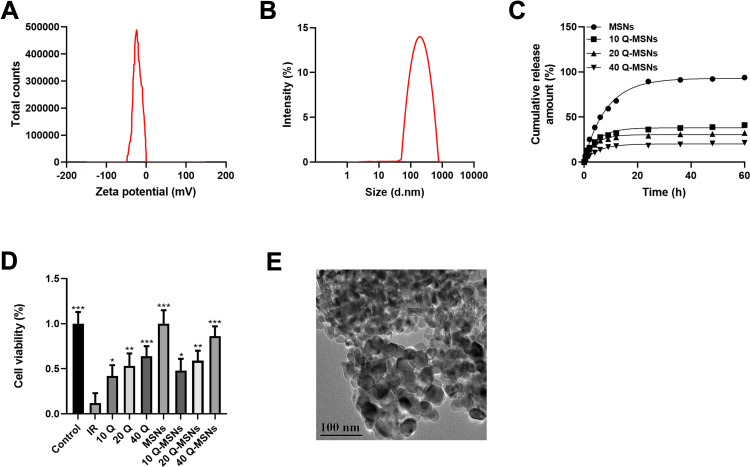
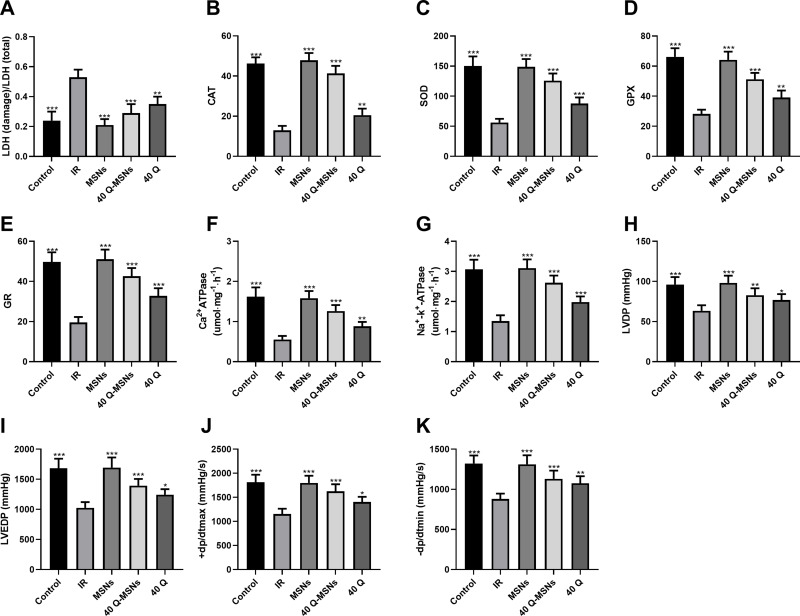
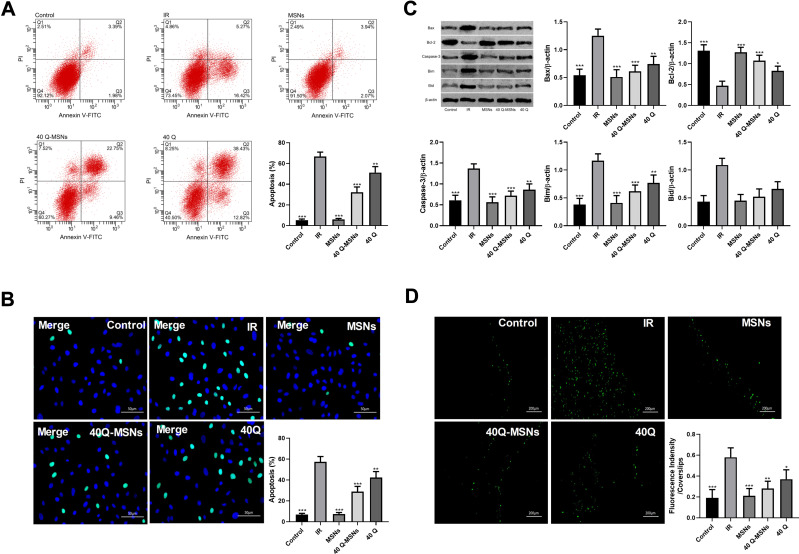
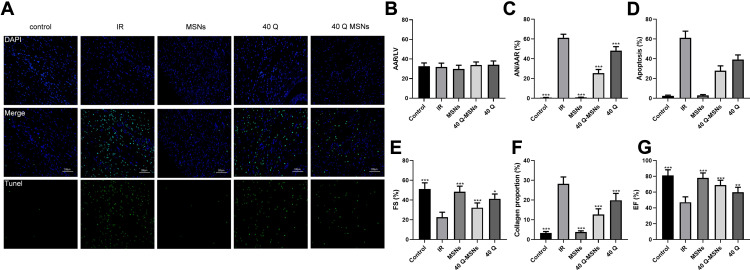
Q-MSNs were synthesized, and the morphology of Q-MSNs and MSNs was characterized by transmission electron microscopy and dynamic light scattering technique, respectively. Healthy rats were enrolled and randomly divided into a sham operation control group, an ischemia-reperfusion (IR) group, an IR+Q group, an IR+Q-MSNs group, and an MSNs group (each n = 10). Rats in the sham operation group were not treated with ischemia reperfusion, but given normal perfusion meantime. Rats in the sham operation control group, IR group, and MSNs group were given normal saline for 10 days before ischemia reperfusion, and rats in the IR+Q group and IR+Q-MSNs group were given drugs by gavage for 10 days before ischemia reperfusion. Primary myocardial cells were sampled from SD neonatal rats to construct hypoxia/reoxygenation myocardial cell models. The myocardial cells were assigned to a control group, IR group, quercetin (Q) group, Q-MSNs group, and MSNs group. Except for the control group, all the other groups were treated with hypoxia/reoxygenation. Cells in the Q group were treated with quercetin (10 μM, 20 μM, 40 μM) for 24 h in advance and then treated with measures to cause hypoxia-reoxygenation injury. Cells in the Q-MSNs group were treated with the same concentration of loaded quercetin and the same method used for the Q group. The myocardial apoptosis, myocardial infarction, ventricular remodeling, hemodynamic indexes, physiological and biochemical indexes, and JAK2/STAT3 pathway expression of each group were detected, and the apoptosis, viability, oxidative stress, and JAK2/STAT3 pathway expression of primary myocardial cells in each group were also detected.
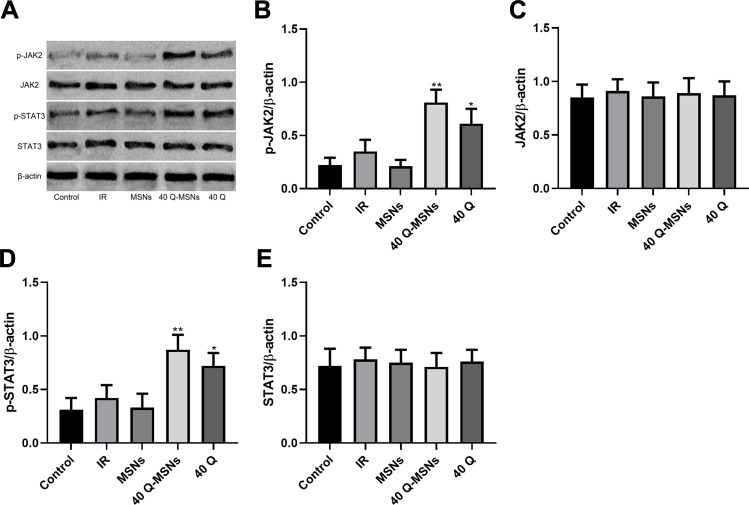
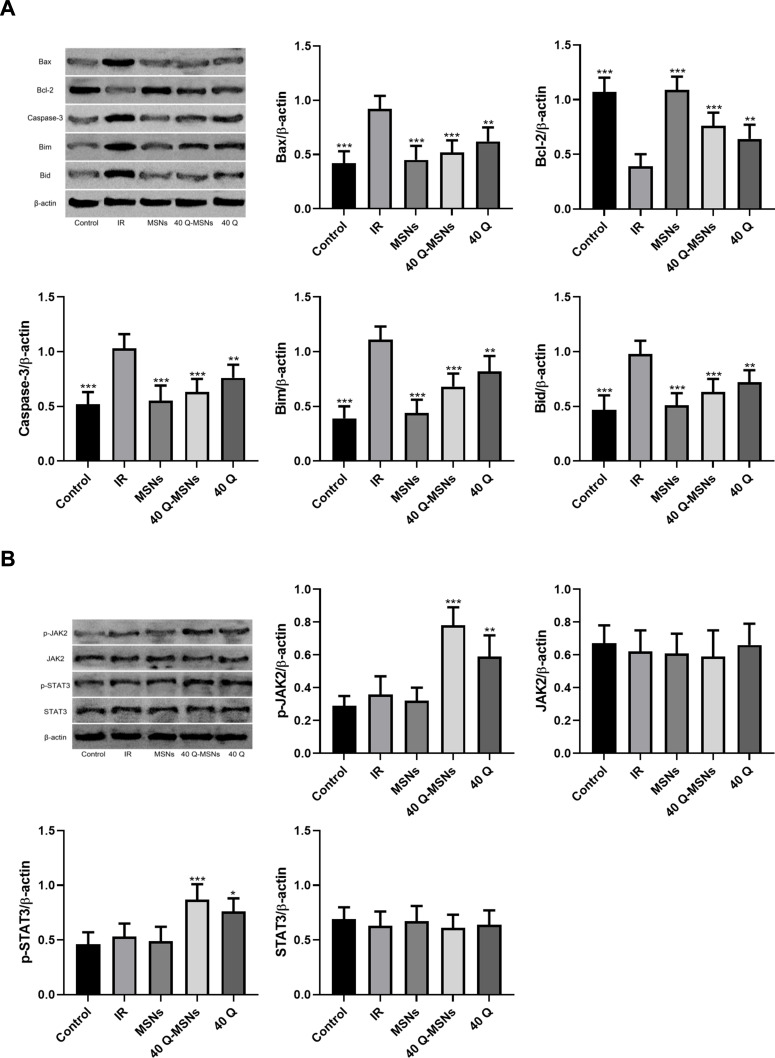
Quercetin significantly activated the JAK2/STAT3 pathway in vivo and in vitro, and MSNs intensified the activation. Compared with quercetin, Q-MSNs were more effective in inhibiting cell apoptosis and oxidative stress, reducing myocardial infarction size, improving ventricular remodeling and cardiac function-related biochemical indexes, and promoting the recovery of cardiac blood flow.
Q-MSNs can significantly enhance the activation effect of quercetin on JAK2/STAT3 pathway, thus enhancing its protection on the heart of MIRI rats.
槲皮素在治疗心血管疾病方面具有潜在价值,但由于其自身水溶性较差,并不适合临床应用。通过纳米载体输送可以明显改善槲皮素的局限性。
探讨载槲皮素介孔硅纳米粒(Q-MSNs)对大鼠心肌缺血再灌注损伤的作用及其机制。
合成 Q-MSNs,分别采用透射电子显微镜和动态光散射技术对 Q-MSNs 和 MSNs 的形态进行表征。将健康大鼠纳入并随机分为假手术对照组、缺血再灌注(IR)组、IR+Q 组、IR+Q-MSNs 组和 MSNs 组(每组 n=10)。假手术组大鼠不进行缺血再灌注,但同时给予正常灌注。假手术对照组、IR 组和 MSNs 组大鼠在缺血再灌注前 10 天给予生理盐水,IR+Q 组和 IR+Q-MSNs 组大鼠在缺血再灌注前 10 天给予药物灌胃。从 SD 新生大鼠中提取原代心肌细胞,构建缺氧/复氧心肌细胞模型。将心肌细胞分为对照组、IR 组、槲皮素(Q)组、Q-MSNs 组和 MSNs 组。除对照组外,其余各组均进行缺氧/复氧处理。Q 组细胞先用 10 μM、20 μM、40 μM 槲皮素预处理 24 h,然后给予缺氧/复氧损伤措施。Q-MSNs 组细胞用相同浓度的负载槲皮素,采用与 Q 组相同的方法处理。检测各组的心肌细胞凋亡、心肌梗死、心室重构、血流动力学指标、生理生化指标和 JAK2/STAT3 通路表达,检测各组原代心肌细胞的凋亡、活力、氧化应激和 JAK2/STAT3 通路表达。
槲皮素在体内和体外均能显著激活 JAK2/STAT3 通路,MSNs 能增强其激活作用。与槲皮素相比,Q-MSNs 更能有效抑制细胞凋亡和氧化应激,减少心肌梗死面积,改善心室重构和心功能相关生化指标,促进心肌血流恢复。
Q-MSNs 可显著增强槲皮素对 JAK2/STAT3 通路的激活作用,从而增强其对 MIRI 大鼠心脏的保护作用。