Asghar Adil, Naaz Shagufta, Narayan Ravi K, Kumar Anup
Anatomy, All India Institute of Medical Sciences Patna, Patna, IND.
Anesthesiology, All India Institute of Medical Sciences Patna, Patna, IND.
Cureus. 2021 Jan 6;13(1):e12535. doi: 10.7759/cureus.12535.
Osteoarthritis (OA) and age-related degeneration (ARD) are stimulants for the development of the fabella in the knee joint. This meta-analysis updates previous studies and reviews on the prevalence of the fabella in OA or ARD knee joints. In addition, it provides a quantitative estimation of the fabellar prevalence in knees having OA and ARD.
Twenty studies containing data from 11,056 knee joints were utilized in the investigation, consisting of 6,819 knees of individuals with OA (including those with age greater than 40 years) and 4,237 knees of individuals without OA (including less than 40 years of age), respectively. Totally, 2,434 knees of the OA subjects had fabellae (including more than 40 years), while in the non-OA subjects, 844 had fabellae (including less than 40years). The odds ratio (OR) and relative risk (RR) were calculated.
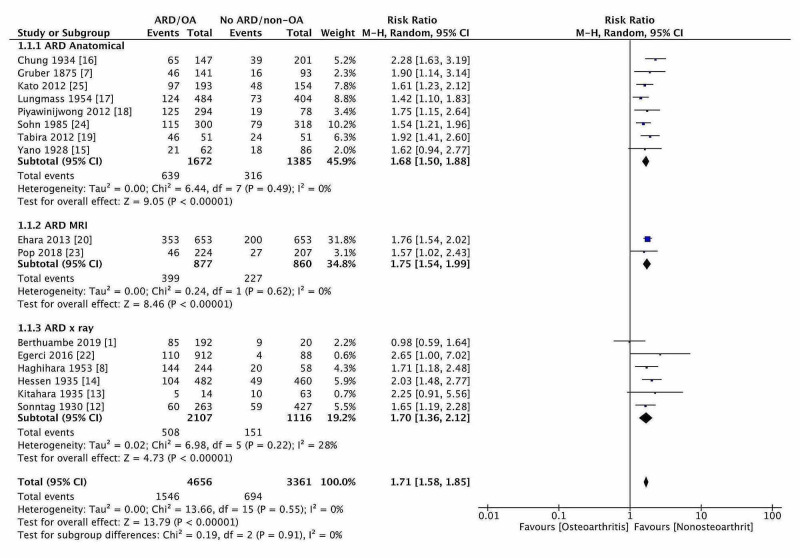
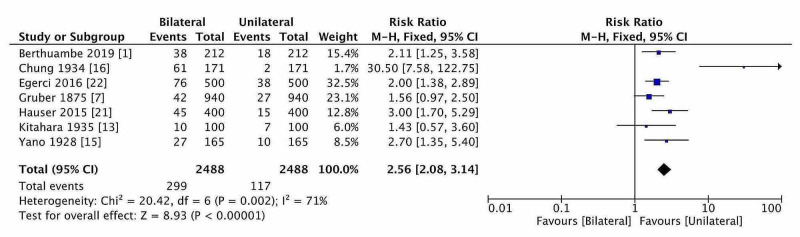
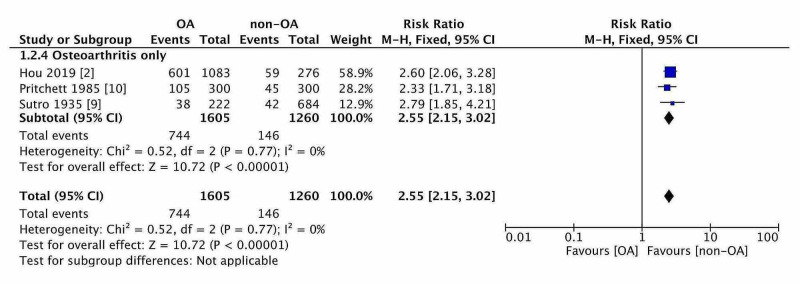
The fabellar prevalence was observed to be higher in OA knees, where the risk ratio of developing fabella was 2.55 (2.15-3.02). Compared with this, the risk ratio for the incidence of fabella in ARD knee was 1.71 (1.59-1.85). The bilateral occurrence of fabella was more common than unilateral. The risk of developing fabella in individuals aged less than 40-year was 0.59 which was 41% less than individuals aged more than 40 years. The risk ratio of developing fabella in co-exposure of ARD and OA was 1.84 [1.66, 2.04, 95% CI].
OA and ARD would increase the prevalence of ossified fabella by 84%, thus acting as stimulants or associations and risk factors for ossified fabella.
骨关节炎(OA)和年龄相关性退变(ARD)是膝关节中籽骨发育的刺激因素。本荟萃分析更新了以往关于籽骨在OA或ARD膝关节中患病率的研究和综述。此外,它还对患有OA和ARD的膝关节中籽骨的患病率进行了定量估计。
本研究采用了20项包含11,056个膝关节数据的研究,分别包括6,819个OA患者(包括年龄大于40岁者)的膝关节和4,237个非OA患者(包括年龄小于40岁者)的膝关节。OA组中共有2,434个膝关节有籽骨(包括年龄大于40岁者),而非OA组中有844个膝关节有籽骨(包括年龄小于40岁者)。计算了比值比(OR)和相对风险(RR)。
观察到籽骨在OA膝关节中的患病率更高,其中籽骨发育的风险比为2.55(2.15 - 3.02)。相比之下,ARD膝关节中籽骨发生的风险比为1.71(1.59 - 1.85)。籽骨双侧出现比单侧更常见。年龄小于40岁的个体中籽骨发育的风险为0.59,比年龄大于40岁的个体低41%。ARD和OA共同暴露时籽骨发育的风险比为1.84 [1.66, 2.04, 95% CI]。
OA和ARD会使籽骨骨化的患病率增加84%,因此是籽骨骨化的刺激因素、关联因素和风险因素。