Radboud University Medical Center, Radboud Institute for Health Sciences, Department of Rehabilitation, Nijmegen, the Netherlands.
Residential Care Center IJsselheem, Zwolle, the Netherlands.
Phys Ther. 2021 Jul 1;101(7). doi: 10.1093/ptj/pzab054.
The purpose of this study was to explore differences in sedentary behavior, length of hospital stay, and discharge destination of patients before and after the Ban Bedcentricity implementation at ward level.
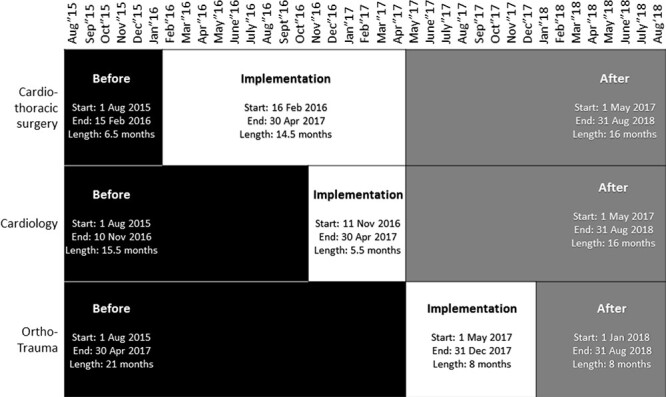
The Ban Bedcentricity innovation and implementation procedure were implemented at the cardiothoracic surgery, cardiology, and orthopedics-traumatology wards. Sedentary behavior data were collected 2 weeks before and after the implementation using behavioral observations and analyzed with Pearson chi-square. Length of hospital stay and discharge destination data were collected from all admitted patients and analyzed with multiple and logistic regression analyses.
Behavioral observations showed that in 52% of the observations, patients were lying in bed before implementation and 40% after implementation at the cardiothoracic surgery, 64% and 46% at the cardiology, and 53% and 57% at the orthopedics-traumatology wards, respectively. The mean length of hospital stay after implementation (compared with implementation before) was 5.1 days at the cardiothoracic surgery (n = 1923; mean = +0.13 days, 95% CI = -0.32 to 0.60), 2.6 days at the cardiology (n = 2646; mean = -0.22 days, 95% CI = -0.29 to -0.14), and 2.4 days at the orthopedics-traumatology wards (n = 1598; mean = +0.28 days, 95% CI = 0.06 to 0.50). After the implementation, more patients were discharged home from the cardiothoracic surgery (odds ratio [OR = 1.23], 95% CI = 1.07 to 1.37) and cardiology wards (OR = 1.37, 95% CI = 1.22 to 1.49), and no statistically significant difference was found at the orthopedics-traumatology ward (OR = 1.09, 95% CI = 0.88 to 1.27).
The results indicate beneficial outcomes after the implementation with less sedentary behavior and proportionately more patients being discharged home compared with before the implementation. However, little information is available about the adoption and fidelity of Ban Bedcentricity; therefore, outcomes should be interpreted with caution.
This multifaceted innovation to reduce sedentary behavior of patients during the hospital stay seems to be promising, with outcomes indicating less sedentary behavior in patients and more patients being discharged home after the implementation.
We introduced Ban Bedcentricity, an intervention to reduce the amount of time patients lie in the hospital bed during their hospitalization. This study shows that after the introduction of Ban Bedcentricity, patients lie in bed less and are more often discharged home.
本研究旨在探讨在病房层面实施“反卧床中心化”前后患者的卧床行为、住院时间和出院去向的差异。
在心胸外科、心内科和骨科-创伤科实施“反卧床中心化”创新和实施程序。在实施前后使用行为观察收集卧床行为数据,并进行皮尔逊卡方分析。收集所有入院患者的住院时间和出院去向数据,并进行多变量和逻辑回归分析。
行为观察显示,在心胸外科,实施前有 52%的观察中患者卧床,实施后有 40%卧床;在心内科,实施前有 64%的观察中患者卧床,实施后有 46%卧床;在骨科-创伤科,实施前有 53%的观察中患者卧床,实施后有 57%卧床。心胸外科实施后(与实施前相比)的平均住院时间为 5.1 天(n=1923;均值=+0.13 天,95%CI=-0.32 至 0.60),心内科为 2.6 天(n=2646;均值=-0.22 天,95%CI=-0.29 至-0.14),骨科-创伤科为 2.4 天(n=1598;均值=+0.28 天,95%CI=0.06 至 0.50)。实施后,心胸外科(比值比[OR]=1.23,95%CI=1.07 至 1.37)和心内科(OR=1.37,95%CI=1.22 至 1.49)出院回家的患者比例更高,而骨科-创伤科无显著差异(OR=1.09,95%CI=0.88 至 1.27)。
结果表明,与实施前相比,实施后患者卧床行为减少,出院回家的患者比例增加,这表明实施后有有益的结果。然而,关于“反卧床中心化”的采用和忠实度的信息有限,因此,结果应谨慎解读。
这种减少患者住院期间卧床时间的多方面创新似乎很有前景,结果表明患者卧床时间减少,实施后更多患者出院回家。
我们引入了“反卧床中心化”,这是一种干预措施,旨在减少患者住院期间卧床的时间。本研究表明,引入“反卧床中心化”后,患者卧床时间减少,出院回家的患者增多。