Seah Jowy Yi Hoong, Chew Wee Siong, Torta Federico, Khoo Chin Meng, Wenk Markus R, Herr Deron R, Tai E Shyong, van Dam Rob M
Saw Swee Hock School of Public Health, National University of Singapore (NUS), Singapore 117549, Singapore.
NUS Graduate School for Integrative Sciences and Engineering, NUS, Singapore 119077, Singapore.
Metabolites. 2021 Feb 8;11(2):93. doi: 10.3390/metabo11020093.
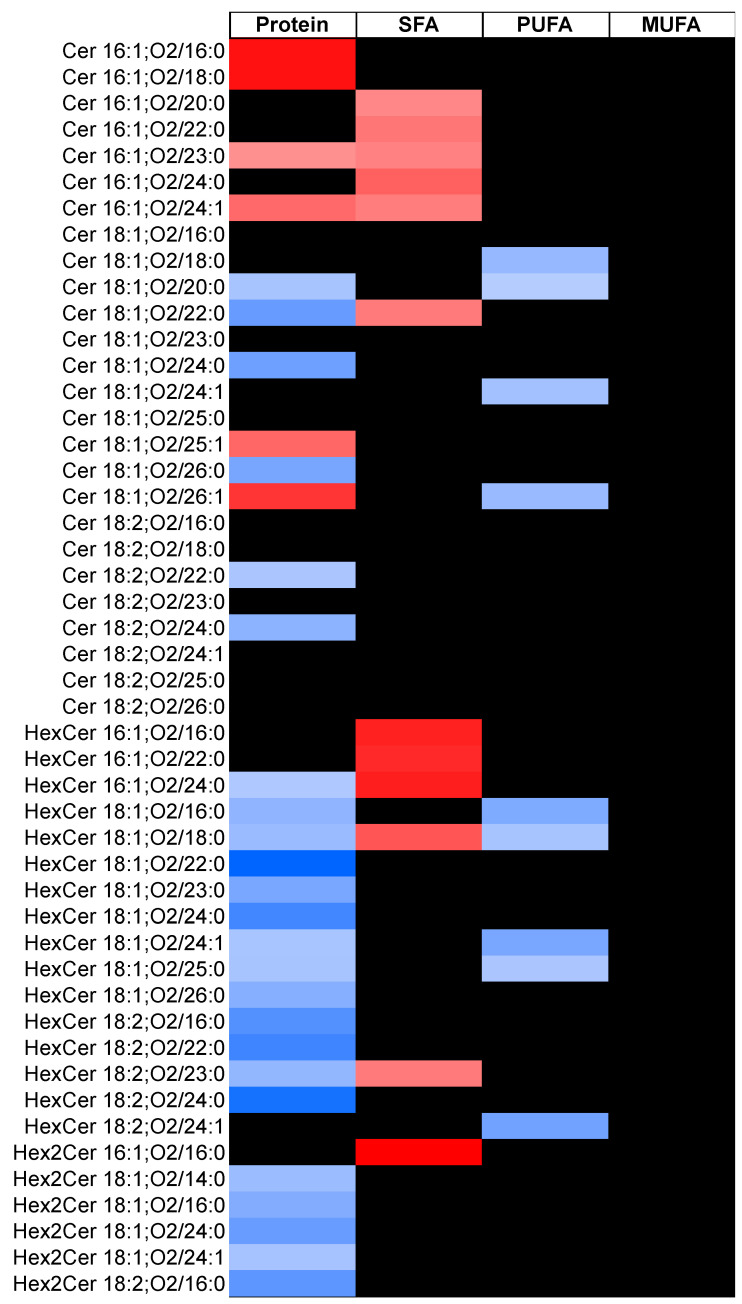
Sphingolipid concentrations have been associated with risk of type 2 diabetes and cardiovascular diseases. Because sphingolipids can be synthesized de novo from saturated fatty acids (SFA), dietary fatty acids may affect plasma sphingolipid concentrations. We aimed to evaluate dietary fat and protein intakes in relation to circulating sphingolipid levels. We used cross-sectional data from 2860 ethnic Chinese Singaporeans collected from 2004-2007. Nutrient intakes were estimated on the basis of a validated 159-item food frequency questionnaire. We quantified 79 molecularly distinct sphingolipids in a large-scale lipidomic evaluation from plasma samples. Higher saturated fat intake was associated with higher concentrations of 16:1;O2 sphingolipids including ceramides, monohexosylcermides, dihexosylceramides, sphingomyelins, and sphingosine 1-phosphates. Higher polyunsaturated fat intake was associated with lower plasma long-chain ceramides and long-chain monohexosylcermide concentrations. Protein intake was inversely associated with concentrations of most subclasses of sphingolipids, with the exception of sphingolipids containing a 16:1;O2 sphingoid base. Lower intake of saturated fat and higher intake of polyunsaturated fat and protein may decrease plasma concentrations of several sphingolipid classes. These findings may represent a novel biological mechanism for the impact of nutrient intakes on cardio-metabolic health.
鞘脂浓度与2型糖尿病和心血管疾病的风险相关。由于鞘脂可由饱和脂肪酸(SFA)从头合成,膳食脂肪酸可能会影响血浆鞘脂浓度。我们旨在评估膳食脂肪和蛋白质摄入量与循环鞘脂水平之间的关系。我们使用了2004年至2007年收集的2860名新加坡华裔的横断面数据。营养摄入量是根据一份经过验证的包含159个条目的食物频率问卷估算的。我们在对血浆样本进行的大规模脂质组学评估中对79种分子结构不同的鞘脂进行了定量分析。较高的饱和脂肪摄入量与16:1;O2鞘脂浓度升高有关,这些鞘脂包括神经酰胺、单己糖神经酰胺、二己糖神经酰胺、鞘磷脂和鞘氨醇1-磷酸。较高的多不饱和脂肪摄入量与较低的血浆长链神经酰胺和长链单己糖神经酰胺浓度有关。蛋白质摄入量与大多数鞘脂亚类的浓度呈负相关,但含16:1;O2鞘氨醇碱基的鞘脂除外。较低的饱和脂肪摄入量、较高的多不饱和脂肪和蛋白质摄入量可能会降低几种鞘脂类别的血浆浓度。这些发现可能代表了营养摄入对心脏代谢健康影响的一种新的生物学机制。