Tran Dan B, Owyang Ashley, Hwang Jin, Potvin Richard
Coastal Vision Medical Group, Orange, CA, USA.
Science in Vision, Bend, OR, USA.
Clin Ophthalmol. 2021 Feb 3;15:403-412. doi: 10.2147/OPTH.S295503. eCollection 2021.
To evaluate the visual acuity, quality of vision and patient reported outcomes for patients that were either bilaterally implanted with a trifocal intraocular lens (IOL) or an extended depth of focus (EDOF) IOL.
Single site, prospective, non-interventional, masked, two-arm comparative study.
Subjects who had prior uncomplicated cataract surgery with bilateral implantation of one of the lenses above were evaluated. Subjects in each group were assessed during a single visit. The uncorrected and best distance-corrected binocular near (40 cm), intermediate (60 cm), and distance visual acuity (VA) were measured, along with a spectacle independence questionnaire, a quality of vision questionnaire and contrast sensitivity measured in both mesopic and photopic conditions.
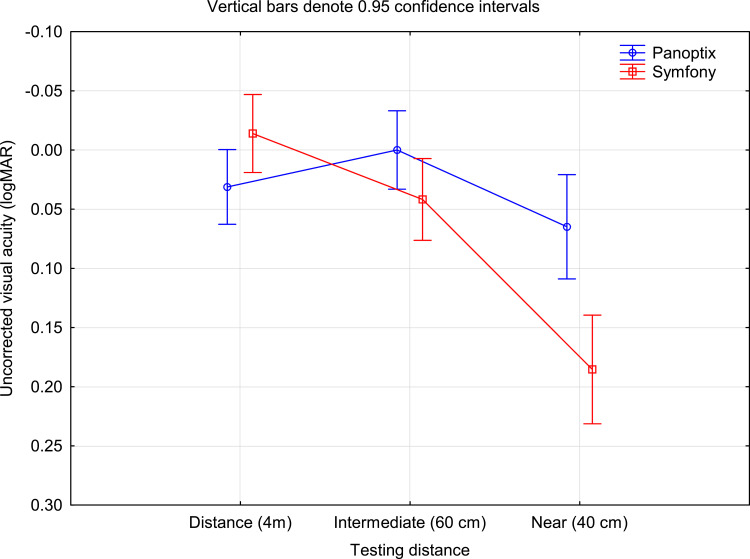
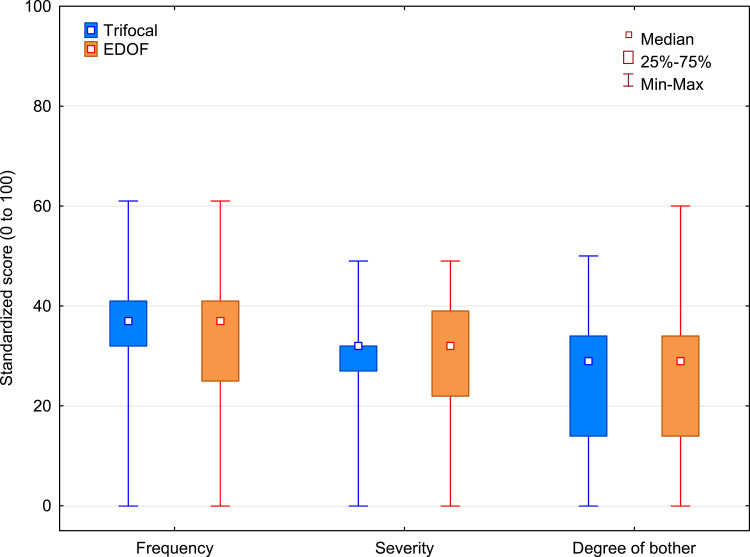
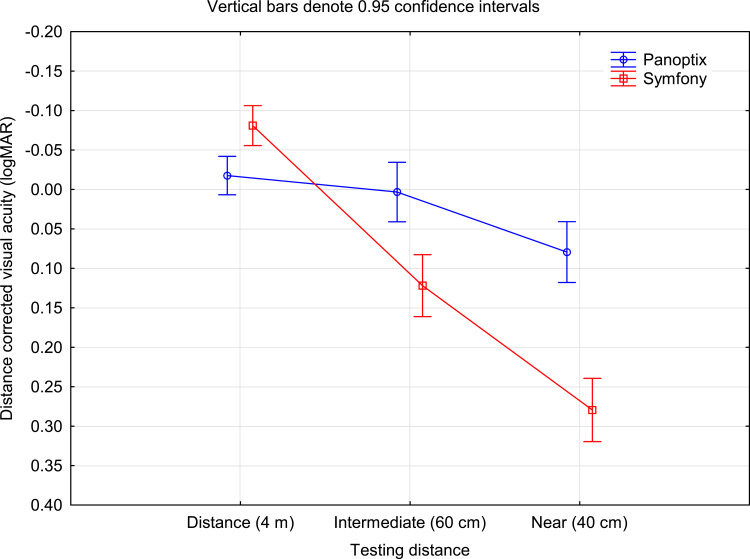
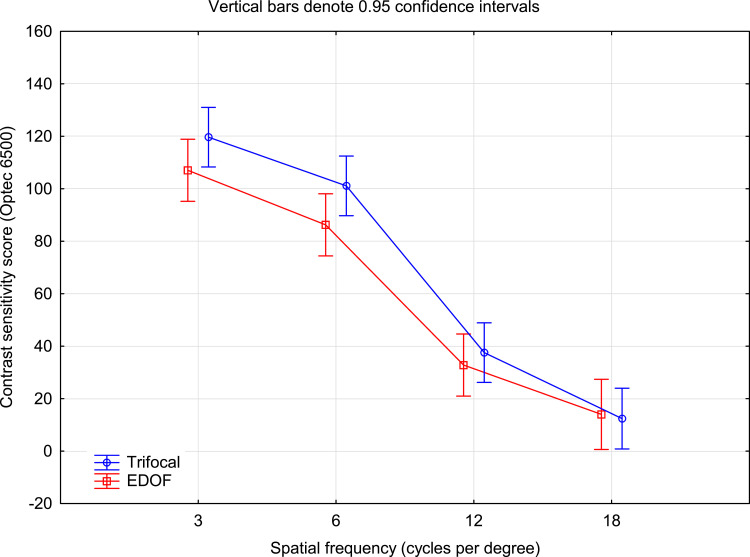
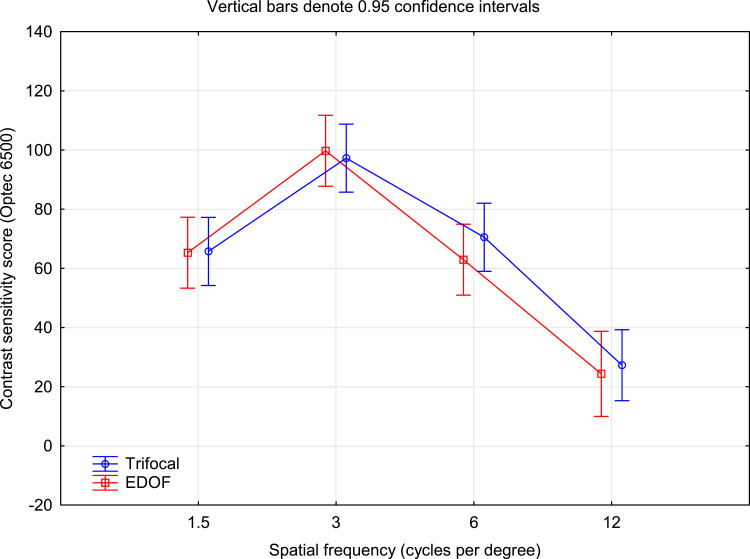
The study included 23 EDOF and 25 trifocal subjects. Binocular Uncorrected VAs were similar at distance and intermediate, but about 1.5 lines better at near with the trifocal (p < 0.001). Binocular best corrected distance - VA was significantly better with the EDOF lens (0.5 lines, p < 0.001), though the mean VA was better than 20/20 in both groups. Distance-corrected intermediate and near VA were significantly better with the trifocal IOL (1 line and 1.5 lines respectively, p < 0.001). Significantly more trifocal subjects had 20/25 or better VA at all three test distances (64% vs 4%, p<0.001). Patient reported spectacle independence was significantly higher in the trifocal group, driven primarily by differences in near vision. Mesopic and photopic binocular contrast sensitivity, satisfaction and subjective quality of vision scores were similar between groups.
The trifocal IOL provided significantly better near vision (1.5 lines) with slightly worse distance vision (0.5 lines), while providing similar contrast sensitivity and visual quality. It may be the preferred choice for patients desiring more spectacle independence.
评估双侧植入三焦点人工晶状体(IOL)或扩展景深(EDOF)IOL的患者的视力、视觉质量及患者报告的结局。
单中心、前瞻性、非干预性、盲法、双臂对照研究。
对既往进行过无并发症白内障手术且双侧植入上述其中一种晶状体的受试者进行评估。每组受试者在单次就诊时接受评估。测量未矫正及最佳距离矫正的双眼近视力(40cm)、中视力(60cm)和远视力(VA),同时进行一份不依赖眼镜问卷、一份视觉质量问卷以及在暗光和明视条件下测量的对比敏感度。
该研究纳入了23例EDOF受试者和25例三焦点受试者。双眼未矫正远视力和中视力相似,但三焦点组的双眼未矫正近视力要好约1.5行(p<0.001)。使用EDOF晶状体时,双眼最佳矫正远视力显著更好(0.5行,p<0.001),不过两组的平均视力均优于20/20。三焦点IOL矫正距离后的中视力和近视力显著更好(分别为1行和1.5行,p<0.001)。在所有三个测试距离(64%对4%,p<0.001),显著更多的三焦点受试者的视力达到20/25或更好。患者报告的不依赖眼镜程度在三焦点组显著更高,主要由近视力差异所致。两组间暗光和明视双眼对比敏感度、满意度及主观视觉质量评分相似。
三焦点IOL提供了显著更好的近视力(1.5行),远视力稍差(0.5行),同时提供了相似的对比敏感度和视觉质量。对于希望更不依赖眼镜的患者而言,它可能是首选。