Wang Ya-Nan, Hammers Christoph M, Mao Xuming, Jin Hong-Zhong, Yuan Jing, Li Li
Department of Dermatology, Peking Union Medical College Hospital, Chinese Academy of Medical Sciences & Peking Union Medical College, Beijing, China.
Department of Dermatology, University of Luebeck, Luebeck, Germany.
Ann Transl Med. 2021 Jan;9(2):107. doi: 10.21037/atm-20-5343.
Current epidemiological studies suggest a significant correlation between Alzheimer's disease (AD) and bullous pemphigoid (BP). However, the autoimmune response against BP180 in patients with AD has not been fully understood. investigated.
We randomly enrolled 48 patients with AD and 50 sex- and age-matched healthy controls. We detected the presence/absence and the level of anti-BP180/BP230 immunoglobulin G (IgG) autoantibodies in the patients' serum to determine whether said antibodies possess reactivity against the BP180 protein in the human brain and skin.
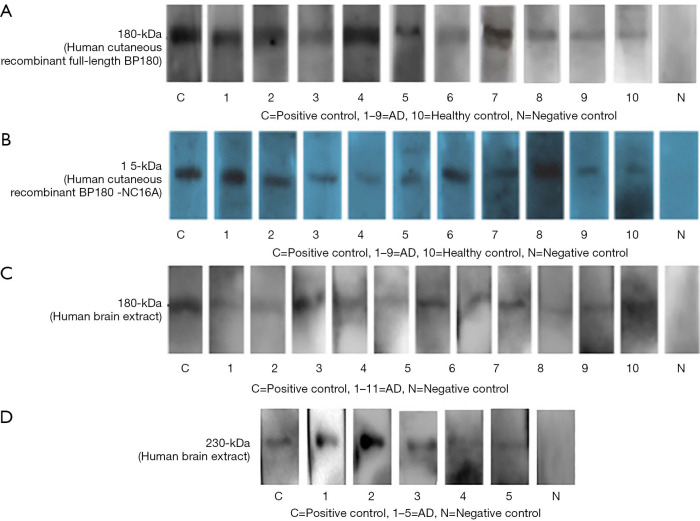
The enzyme-linked immunosorbent assay (ELISA) results revealed that the positive rate of anti-BP180 autoantibodies in patients with AD (23/48, 47.9%) was significantly higher than that in controls (4/50, 8.0%; P<0.0001). These ELISA-positive patients were further examined through immunoblotting. Sera from nine patients with AD (9/23, 39.1%) and one control (1/4, 25.0%) reacted with human cutaneous recombinant full-length BP180 and BP180-noncollagenous 16A (NC16A). Sera from 11 (11/23, 47.8%) patients with AD reacted with a 180-kDa protein from the human brain extract, but none of the controls' sera recognized the corresponding protein band. The majority of the patients in the anti-BP180-positive AD group were men (14/23, 60.9%) who were older (74.0 years) compared with those in the control group (6/25, 24.0%; P<0.05) (72.2 years; P<0.01).
Anti-BP180 autoantibodies are present in AD and recognize human recombinant full-length BP180 and a 180-kDa protein from the human brain extract, suggesting that BP180 is a shared autoantigen in AD and BP and may help clarify the mechanism to explain why a high risk of BP exists in AD. Elderly male patients with AD are significantly more likely to develop BP180 serum autoreactivity compared with other patients with AD.
目前的流行病学研究表明,阿尔茨海默病(AD)与大疱性类天疱疮(BP)之间存在显著相关性。然而,AD患者针对BP180的自身免疫反应尚未完全明确。
我们随机招募了48例AD患者和50例年龄及性别匹配的健康对照。我们检测了患者血清中抗BP180/BP230免疫球蛋白G(IgG)自身抗体的有无及水平,以确定这些抗体是否与人脑和皮肤中的BP180蛋白具有反应性。
酶联免疫吸附测定(ELISA)结果显示,AD患者中抗BP180自身抗体的阳性率(23/48,47.9%)显著高于对照组(4/50,8.0%;P<0.0001)。对这些ELISA阳性患者进一步进行免疫印迹检测。9例AD患者(9/23,39.1%)和1例对照(1/4,25.0%)的血清与人皮肤重组全长BP180和BP180非胶原16A(NC16A)发生反应。11例(11/23,47.8%)AD患者的血清与人脑提取物中的一种180 kDa蛋白发生反应,但对照组血清均未识别出相应的蛋白条带。抗BP180阳性AD组中的大多数患者为男性(14/23,60.9%),年龄(74.0岁)大于对照组(6/25,24.0%;P<0.05)(72.2岁;P<0.01)。
AD患者体内存在抗BP180自身抗体,且能识别重组人全长BP180和人脑提取物中的一种180 kDa蛋白,这表明BP180是AD和BP中的共同自身抗原,可能有助于阐明AD患者发生BP风险较高的机制。与其他AD患者相比,老年男性AD患者发生BP180血清自身反应性的可能性显著更高。