James Kieran D, Legler Daniel F, Purvanov Vladimir, Ohigashi Izumi, Takahama Yousuke, Parnell Sonia M, White Andrea J, Jenkinson William E, Anderson Graham
Institute of Immunology and Immunotherapy, University of Birmingham, Birmingham, United Kingdom.
Biotechnology Institute Thurgau, University of Konstanz, Kreuzlingen, Switzerland.
Blood Adv. 2021 Jan 12;5(1):99-112. doi: 10.1182/bloodadvances.2020003192.
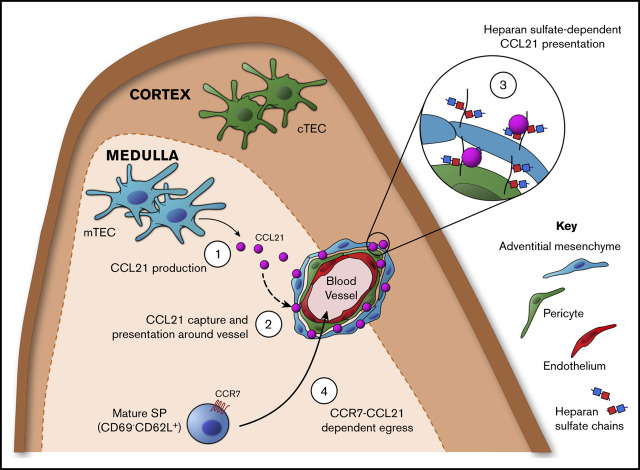
The release of newly selected αβT cells from the thymus is key in establishing a functional adaptive immune system. Emigration of the first cohorts of αβT cells produced during the neonatal period is of particular importance, because it initiates formation of the peripheral αβT-cell pool and provides immune protection early in life. Despite this, the cellular and molecular mechanisms of thymus emigration are poorly understood. We examined the involvement of diverse stromal subsets and individual chemokine ligands in this process. First, we demonstrated functional dichotomy in the requirement for CCR7 ligands and identified CCL21, but not CCL19, as an important regulator of neonatal thymus emigration. To explain this ligand-specific requirement, we examined sites of CCL21 production and action and found Ccl21 gene expression and CCL21 protein distribution occurred within anatomically distinct thymic areas. Although Ccl21 transcription was limited to subsets of medullary epithelium, CCL21 protein was captured by mesenchymal stroma consisting of integrin α7+ pericytes and CD34+ adventitial cells at sites of thymic exit. This chemokine compartmentalization involved the heparan sulfate-dependent presentation of CCL21 via its C-terminal extension, explaining the absence of a requirement for CCL19, which lacks this domain and failed to be captured by thymic stroma. Collectively, we identified an important role for CCL21 in neonatal thymus emigration, revealing the importance of this chemokine in initial formation of the peripheral immune system. Moreover, we identified an intrathymic mechanism involving cell-specific production and presentation of CCL21, which demonstrated a functional synergy between thymic epithelial and mesenchymal cells for αβT-cell emigration.
从胸腺释放新选择的αβT细胞是建立功能性适应性免疫系统的关键。新生儿期产生的首批αβT细胞的迁出尤为重要,因为它启动了外周αβT细胞库的形成,并在生命早期提供免疫保护。尽管如此,胸腺迁出的细胞和分子机制仍知之甚少。我们研究了不同的基质亚群和单个趋化因子配体在此过程中的作用。首先,我们证明了CCR7配体需求的功能二分法,并确定CCL21而非CCL19是新生儿胸腺迁出的重要调节因子。为了解释这种配体特异性需求,我们研究了CCL21产生和作用的位点,发现Ccl21基因表达和CCL21蛋白分布发生在解剖学上不同的胸腺区域。虽然Ccl21转录仅限于髓质上皮亚群,但CCL21蛋白在胸腺出口处被由整合素α7 +周细胞和CD34 +外膜细胞组成的间充质基质捕获。这种趋化因子的区室化涉及通过其C末端延伸以硫酸乙酰肝素依赖性方式呈递CCL21,这解释了对缺乏该结构域且未能被胸腺基质捕获的CCL19没有需求的原因。总的来说,我们确定了CCL21在新生儿胸腺迁出中的重要作用,揭示了这种趋化因子在周围免疫系统初始形成中的重要性。此外,我们确定了一种胸腺内机制,涉及CCL21的细胞特异性产生和呈递,这证明了胸腺上皮细胞和间充质细胞在αβT细胞迁出方面的功能协同作用。