Center for Synaptic Neuroscience and Technology (NSYN@UniGe), Istituto Italiano di Tecnologia, Largo Rosanna Benzi, 10, 16132 Genova, Italy.
Department of Experimental Medicine, Università degli Studi di Genova, Viale Benedetto XV, 3, 16132 Genova, Italy.
J Chem Inf Model. 2021 Mar 22;61(3):1354-1367. doi: 10.1021/acs.jcim.0c01407. Epub 2021 Feb 11.
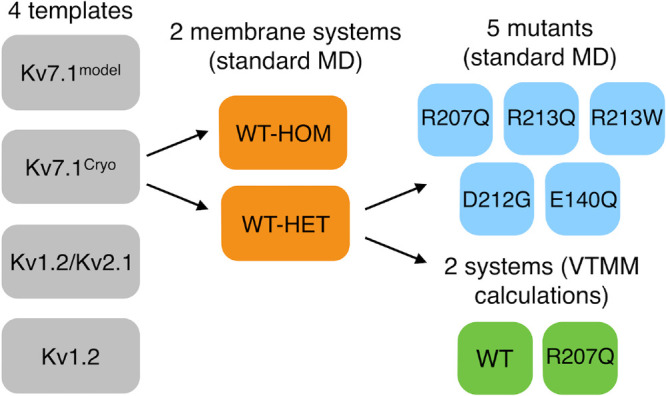
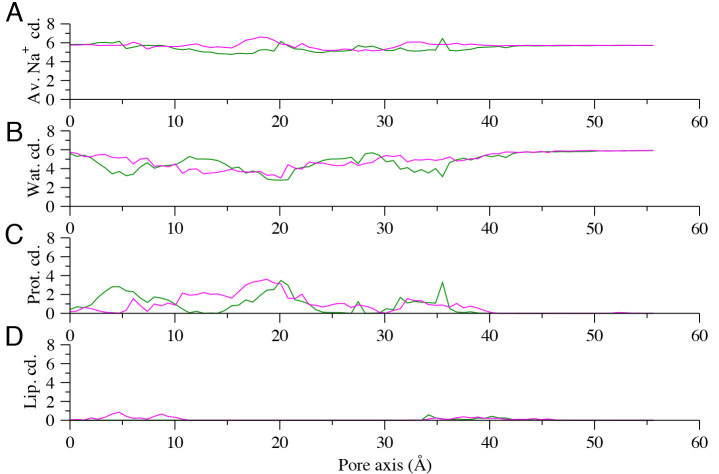
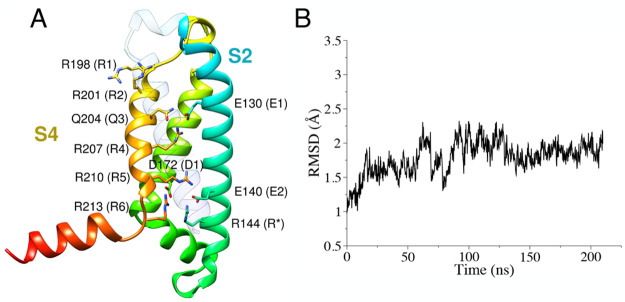
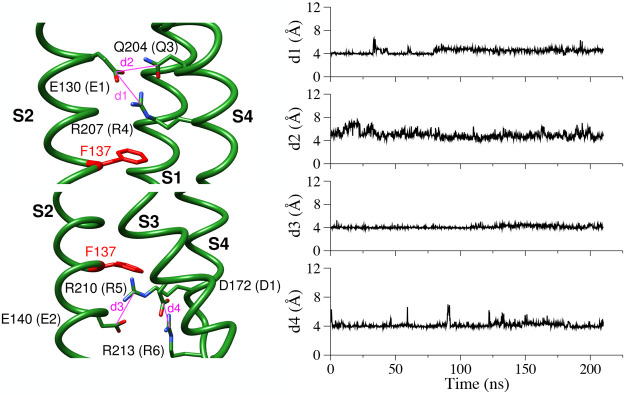
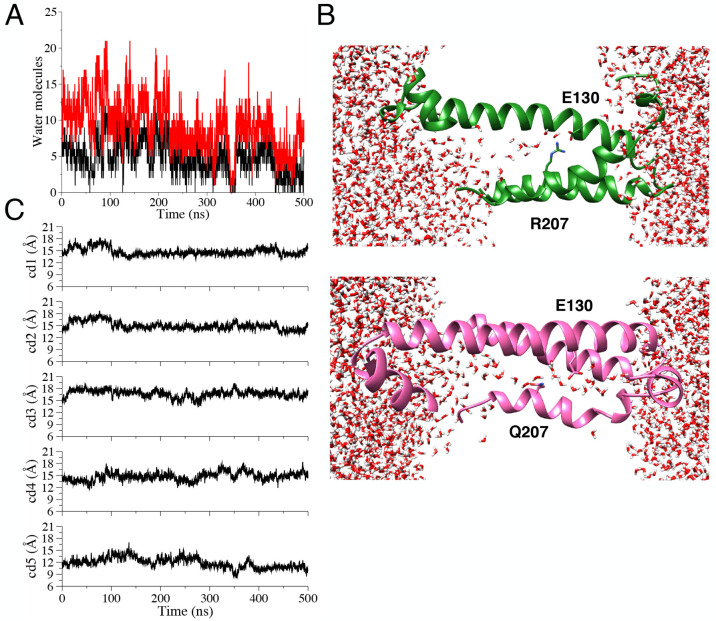
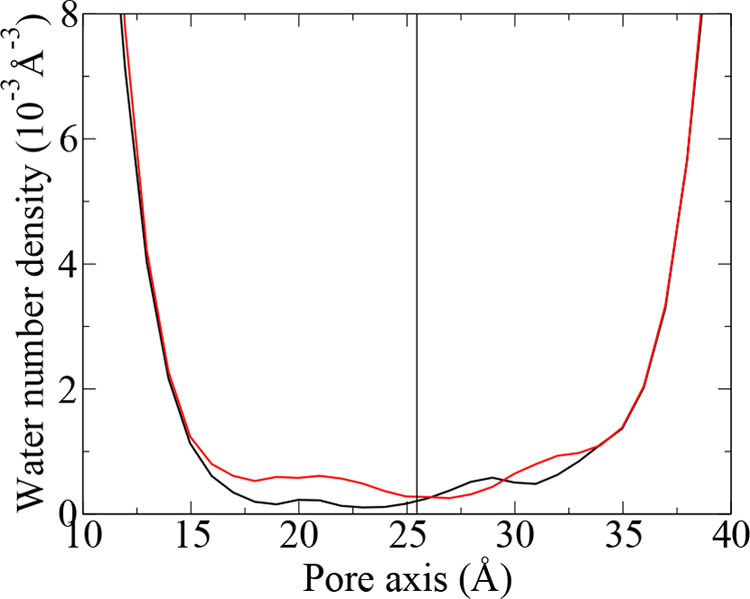
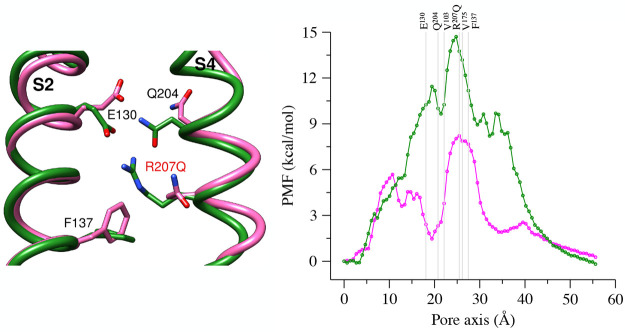
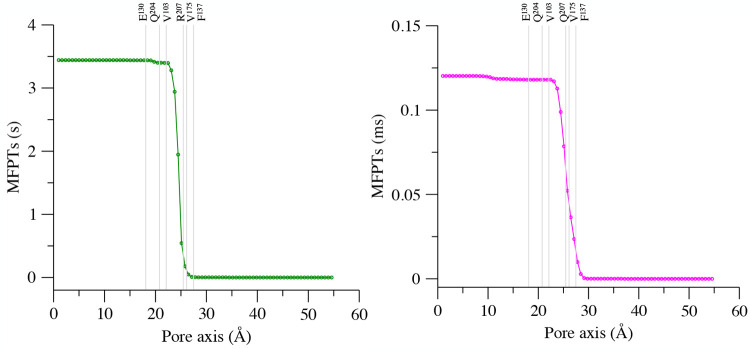
Activation of voltage-gated ion channels is regulated by conformational changes of the voltage sensor domains (VSDs), four water- and ion-impermeable modules peripheral to the central, permeable pore domain. Anomalous currents, defined as ω-currents, have been recorded in response to mutations of residues on the VSD S4 helix and associated with ion fluxes through the VSDs. In humans, gene defects in the potassium channel Kv7.2 result in a broad range of epileptic disorders, from benign neonatal seizures to severe epileptic encephalopathies. Experimental evidence suggests that the R207Q mutation in S4, associated with peripheral nerve hyperexcitability, induces ω-currents at depolarized potentials, but the fine structural details are still elusive. In this work, we use atom-detailed molecular dynamics simulations and a refined model structure of the Kv7.2 VSD in the active conformation in a membrane/water environment to study the effect of R207Q and four additional mutations of proven clinical importance. Our results demonstrate that the R207Q mutant shows the most pronounced increase of hydration in the internal VSD cavity, a feature favoring the occurrence of ω-currents. Free energy and kinetics calculations of sodium permeation through the native and mutated VSD indicate as more favorable the formation of a cationic current in the latter. Overall, our simulations establish a mechanistic linkage between genetic variations and their physiological outcome, by providing a computational description that includes both thermodynamic and kinetic features of ion permeation associated with ω-currents.
电压门控离子通道的激活受电压传感器域(VSD)构象变化的调节,VSD 是位于中央可渗透孔域周围的四个不透水和离子的模块。已经记录到异常电流,称为 ω 电流,这是对 VSD S4 螺旋上残基突变的反应,并与 VSD 中的离子通量有关。在人类中,钾通道 Kv7.2 的基因缺陷导致广泛的癫痫疾病,从良性新生儿癫痫到严重的癫痫性脑病。实验证据表明,与周围神经兴奋性过高相关的 S4 中的 R207Q 突变在去极化电位下诱导 ω 电流,但精细的结构细节仍难以捉摸。在这项工作中,我们使用原子细节的分子动力学模拟和在膜/水环境中处于激活构象的 Kv7.2 VSD 的改进模型结构来研究 R207Q 突变以及另外四个已证明具有临床重要性的突变的影响。我们的结果表明,R207Q 突变体显示出内部 VSD 腔中最显著的水合增加,这一特征有利于 ω 电流的发生。通过天然和突变 VSD 钠离子渗透的自由能和动力学计算表明,后者形成阳离子电流的可能性更大。总的来说,我们的模拟通过提供包括与 ω 电流相关的离子渗透的热力学和动力学特征的计算描述,在遗传变异与其生理结果之间建立了一种机制联系。