Peel Trisha N, Watson Eliza, Lee Sue J
Department of Infectious Diseases, Alfred Hospital and Central Clinical School, Monash University, 85 Commercial Road, Melbourne, VIC 3004, Australia.
J Clin Med. 2021 Feb 9;10(4):663. doi: 10.3390/jcm10040663.
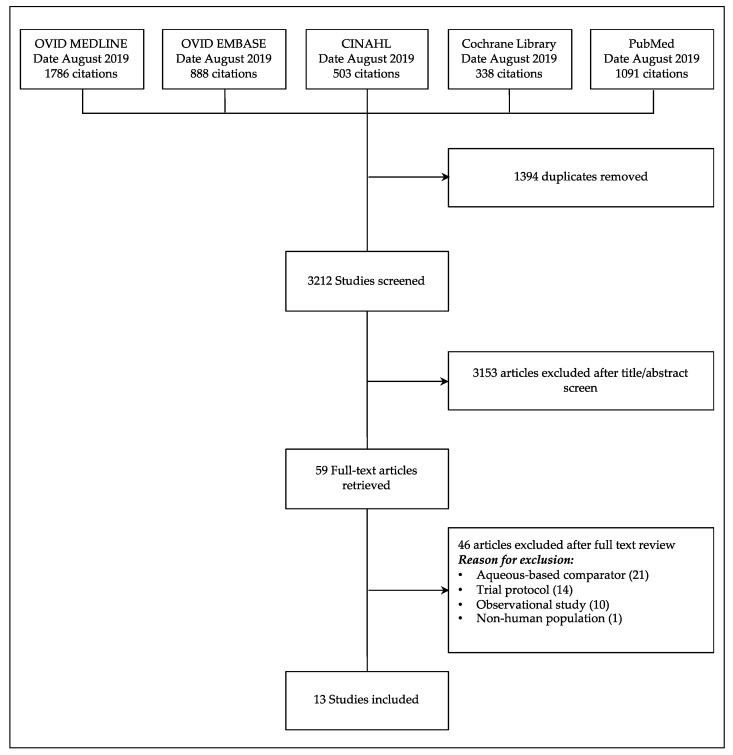
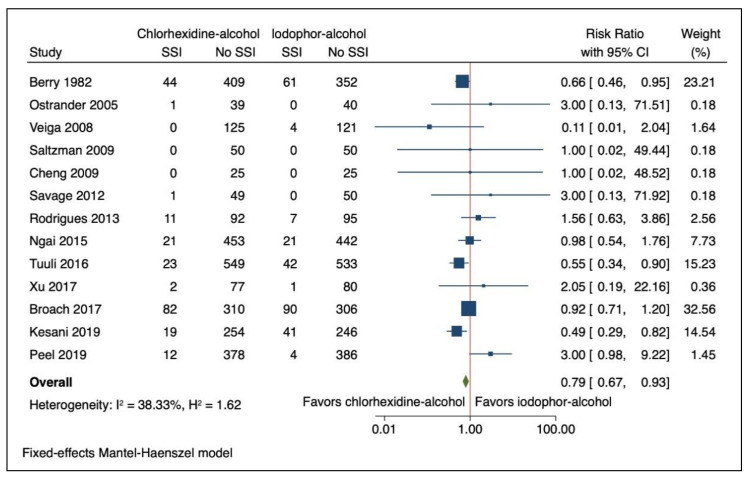
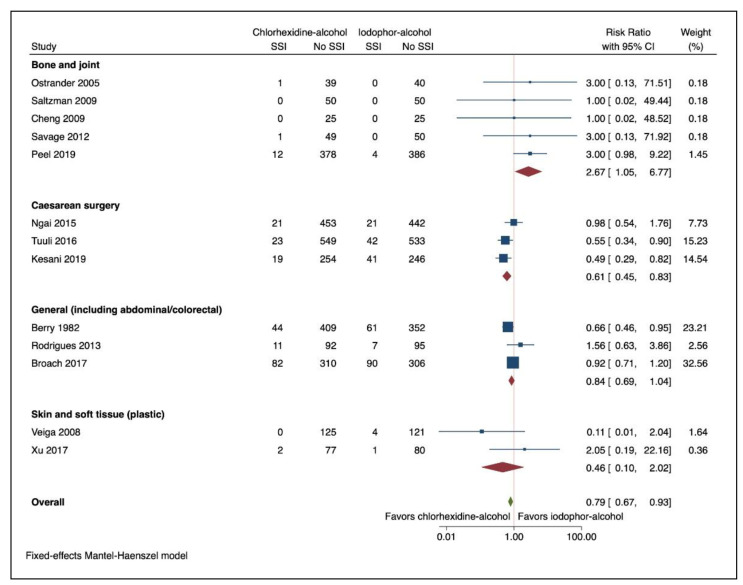
(1) Background: Surgical site skin preparation is an important approach to prevent postoperative wound infections. International guidelines recommend that alcohol-based combinations be used, however, the optimal combination remains uncertain. This study compares the effectiveness of alcohol-based chlorhexidine and alcohol-based iodophor for surgical site skin preparation for prevention of surgical site infections (SSIs). (2) Methods: Randomised controlled trials comparing alcohol-based interventions for surgical site skin preparation were included. The proportion of SSIs was compared using risk ratios (RR) with 95% confidence intervals (95% CI). The meta-analysis was performed with a fixed effect model using Mantel-Haenszel methods. As an a priori subgroup analysis SSI risk was examined according to different surgical procedural groups. (3) Results: Thirteen studies were included ( = 6023 participants). The use of chlorhexidine-alcohol was associated with a reduction in risk of SSIs compared with iodophor-alcohol (RR 0.790; 95% CI 0.669, 0.932). On sub-group analysis, chlorhexidine-alcohol was associated with a reduction in SSIs in caesarean surgery (RR 0.614; 95% CI 0.453, 0.831) however, chlorhexidine-alcohol was associated with an increased risk of SSI in bone and joint surgery (RR 2.667; 95% CI 1.051, 6.765). When excluding studies at high risk of bias on sensitivity analysis, this difference in alcohol-based combinations for bone and joint surgery was no longer observed (RR 2.636; 95% CI 0.995, 6.983). (4) Conclusions: The use of chlorhexidine-alcohol skin preparations was associated with a reduced risk of SSI compared to iodophor-alcohol agents. However, the efficacy of alcohol-based preparation agents may differ according to the surgical procedure group. This difference must be interpreted with caution given the low number of studies and potential for bias, however, it warrants further investigation into the potential biological and clinical validity of these findings.
(1)背景:手术部位皮肤准备是预防术后伤口感染的重要措施。国际指南推荐使用含酒精的复方制剂,然而,最佳组合仍不确定。本研究比较了含酒精的氯己定和含酒精的碘伏用于手术部位皮肤准备以预防手术部位感染(SSI)的效果。(2)方法:纳入比较含酒精干预措施用于手术部位皮肤准备的随机对照试验。使用风险比(RR)及95%置信区间(95%CI)比较SSI的比例。采用Mantel-Haenszel方法的固定效应模型进行荟萃分析。作为一项预先设定的亚组分析,根据不同手术程序组检查SSI风险。(3)结果:纳入13项研究(n = 6023名参与者)。与碘伏酒精制剂相比,使用氯己定酒精制剂可降低SSI风险(RR 0.790;95%CI 0.669,0.932)。在亚组分析中,氯己定酒精制剂与剖宫产手术中SSI的减少相关(RR 0.614;95%CI 0.453,0.831),然而,氯己定酒精制剂与骨与关节手术中SSI风险增加相关(RR 2.667;95%CI 1.051,6.765)。在敏感性分析中排除存在高偏倚风险的研究时,不再观察到骨与关节手术中含酒精复方制剂的这种差异(RR 2.636;95%CI 0.995,6.983)。(4)结论:与碘伏酒精制剂相比,使用氯己定酒精皮肤制剂可降低SSI风险。然而,含酒精制剂的疗效可能因手术程序组而异。鉴于研究数量较少和存在偏倚的可能性,必须谨慎解释这种差异,不过,这值得对这些发现的潜在生物学和临床有效性进行进一步研究。