Health Research Institute of Santiago de Compostela (IDIS), University Hospital of Santiago de Compostela-CHUS, 15706 Santiago de Compostela, Spain.
CLINURSID Research Group, Psychiatry, Radiology, Public Health, Nursing and Medicine Department, Universidade de Santiago de Compostela, 15782 Santiago de Compostela, Spain.
Int J Environ Res Public Health. 2021 Feb 9;18(4):1652. doi: 10.3390/ijerph18041652.
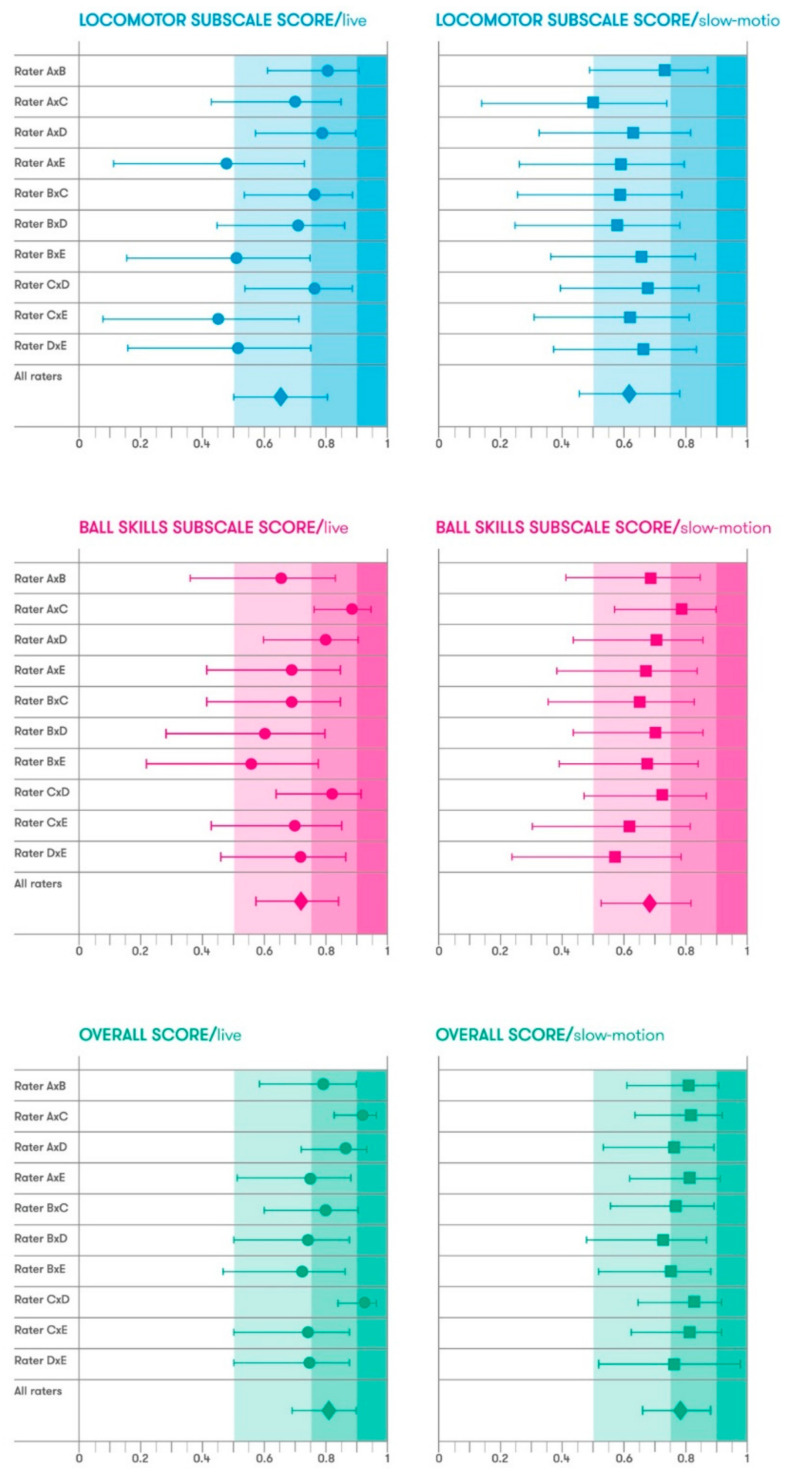
The Test of Gross Motor Development (TGMD) is one of the most common tools for assessing the fundamental movement skills (FMS) in children between 3 and 10 years. This study aimed to examine the intra-rater and inter-rater reliability of the TGMD-3rd Edition (TGMD-3) between expert and novice raters using live and video assessment. Five raters [2 experts and 3 novices (one of them BSc in Physical Education and Sport Science)] assessed and scored the performance of the TGMD-3 of 25 healthy children [Female: 60%; mean (standard deviation) age 9.16 (1.31)]. Schoolchildren were attending at one public elementary school during the academic year 2019-2020 from Santiago de Compostela (Spain). Raters scored each children performance through two viewing moods (live and slow-motion). The ICC (Intraclass Correlation Coefficient) was used to determine the agreement between raters. Our results showed moderate-to-excellent intra-rater reliability for overall score and locomotor and ball skills subscales; moderate-to-good inter-rater reliability for overall and ball skills; and poor-to-good for locomotor subscale. Higher intra-rater reliability was achieved by the expert raters and novice rater with physical education background compared to novice raters. However, the inter-rater reliability was more variable in all the raters regardless of their experience or background. No significant differences in reliability were found when comparing live and video assessments. For clinical practice, it would be recommended that raters reach an agreement before the assessment to avoid subjective interpretations that might distort the results.
粗大运动发育测试(TGMD)是评估 3 至 10 岁儿童基本运动技能(FMS)的最常用工具之一。本研究旨在使用实时和视频评估,检验专家和新手评估者在 TGMD-3 版(TGMD-3)中的组内和组间可靠性。5 名评估者[2 名专家和 3 名新手(其中 1 名为体育教育与运动科学学士)]评估并记录了 25 名健康儿童的 TGMD-3 表现[女性:60%;平均(标准差)年龄 9.16(1.31)]。学生在 2019-2020 学年期间在圣地亚哥德孔波斯特拉(西班牙)的一所公立小学上学。评估者通过两种观看模式(实时和慢动作)对每个孩子的表现进行评分。ICC(组内相关系数)用于确定评估者之间的一致性。我们的结果表明,在总体得分和移动技能与球技子量表方面,评估者的组内可靠性为中等至优秀;在总体得分和球技子量表方面,评估者的组间可靠性为中等至良好;在移动技能子量表方面,评估者的组间可靠性为较差至良好。与新手评估者相比,专家评估者和具有体育教育背景的新手评估者的组内可靠性更高。然而,所有评估者的组间可靠性差异更大,无论其经验或背景如何。在比较实时和视频评估时,没有发现可靠性存在显著差异。在临床实践中,建议评估者在评估前达成一致,以避免可能扭曲结果的主观解释。