Molecular Biology Group, FemPharma, LLC, Debrecen, Hungary.
Department of Obstetrics and Gynecology, Faculty of Medicine, University of Debrecen, Debrecen, Hungary.
BMC Womens Health. 2021 Feb 11;21(1):62. doi: 10.1186/s12905-021-01215-6.
Zinc and copper are essential trace elements and play a crucial role in the homeostasis of connective tissues. In this study, we aimed to define zinc and copper levels in the vaginal tissue and establish whether a correlation exists between the zinc and copper levels either or both in whole blood or vaginal tissue samples and whether the finding correlates with the age of the patient or at least with her menopausal status.
We collected whole blood and vaginal tissue samples from 32 women and measured their zinc and copper levels by inductively coupled plasma optical emission spectrometry. We have performed Student's t test to evaluate the differences in the mean levels of trace elements and multiple regression to evaluate the association between vaginal tissue zinc/copper levels and age, menopausal status, number of vaginal deliveries, and zinc/copper blood levels.
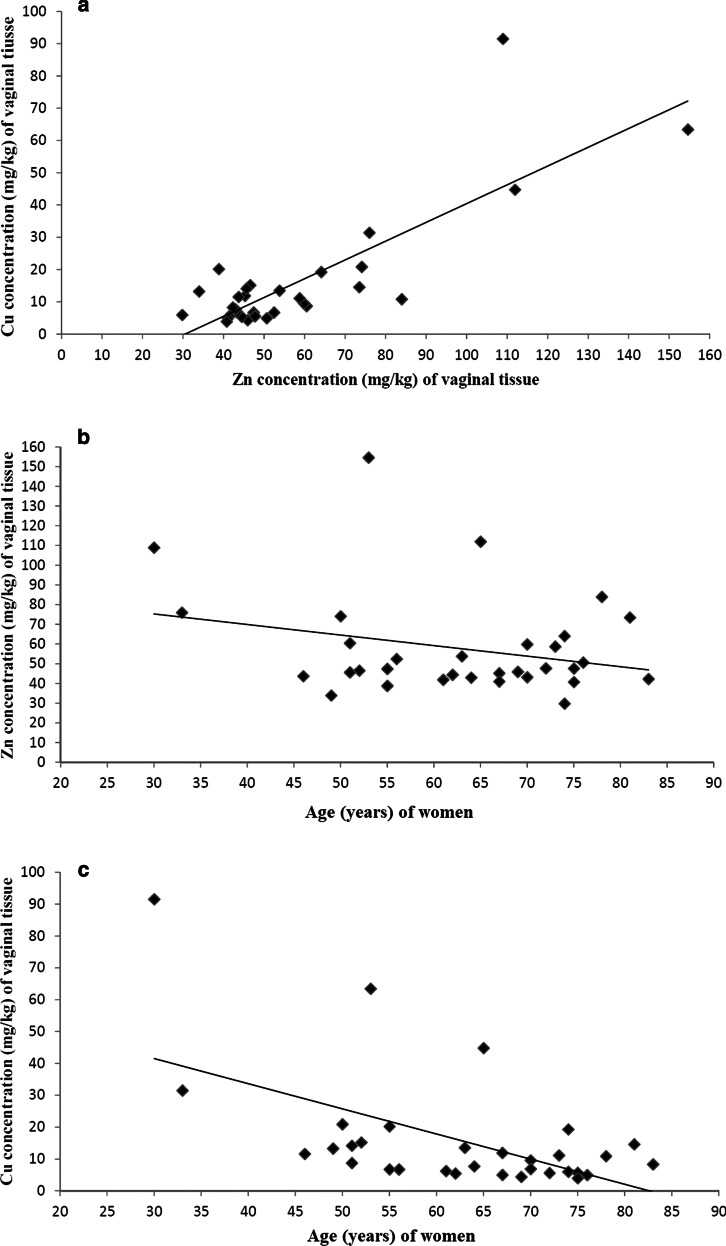
Zinc levels were significantly higher in both the vaginal tissues and whole blood samples than copper levels (p < 0.01). In the vaginal tissue samples, a strong positive correlation could be detected between zinc and copper levels (r = 0.82, p < 0.01). In the vaginal tissue, a negative correlation was found for zinc and copper levels with the age of women (r = - 0.27, p = 0.04 and r = - 0.56, p < 0.01). Multiple linear regression model (age, menopausal status, vaginal delivery and copper/zinc blood levels) showed that only age remained a significant predictor for zinc and copper vaginal tissues levels (p = 0.03, 95% CI - 2.28 to - 0.06; p = 0.004, 95% CI - 1.76 to - 0.34).
Zinc and copper levels in the vaginal tissue decline with age. Out of the examined variables (age, menopausal status, vaginal delivery, and copper/zinc levels), only age is a significant predictor of vaginal zinc/copper levels.
锌和铜是必需的微量元素,在结缔组织的动态平衡中起着关键作用。在这项研究中,我们旨在确定阴道组织中的锌和铜水平,并确定全血或阴道组织样本中的锌和铜水平之间是否存在相关性,以及这种相关性是否与患者的年龄或至少与她的绝经状态相关。
我们收集了 32 名女性的全血和阴道组织样本,并通过电感耦合等离子体发射光谱法测量了她们的锌和铜水平。我们进行了学生 t 检验,以评估微量元素平均水平的差异,并进行多元回归分析,以评估阴道组织中锌/铜水平与年龄、绝经状态、阴道分娩次数以及锌/铜的血液水平之间的关系。
锌水平在阴道组织和全血样本中均明显高于铜水平(p<0.01)。在阴道组织样本中,锌和铜水平之间存在很强的正相关(r=0.82,p<0.01)。在阴道组织中,锌和铜水平与女性年龄呈负相关(r=-0.27,p=0.04 和 r=-0.56,p<0.01)。多元线性回归模型(年龄、绝经状态、阴道分娩和铜/锌的血液水平)显示,只有年龄仍然是阴道组织中锌和铜水平的显著预测因子(p=0.03,95%置信区间-2.28 至-0.06;p=0.004,95%置信区间-1.76 至-0.34)。
阴道组织中的锌和铜水平随年龄增长而下降。在所检查的变量(年龄、绝经状态、阴道分娩和铜/锌水平)中,只有年龄是阴道锌/铜水平的显著预测因子。