Chen Jiahong, Huang Yaqiang, Tang Zhenfeng, Li Maozhang, Ling Xiaohui, Liao Jinxian, Zhou Xiaobo, Fang Shumin, Zhao Haibo, Zhong Weide, Yuan Xia
Department of Urology, Huizhou Municipal Central Hospital, Huizhou, China.
Department of Urology, Zhongshan City People's Hospital, Zhongshan, China.
Front Cell Dev Biol. 2021 Jan 26;8:616332. doi: 10.3389/fcell.2020.616332. eCollection 2020.
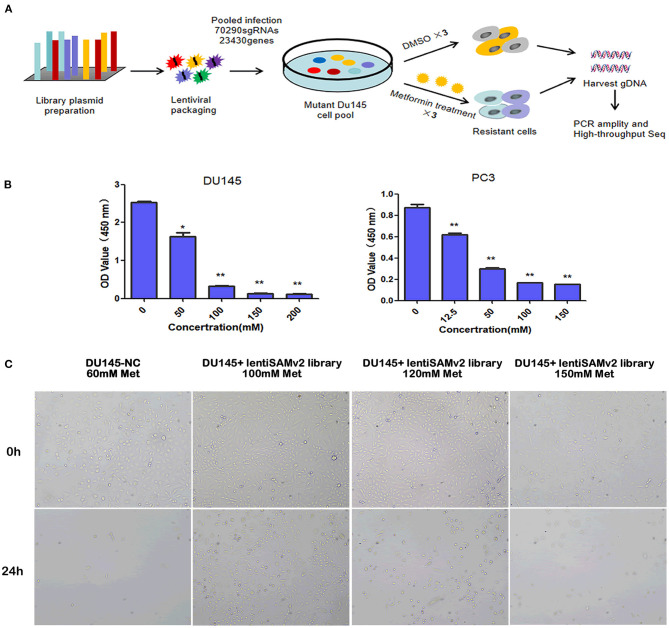
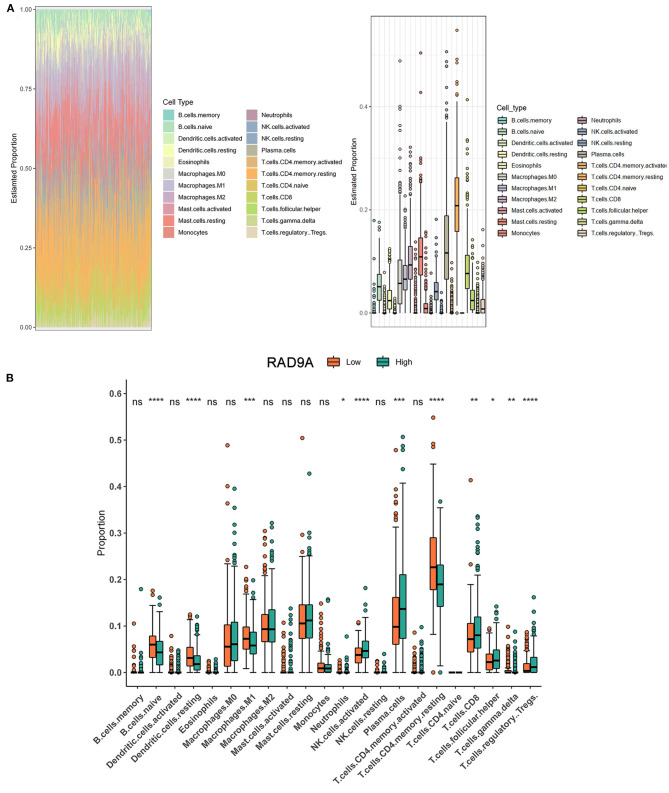
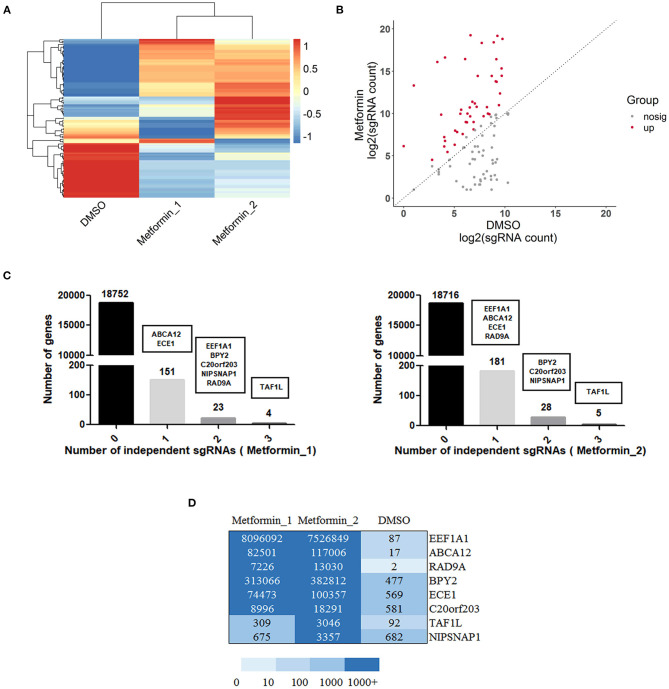
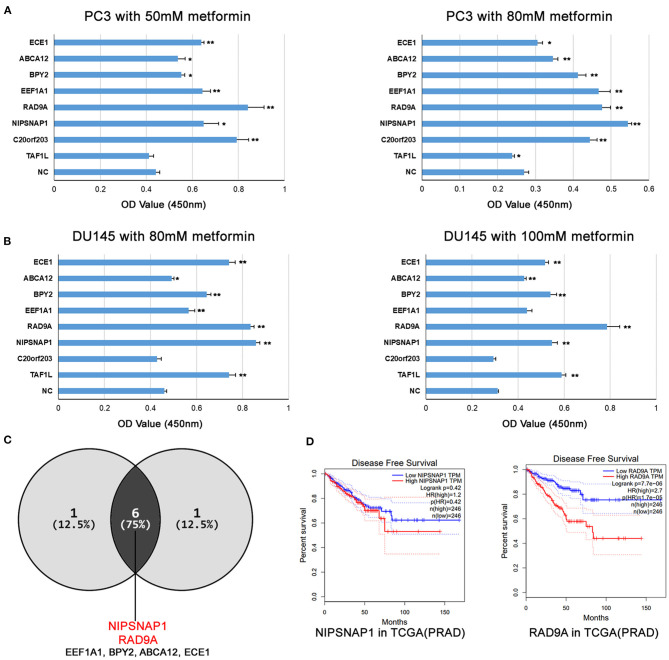
Metformin is a classic type II diabetes drug which possesses anti-tumor properties for various cancers. However, different cancers do not respond to metformin with the same effectiveness or acquire resistance. Thus, searching for vulnerabilities of metformin-resistant prostate cancer is a promising strategy to improve the therapeutic efficiency of the drug. A genome-scale CRISPR-Cas9 activation library search targeting 23,430 genes was conducted to identify the genes that confer resistance to metformin in prostate cancer cells. Candidate genes were selected by total reads of sgRNA and sgRNA diversity, and then a CCK8 assay was used to verify their resistance to metformin. Interestingly, we discovered that the activation of ECE1, ABCA12, BPY2, EEF1A1, RAD9A, and NIPSNAP1 contributed to resistance to metformin in DU145 and PC3 cell lines. Notably, a high level of RAD9A, with poor prognosis in PCa, was the most significant gene in the CCK8 assay. Furthermore, we discerned the tumor immune microenvironment with RAD9A expression by CIBERSORT. These results suggested that a high level of RAD9A may upregulate regulatory T cells to counterbalance metformin in the tumor immune microenvironment.
二甲双胍是一种经典的II型糖尿病药物,对多种癌症具有抗肿瘤特性。然而,不同的癌症对二甲双胍的反应效果不同或会产生耐药性。因此,寻找耐二甲双胍前列腺癌的弱点是提高该药物治疗效果的一种有前景的策略。进行了一项针对23430个基因的全基因组规模CRISPR-Cas9激活文库筛选,以鉴定前列腺癌细胞中赋予对二甲双胍耐药性的基因。通过sgRNA的总读数和sgRNA多样性选择候选基因,然后使用CCK8测定法验证它们对二甲双胍的耐药性。有趣的是,我们发现ECE1、ABCA12、BPY2、EEF1A1、RAD9A和NIPSNAP1的激活导致DU145和PC3细胞系对二甲双胍产生耐药性。值得注意的是,在CCK8测定中,在前列腺癌中预后较差的高水平RAD9A是最显著的基因。此外,我们通过CIBERSORT分析了具有RAD9A表达的肿瘤免疫微环境。这些结果表明,高水平的RAD9A可能上调调节性T细胞,以在肿瘤免疫微环境中抵消二甲双胍的作用。