Departamento de Bioquímica, Instituto de Química, Universidade de São Paulo, Av. Prof. Lineu Prestes, 748. Sala 964 Bloco 9 Superior, Cidade Universitária, São Paulo, SP, 05508-000, Brazil.
Instituto Nacional de Ciência e Tecnologia em Medicina Regenerativa, INCT-REGENERA , Rio de Janeiro, Brazil.
Stem Cell Rev Rep. 2021 Feb;17(1):241-252. doi: 10.1007/s12015-021-10129-7. Epub 2021 Feb 11.
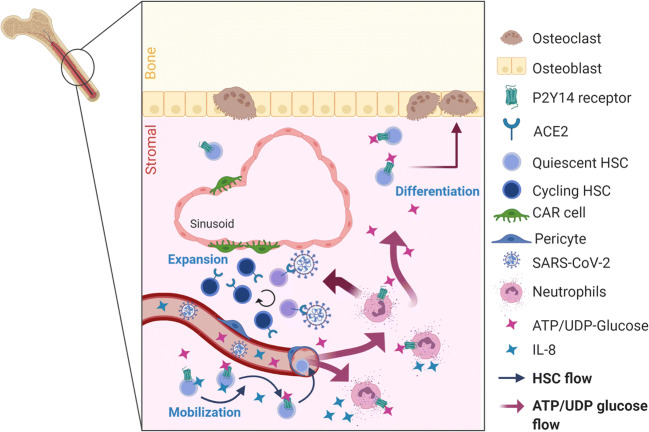
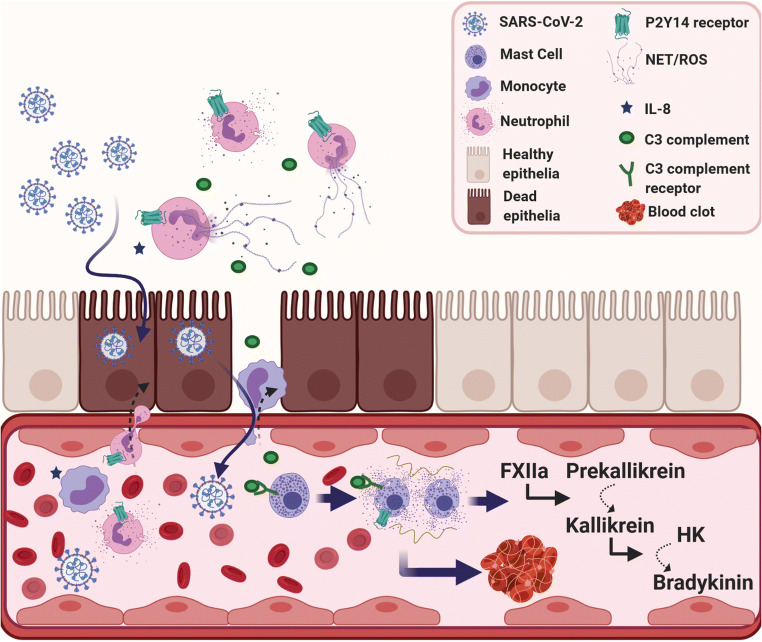
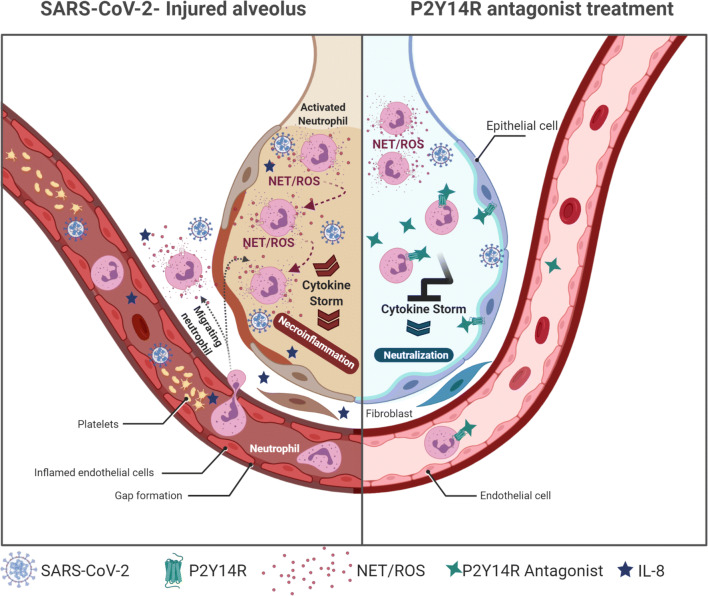
The global SARS-CoV-2 pandemic starting in 2019 has already reached more than 2.3 million deaths. Despite the scientific community's efforts to investigate the COVID-19 disease, a drug for effectively treating or curing patients yet needs to be discovered. Hematopoietic stem cells (HSC) differentiating into immune cells for defense express COVID-19 entry receptors, and COVID-19 infection hinders their differentiation. The importance of purinergic signaling in HSC differentiation and innate immunity has been recognized. The metabotropic P2Y14 receptor subtype, activated by UDP-glucose, controls HSC differentiation and mobilization. Thereon, the exacerbated activation of blood immune cells amplifies the inflammatory state observed in COVID-19 patients, specially through the continuous release of reactive oxygen species and extracellular neutrophil traps (NETs). Further, the P2Y14 subtype, robustly inhibits the infiltration of neutrophils into various epithelial tissues, including lungs and kidneys. Here we discuss findings suggesting that antagonism of the P2Y14 receptor could prevent the progression of COVID-19-induced systemic inflammation, which often leads to severe illness and death cases. Considering the modulation of neutrophil recruitment of extreme relevance for respiratory distress and lung failure prevention, we propose that P2Y14 receptor inhibition by its selective antagonist PPTN could limit neutrophil recruitment and NETosis, hence limiting excessive formation of oxygen reactive species and proteolytic activation of the kallikrein-kinin system and subsequent bradykinin storm in the alveolar septa of COVID-19 patients.
自 2019 年开始的全球 SARS-CoV-2 大流行已经导致超过 230 万人死亡。尽管科学界努力研究 COVID-19 疾病,但仍需要发现一种有效治疗或治愈患者的药物。分化为免疫细胞以进行防御的造血干细胞 (HSC) 表达 COVID-19 进入受体,而 COVID-19 感染会阻碍其分化。嘌呤能信号在 HSC 分化和先天免疫中的重要性已经得到认可。被 UDP-葡萄糖激活的代谢型 P2Y14 受体亚型控制着 HSC 的分化和动员。因此,血液免疫细胞的过度激活会放大 COVID-19 患者中观察到的炎症状态,特别是通过持续释放活性氧物质和细胞外中性粒细胞陷阱 (NETs)。此外,P2Y14 亚型强烈抑制中性粒细胞浸润到各种上皮组织,包括肺和肾脏。在这里,我们讨论了一些发现,这些发现表明,拮抗 P2Y14 受体可能会阻止 COVID-19 引起的全身性炎症的进展,这种炎症通常会导致严重疾病和死亡。考虑到对呼吸窘迫和肺衰竭预防的中性粒细胞募集的调节具有极端重要性,我们提出通过其选择性拮抗剂 PPTN 抑制 P2Y14 受体可以限制中性粒细胞募集和 NETosis,从而限制 COVID-19 患者肺泡隔中活性氧物质的过度形成以及激肽释放酶-激肽系统的蛋白水解激活和随后的缓激肽风暴。