Division of Rheumatology, Department of Medicine, Center of Molecular Medicine, Karolinska University Hospital Solna, Karolinska Institute, Stockholm, Sweden.
Department Immunology, Genetics and Pathology, Uppsala University, Uppsala, Sweden.
Clin Exp Immunol. 2021 Jul;205(1):44-52. doi: 10.1111/cei.13585. Epub 2021 Mar 16.
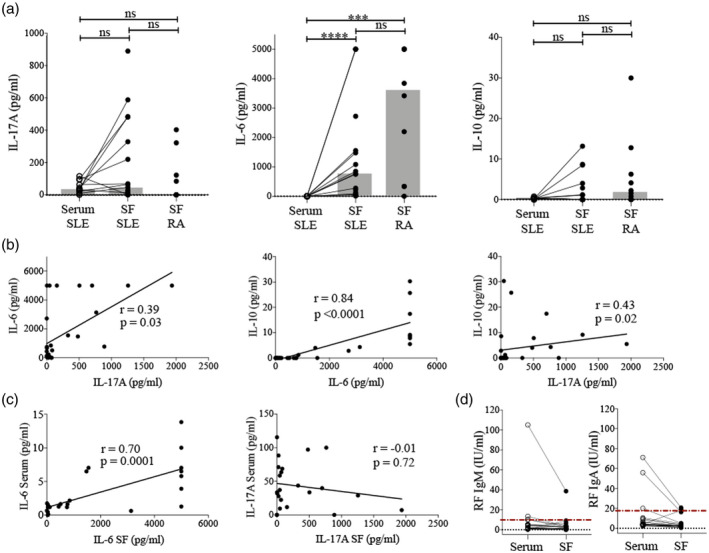
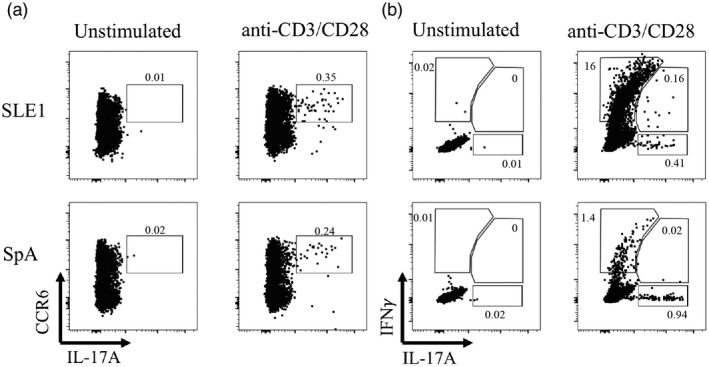
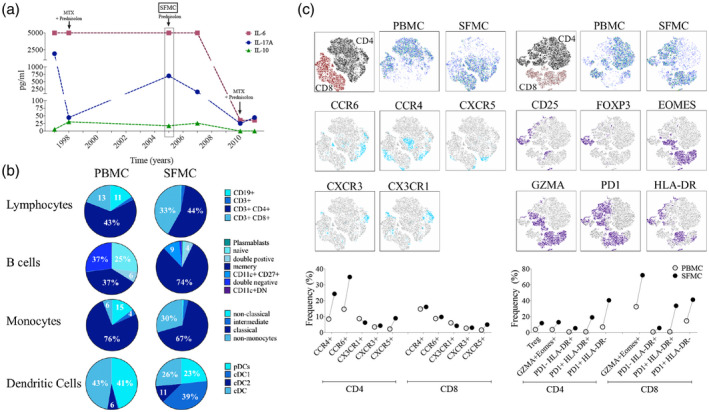
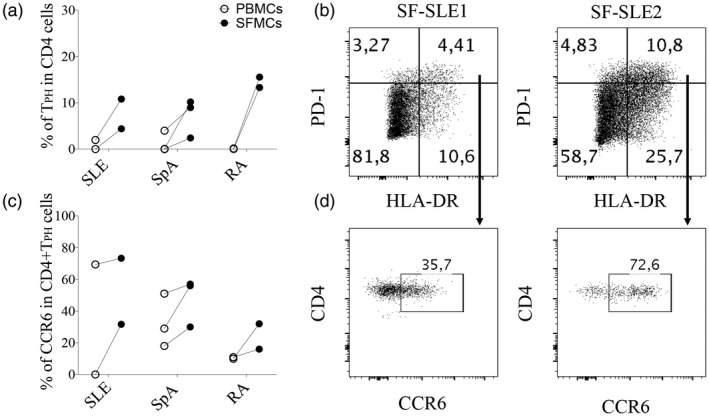
Arthritis is a common clinical feature of systemic lupus erythematosus (SLE) and is usually non-erosive, as opposed to rheumatoid arthritis (RA). While RA synovial pathology has been extensively studied, little is known about the pathophysiology of lupus arthritis. Here, we aimed to explore the cytokine and cellular compartments in synovial fluids of SLE patients with arthritic manifestations. Acellular synovial fluid and paired serum samples from SLE patients (n = 17) were analyzed with cytokine bead array for T helper-associated cytokines. From two SLE patients, synovial fluid mononuclear cells (SFMC) could also be captured and were analyzed by multiparameter flow cytometry to dissect T cell, B cell, monocyte and dendritic cell phenotypes. SLE-derived SFMC were further stimulated in vitro to measure their capacity for producing interferon (IFN)-γ and interleukin (IL)-17A. All patients fulfilled the ACR 1982 classification criteria for SLE. Clinical records were reviewed to exclude the presence of co-morbidities such as osteoarthritis or overlap with RA. IL-17A and IL-6 levels were high in SLE synovial fluid. A clear subset of the synovial CD4 T cells expressed CCR6 , a marker associated with T helper type 17 (Th17) cells. IL-17A-production was validated among CD4 CCR6 T cells following in-vitro stimulation. Furthermore, a strong IFN-γ production was observed in both CD4 and CD8 cells. Our study shows high IL-17A and IL-6 levels in synovial fluids of patients with lupus arthritis. The Th17 pathway has been implicated in several aspects of SLE disease pathogenesis and our data also point to Th17 involvement for lupus arthritis.
关节炎是系统性红斑狼疮(SLE)的常见临床特征,通常是非侵蚀性的,与类风湿关节炎(RA)相反。虽然已经广泛研究了 RA 滑膜病理学,但对狼疮关节炎的病理生理学知之甚少。在这里,我们旨在探讨有关节炎表现的 SLE 患者滑膜液中的细胞因子和细胞区室。使用细胞因子珠阵列分析无细胞滑膜液和来自 SLE 患者(n = 17)的配对血清样本中的 T 辅助相关细胞因子。从两名 SLE 患者中,还可以捕获滑膜液单核细胞(SFMC),并通过多参数流式细胞术进行分析,以剖析 T 细胞、B 细胞、单核细胞和树突状细胞表型。SLE 衍生的 SFMC 进一步在体外刺激以测量其产生干扰素(IFN)-γ和白细胞介素(IL)-17A 的能力。所有患者均符合 ACR 1982 年 SLE 分类标准。临床记录被审查以排除存在骨关节炎或与 RA 重叠等合并症。SLE 滑膜液中的 IL-17A 和 IL-6 水平较高。滑膜 CD4 T 细胞中有一个明确的亚群表达 CCR6,这是与 Th17 细胞相关的标志物。在体外刺激后验证了 CD4 CCR6 T 细胞中 IL-17A 的产生。此外,还观察到 CD4 和 CD8 细胞中强烈的 IFN-γ产生。我们的研究表明狼疮关节炎患者滑膜液中 IL-17A 和 IL-6 水平较高。Th17 途径已被牵连到 SLE 疾病发病机制的多个方面,我们的数据也表明 Th17 参与了狼疮关节炎。