Division of Respiratory Medicine, Department of Pediatrics, University of California San Diego, La Jolla, CA 92093, USA.
Department of Neurosciences, University of California at San Diego, La Jolla, CA 92093, USA.
G3 (Bethesda). 2021 Feb 9;11(2). doi: 10.1093/g3journal/jkab038.
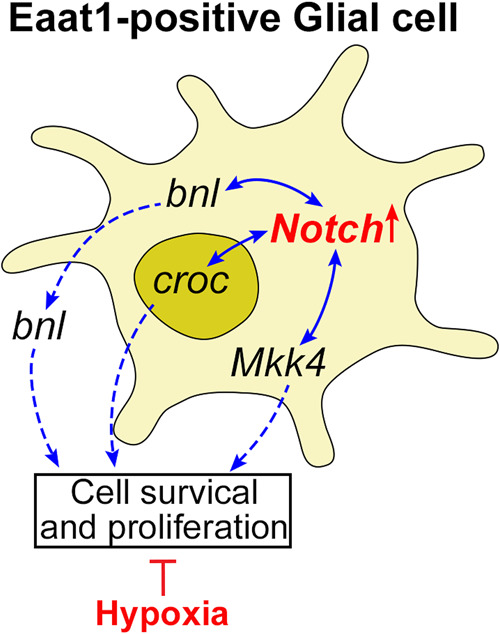
Hypoxia is a critical pathological element in many human diseases, including ischemic stroke, myocardial infarction, and solid tumors. Of particular significance and interest of ours are the cellular and molecular mechanisms that underlie susceptibility or tolerance to low O2. Previous studies have demonstrated that Notch signaling pathway regulates hypoxia tolerance in both Drosophila melanogaster and humans. However, the mechanisms mediating Notch-conferred hypoxia tolerance are largely unknown. In this study, we delineate the evolutionarily conserved mechanisms underlying this hypoxia tolerant phenotype. We determined the role of a group of conserved genes that were obtained from a comparative genomic analysis of hypoxia-tolerant D.melanogaster populations and human highlanders living at the high-altitude regions of the world (Tibetans, Ethiopians, and Andeans). We developed a novel dual-UAS/Gal4 system that allows us to activate Notch signaling in the Eaat1-positive glial cells, which remarkably enhances hypoxia tolerance in D.melanogaster, and, simultaneously, knock down a candidate gene in the same set of glial cells. Using this system, we discovered that the interactions between Notch signaling and bnl (fibroblast growth factor), croc (forkhead transcription factor C), or Mkk4 (mitogen-activated protein kinase kinase 4) are important for hypoxia tolerance, at least in part, through regulating neuronal development and survival under hypoxic conditions. Becausethese genetic mechanisms are evolutionarily conserved, this group of genes may serve as novel targets for developing therapeutic strategies and have a strong potential to be translated to humans to treat/prevent hypoxia-related diseases.
缺氧是许多人类疾病的关键病理因素,包括缺血性中风、心肌梗死和实体瘤。特别值得我们关注的是,导致对低氧易感性或耐受性的细胞和分子机制。先前的研究表明,Notch 信号通路调节果蝇和人类对低氧的耐受性。然而,介导 Notch 赋予的低氧耐受性的机制在很大程度上是未知的。在这项研究中,我们描述了这种低氧耐受表型的保守机制。我们确定了一组保守基因的作用,这些基因是通过对耐受低氧的果蝇种群和生活在世界高海拔地区(藏人、埃塞俄比亚人和安第斯人)的人类高原适应者的比较基因组分析获得的。我们开发了一种新的双 UAS/Gal4 系统,允许我们在 Eaat1 阳性神经胶质细胞中激活 Notch 信号,这显著增强了果蝇的低氧耐受性,同时在同一组神经胶质细胞中敲低一个候选基因。使用这个系统,我们发现 Notch 信号与 bnl(成纤维细胞生长因子)、croc(叉头转录因子 C)或 Mkk4(丝裂原活化蛋白激酶激酶 4)之间的相互作用对低氧耐受性很重要,至少部分原因是通过调节神经元在低氧条件下的发育和存活。由于这些遗传机制在进化上是保守的,这组基因可能作为开发治疗策略的新靶点,并具有很强的潜力被转化为人类,以治疗/预防与低氧相关的疾病。