U.S. Geological Survey Alaska Science Center, Juneau, AK, USA.
U.S. Geological Survey Alaska Science Center, Anchorage, AK, USA.
Glob Chang Biol. 2021 May;27(9):1859-1878. doi: 10.1111/gcb.15556. Epub 2021 Mar 6.
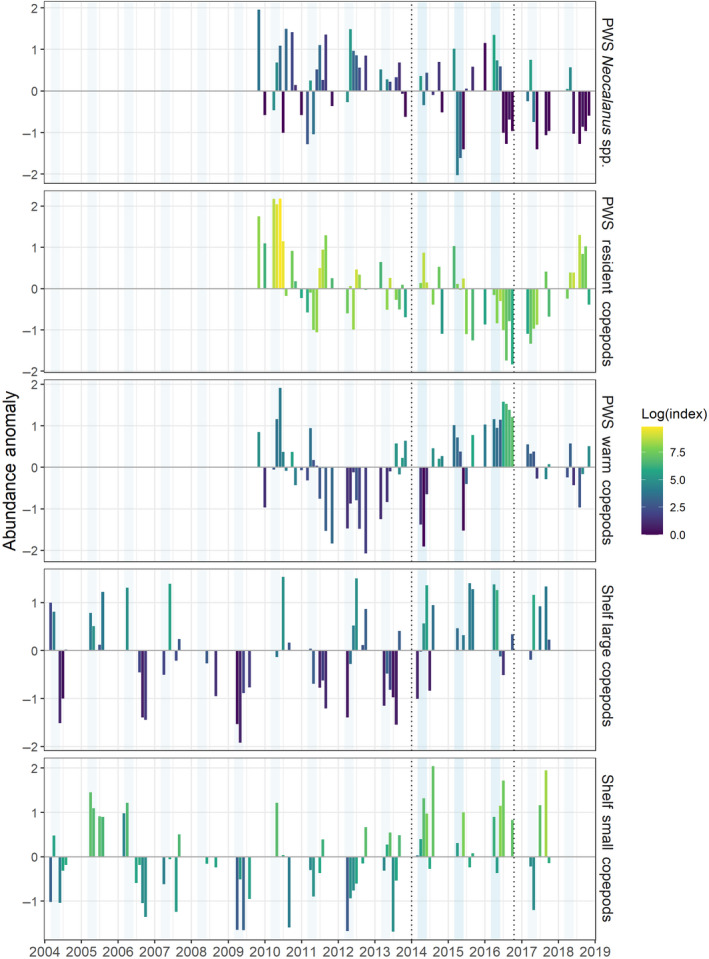
During the Pacific marine heatwave of 2014-2016, abundance and quality of several key forage fish species in the Gulf of Alaska were simultaneously reduced throughout the system. Capelin (Mallotus catervarius), sand lance (Ammodytes personatus), and herring (Clupea pallasii) populations were at historically low levels, and within this community abrupt declines in portfolio effects identify trophic instability at the onset of the heatwave. Although compensatory changes in age structure, size, growth or energy content of forage fish were observed to varying degrees among all these forage fish, none were able to fully mitigate adverse impacts of the heatwave, which likely included both top-down and bottom-up forcing. Notably, changes to the demographic structure of forage fish suggested size-selective removals typical of top-down regulation. At the same time, changes in zooplankton communities may have driven bottom-up regulation as copepod community structure shifted toward smaller, warm water species, and euphausiid biomass was reduced owing to the loss of cold-water species. Mediated by these impacts on the forage fish community, an unprecedented disruption of the normal pelagic food web was signaled by higher trophic level disruptions during 2015-2016, when seabirds, marine mammals, and groundfish experienced shifts in distribution, mass mortalities, and reproductive failures. Unlike decadal-scale variability underlying ecosystem regime shifts, the heatwave appeared to temporarily overwhelm the ability of the forage fish community to buffer against changes imposed by warm water anomalies, thereby eliminating any ecological advantages that may have accrued from having a suite of coexisting forage species with differing life-history compensations.
在 2014-2016 年太平洋海洋热浪期间,阿拉斯加湾的几种关键饲料鱼类的丰度和质量同时在整个系统中下降。毛鳞鱼(Mallotus catervarius)、沙鳗(Ammodytes personatus)和鲱鱼(Clupea pallasii)的数量处于历史低位,在这个群落中,投资组合效应的突然下降表明,在热浪开始时,食物链出现不稳定。虽然在所有这些饲料鱼类中,都观察到了年龄结构、大小、生长或能量含量的补偿性变化,但这些变化都不能完全缓解热浪的不利影响,这些影响可能包括自上而下和自下而上的强迫。值得注意的是,饲料鱼类的人口结构变化表明存在大小选择性的清除作用,这是自上向下调控的典型特征。与此同时,浮游动物群落的变化可能导致了自下而上的调控,因为桡足类群落结构向较小的暖水物种转移,而磷虾生物量减少是由于冷水物种的丧失。这些对饲料鱼类群落的影响,通过 2015-2016 年高营养级的破坏,标志着正常的浮游生物食物链出现了前所未有的中断,在此期间,海鸟、海洋哺乳动物和底栖鱼类的分布、大量死亡和繁殖失败都发生了变化。与生态系统状态变化的十年尺度变化不同,热浪似乎暂时压倒了饲料鱼类群落缓冲由暖水异常引起的变化的能力,从而消除了由于存在具有不同生活史补偿的共存饲料物种而可能获得的任何生态优势。