Medical Scientist Training Program, Vanderbilt University School of Medicine, Nashville, Tennessee, USA.
Department of Hearing and Speech Sciences, Vanderbilt University Medical Center, Nashville, Tennessee, USA.
Ear Hear. 2021 Sep/Oct;42(5):1137-1150. doi: 10.1097/AUD.0000000000001005.
Hyperacusis, defined as decreased tolerance to sound at levels that would not trouble most individuals, is frequently observed in individuals with autism spectrum disorder (ASD). Despite the functional impairment attributable to hyperacusis, little is known about its prevalence or natural history in the ASD population. The objective of this study was to conduct a systematic review and meta-analysis estimating the current and lifetime prevalence of hyperacusis in children, adolescents, and adults with ASD. By precisely estimating the burden of hyperacusis in the ASD population, the present study aims to enhance recognition of this particular symptom of ASD and highlight the need for additional research into the causes, prevention, and treatment of hyperacusis in persons on the spectrum.
We searched PubMed and ProQuest to identify peer-reviewed articles published in English after January 1993. We additionally performed targeted searches of Google Scholar and the gray literature, including studies published through May 2020. Eligible studies included at least 20 individuals with diagnosed ASD of any age and reported data from which the proportion of ASD individuals with current and/or lifetime hyperacusis could be derived. To account for multiple prevalence estimates derived from the same samples, we utilized three-level Bayesian random-effects meta-analyses to estimate the current and lifetime prevalence of hyperacusis. Bayesian meta-regression was used to assess potential moderators of current hyperacusis prevalence. To reduce heterogeneity due to varying definitions of hyperacusis, we performed a sensitivity analysis on the subset of studies that ascertained hyperacusis status using the Autism Diagnostic Interview-Revised (ADI-R), a structured parent interview.
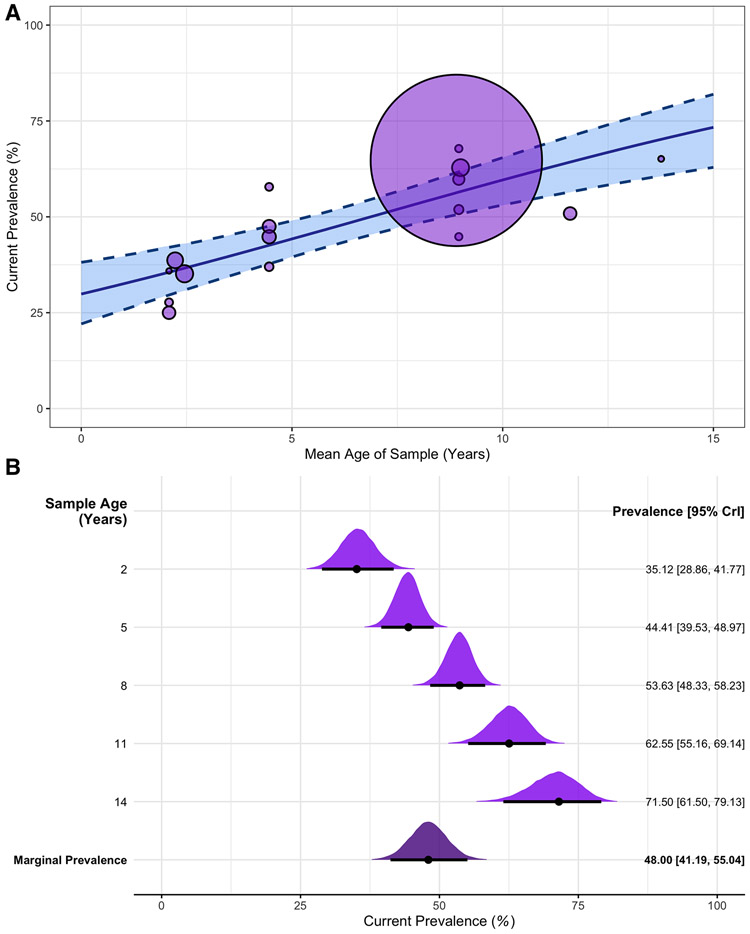
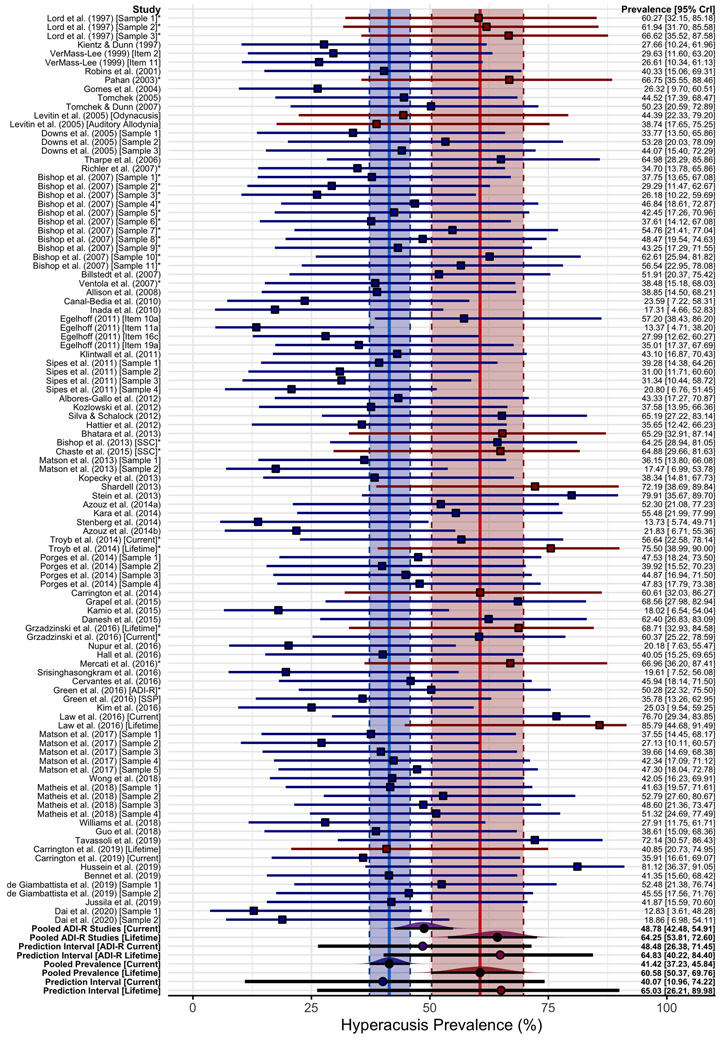
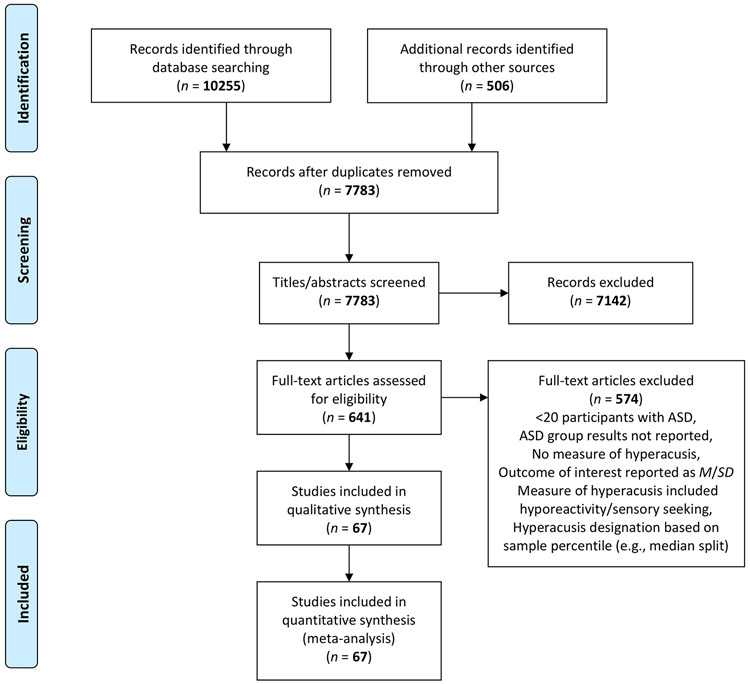
A total of 7783 nonduplicate articles were screened, of which 67 were included in the review and synthesis. Hyperacusis status was ascertained in multiple ways across studies, with 60 articles employing interviews or questionnaires and seven using behavioral observations or objective measures. The mean (range) age of samples in the included studies was 7.88 years (1.00 to 34.89 years). The meta-analysis of interview/questionnaire measures (k(3) = 103, nASD = 13,093) estimated the current and lifetime prevalence of hyperacusis in ASD to be 41.42% (95% CrI, 37.23 to 45.84%) and 60.58% (50.37 to 69.76%), respectively. A sensitivity analysis restricted to prevalence estimates derived from the ADI-R (k(3) = 25, nASD = 5028) produced similar values. The estimate of current hyperacusis prevalence using objective/observational measures (k(3) = 8, nASD = 488) was 27.30% (14.92 to 46.31%). Heterogeneity in the full sample of interview/questionnaire measures was substantial but not significantly explained by any tested moderator. However, prevalence increased sharply with increasing age in studies using the ADI-R (BF10 = 93.10, R2Het = 0.692).
In this meta-analysis, we found a high prevalence of current and lifetime hyperacusis in individuals with ASD, with a majority of individuals on the autism spectrum experiencing hyperacusis at some point in their lives. The high prevalence of hyperacusis in individuals with ASD across the lifespan highlights the need for further research on sound tolerance in this population and the development of services and/or interventions to reduce the burden of this common symptom.
在自闭症谱系障碍(ASD)患者中,常观察到对声音的耐受性降低,定义为在不会困扰大多数个体的水平下对声音的耐受性降低。尽管hyperacusis 会导致功能障碍,但人们对其在 ASD 人群中的患病率或自然史知之甚少。本研究的目的是进行系统评价和荟萃分析,以估计儿童、青少年和成人 ASD 患者中当前和终身 hyperacusis 的患病率。通过准确估计 ASD 人群中 hyperacusis 的负担,本研究旨在提高对 ASD 这一特定症状的认识,并强调需要进一步研究频谱人群中 hyperacusis 的原因、预防和治疗。
我们在 1993 年 1 月之后,在 PubMed 和 ProQuest 中搜索了发表的同行评审文章。我们还在 Google Scholar 和灰色文献中进行了有针对性的搜索,包括截至 2020 年 5 月发表的研究。合格的研究包括至少 20 名年龄不限的被诊断为 ASD 的个体,并报告了可以从中得出 ASD 个体当前和/或终身 hyperacusis 比例的数据。为了说明来自同一样本的多个患病率估计,我们使用三级贝叶斯随机效应荟萃分析来估计当前和终身 hyperacusis 的患病率。使用贝叶斯元回归来评估当前 hyperacusis 患病率的潜在调节因素。为了减少由于 hyperacusis 定义的变化而导致的异质性,我们对使用自闭症诊断访谈修订版(ADI-R)确定 hyperacusis 状态的研究进行了敏感性分析,ADI-R 是一种结构化的家长访谈。
共筛选了 7783 篇非重复文章,其中 67 篇被纳入综述和综合分析。研究中使用了多种方法来确定 hyperacusis 状态,其中 60 篇使用访谈或问卷,7 篇使用行为观察或客观测量。纳入研究样本的平均(范围)年龄为 7.88 岁(1.00 至 34.89 岁)。使用访谈/问卷测量的荟萃分析(k(3) = 103,nASD = 13093)估计 ASD 中当前和终身 hyperacusis 的患病率分别为 41.42%(95% CrI,37.23 至 45.84%)和 60.58%(50.37 至 69.76%)。仅使用 ADI-R 得出的患病率估计值进行的敏感性分析(k(3) = 25,nASD = 5028)产生了类似的值。使用客观/观察测量得出的当前 hyperacusis 患病率估计值为 27.30%(14.92 至 46.31%)。访谈/问卷测量全样本的异质性很大,但没有任何测试的调节因素显著解释。然而,在使用 ADI-R 的研究中,患病率随着年龄的增长急剧增加(BF10 = 93.10,R2Het = 0.692)。
在这项荟萃分析中,我们发现 ASD 患者中当前和终身 hyperacusis 的患病率很高,大多数自闭症谱系患者在其一生中的某个时候都会经历 hyperacusis。ASD 患者终身存在 hyperacusis 的高患病率突出表明需要进一步研究该人群的声音耐受性,并开发服务和/或干预措施,以减轻这一常见症状的负担。