Potgieter Iskra, Fackrell Kathryn, Kennedy Veronica, Crunkhorn Rosa, Hoare Derek J
National Institute for Health Research (NIHR) Nottingham Biomedical Research Centre, University of Nottingham, Ropewalk House, 113 The Ropewalk, Nottingham, NG1 5DU, UK.
Otology and Hearing Group, Division of Clinical Neuroscience, School of Medicine, University of Nottingham, Nottingham, NG7 2UH, UK.
BMC Pediatr. 2020 Jun 29;20(1):319. doi: 10.1186/s12887-020-02223-5.
Hyperacusis is a chronic condition commonly defined as a lowered tolerance or increased sensitivity to everyday environmental sounds. It has been viewed as a paediatric disorder which can cause significant impairment to a child's normal functioning. Although clinical guidance highlights the importance of identifying whether the child has intolerance to loud sounds and managing this appropriately, there are currently no assessment or treatment methods that have been designed and tested for use with children with hyperacusis. A review is therefore indicated to consider the profile of children with hyperacusis as a basis for future research into their assessment and treatment.
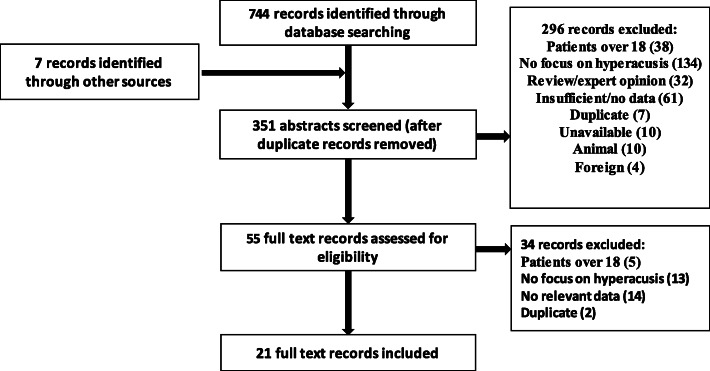
A scoping review methodology was followed with literature searches conducted in Embase, PsychINFO, PubMed CENTRAL, Scopus, Web of Science and Google Scholar. Research articles were included if they reported on research studies describing children diagnosed with hyperacusis, providing clinical profile information, and/or reporting on an assessment or management method for children with a primary complaint of hyperacusis. Data were charted on Excel and verified by a second researcher. Twenty-one research articles were included.
Children with hyperacusis are typically described in terms of age at presentation, troublesome sounds, physical sensation, behavioural reactions, coping strategies, comorbid conditions and impact on daily life. Methods of assessing the children include semi-structured interviews, questionnaires, neurological assessment, observation and uncomfortable loudness levels. Management methods include psychological therapy, sound therapy, tinnitus retraining therapy, medication and neuro-rehabilitation.
The information we catalogued on various elements of clinical profile, assessment and management can serve as a stepping stone in future research developing questionnaires for clinical measurement of the impact of hyperacusis on children, and the measurement of treatment related change in clinic and in trials. Positive outcomes were noted by the authors following all of the above treatments; future research must compare these and specify the parameters for optimal results.
听觉过敏是一种慢性病,通常被定义为对日常环境声音的耐受性降低或敏感性增加。它一直被视为一种儿科疾病,会对儿童的正常功能造成重大损害。尽管临床指南强调了识别儿童是否对大声不耐受并进行适当管理的重要性,但目前尚无专门为听觉过敏儿童设计和测试的评估或治疗方法。因此,有必要进行一项综述,以了解听觉过敏儿童的概况,为未来对其评估和治疗的研究奠定基础。
采用范围综述方法,在Embase、PsychINFO、PubMed CENTRAL、Scopus、Web of Science和谷歌学术上进行文献检索。如果研究文章报道了描述被诊断为听觉过敏的儿童的研究,提供临床概况信息,和/或报道了以听觉过敏为主诉的儿童的评估或管理方法,则纳入研究。数据记录在Excel上,并由另一位研究人员进行核实。共纳入21篇研究文章。
听觉过敏儿童通常根据就诊年龄、困扰声音、身体感觉、行为反应、应对策略、合并症以及对日常生活的影响来描述。评估儿童的方法包括半结构化访谈、问卷调查、神经学评估、观察和不适响度水平。管理方法包括心理治疗、声音治疗、耳鸣再训练治疗、药物治疗和神经康复。
我们整理的关于临床概况、评估和管理的各个要素的信息,可作为未来研究的垫脚石,用于开发问卷,以临床测量听觉过敏对儿童的影响,以及测量临床和试验中与治疗相关的变化。作者在上述所有治疗后均观察到了积极结果;未来的研究必须对这些结果进行比较,并明确最佳结果的参数。