National Institute of Health Research Nottingham Biomedical Research Centre, University of Nottingham, Nottingham, UK
Hearing Sciences, Division of Clinical Neuroscience, School of Medicine, University of Nottingham, Nottingham, UK.
BMJ Open. 2019 Nov 21;9(11):e032178. doi: 10.1136/bmjopen-2019-032178.
To determine research priorities in hyperacusis that key stakeholders agree are the most important.
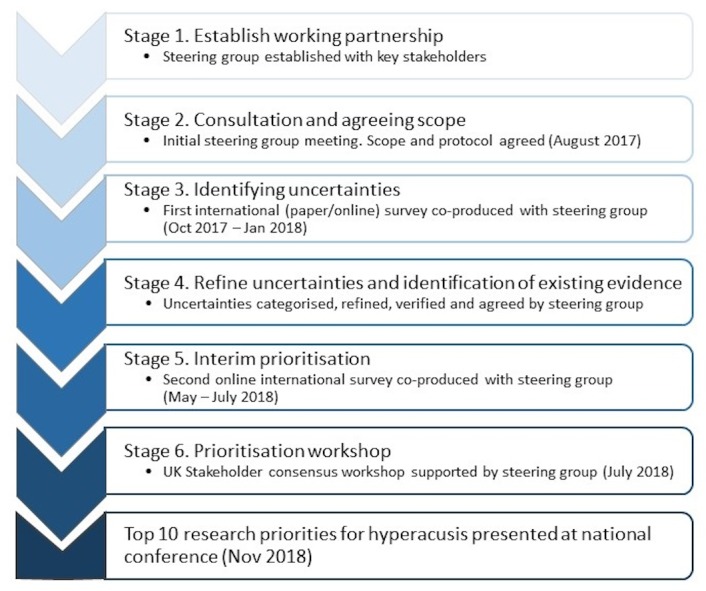
DESIGN/SETTING: A priority setting partnership using two international surveys, and a UK prioritisation workshop, adhering to the six-staged methodology outlined by the James Lind Alliance.
People with lived experience of hyperacusis, parents/carers, family and friends, educational professionals and healthcare professionals who support and/or treat adults and children who experience hyperacusis, including but not limited to surgeons, audiologists, psychologists and hearing therapists.
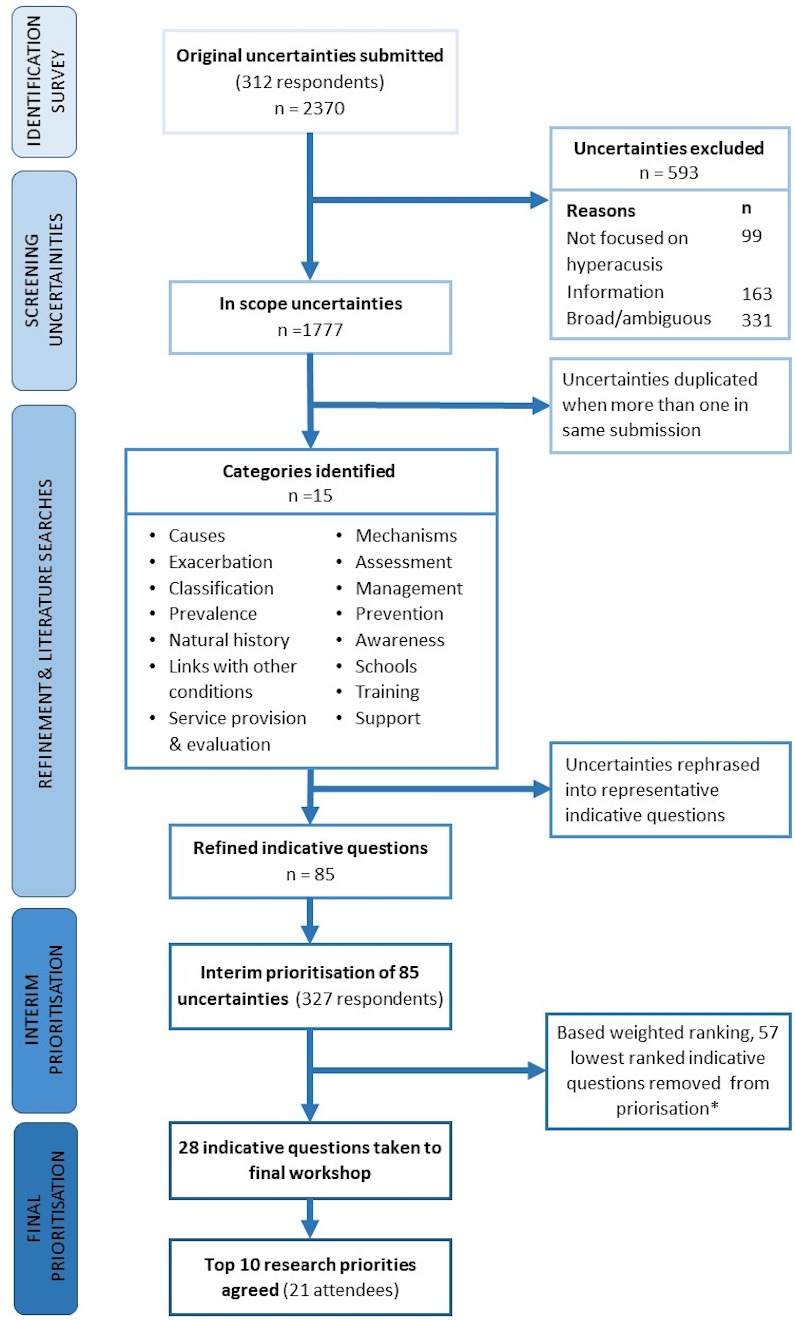
The priority setting partnership was conducted from August 2017 to July 2018. An international identification survey asked respondents to submit any questions/uncertainties about hyperacusis. Uncertainties were categorised, refined and rephrased into representative indicative questions using thematic analysis techniques. These questions were verified as 'unanswered' through searches of current evidence. A second international survey asked respondents to vote for their top 10 priority questions. A shortlist of questions that represented votes from all stakeholder groups was prioritised into a top 10 at the final prioritisation workshop (UK).
In the identification survey, 312 respondents submitted 2730 uncertainties. Of those uncertainties, 593 were removed as out of scope, and the remaining were refined into 85 indicative questions. None of the indicative questions had already been answered in research. The second survey collected votes from 327 respondents, which resulted in a shortlist of 28 representative questions for the final workshop. Consensus was reached on the top 10 priorities for future research, including identifying causes and underlying mechanisms, effective management and training for healthcare professionals.
These priorities were identified and shaped by people with lived experience, parents/carers and healthcare professionals, and as such are an essential resource for directing future research in hyperacusis. Researchers and funders should focus on addressing these priorities.
确定听力过度敏感领域的研究重点,这些重点是利益相关者一致认为最重要的。
设计/设置:采用两项国际调查和一项英国重点制定研讨会,采用詹姆斯·林德联盟(James Lind Alliance)概述的六阶段方法,建立重点制定伙伴关系。
有听力过度敏感生活经历的人、父母/照顾者、家人和朋友、支持和/或治疗经历听力过度敏感的成人和儿童的教育专业人员和医疗保健专业人员,包括但不限于外科医生、听力学家、心理学家和听力治疗师。
重点制定伙伴关系于 2017 年 8 月至 2018 年 7 月进行。一项国际识别调查要求受访者提交有关听力过度敏感的任何问题/不确定。使用主题分析技术对不确定因素进行分类、精炼和重新表述为有代表性的指示性问题。通过搜索当前证据,验证这些问题是否“未回答”。第二项国际调查要求受访者投票选出他们的前 10 个优先问题。在最后一次重点制定研讨会(英国)上,根据所有利益相关者群体的投票,将代表票数的问题名单列为前 10 名。
在识别调查中,312 名受访者提交了 2730 个不确定因素。其中,593 个不确定因素被排除在范围之外,其余的被提炼成 85 个指示性问题。这些指示性问题中没有一个已经在研究中得到回答。第二项调查收集了 327 名受访者的投票,结果产生了 28 个代表问题的候选名单,供最后一次研讨会使用。最终确定了 10 项未来研究的重点,包括确定病因和潜在机制、为医疗保健专业人员提供有效管理和培训。
这些重点是由有生活经验的人、父母/照顾者和医疗保健专业人员确定和塑造的,因此是指导听力过度敏感研究的重要资源。研究人员和资助者应专注于解决这些重点。