• 文献检索
  • 文档翻译
  • 深度研究
  • 学术资讯
  • Suppr Zotero 插件Zotero 插件
  • 邀请有礼
  • 套餐&价格
  • 历史记录
应用&插件
Suppr Zotero 插件Zotero 插件浏览器插件Mac 客户端Windows 客户端微信小程序
定价
高级版会员购买积分包购买API积分包
服务
文献检索文档翻译深度研究API 文档MCP 服务
关于我们
关于 Suppr公司介绍联系我们用户协议隐私条款
关注我们

Suppr 超能文献

核心技术专利:CN118964589B侵权必究
粤ICP备2023148730 号-1Suppr @ 2026

文献检索

告别复杂PubMed语法,用中文像聊天一样搜索,搜遍4000万医学文献。AI智能推荐,让科研检索更轻松。

立即免费搜索

文件翻译

保留排版,准确专业,支持PDF/Word/PPT等文件格式,支持 12+语言互译。

免费翻译文档

深度研究

AI帮你快速写综述,25分钟生成高质量综述,智能提取关键信息,辅助科研写作。

立即免费体验

在人工密集的蜜源环境中饲养的熊蜂蜂巢发育减少。

Reduced nest development of reared Bombus terrestris within apiary dense human-modified landscapes.

机构信息

Department of Plants and Crops, Faculty of Bioscience Engineering, Ghent University, Coupure Links 653, 9000, Ghent, Belgium.

Laboratory of Molecular Entomology and Bee Pathology, Faculty of Sciences, Ghent University, Krijgslaan 281, S2, 9000, Ghent, Belgium.

出版信息

Sci Rep. 2021 Feb 12;11(1):3755. doi: 10.1038/s41598-021-82540-6.

DOI:10.1038/s41598-021-82540-6
PMID:33580131
原文链接:https://pmc.ncbi.nlm.nih.gov/articles/PMC7881143/
Abstract

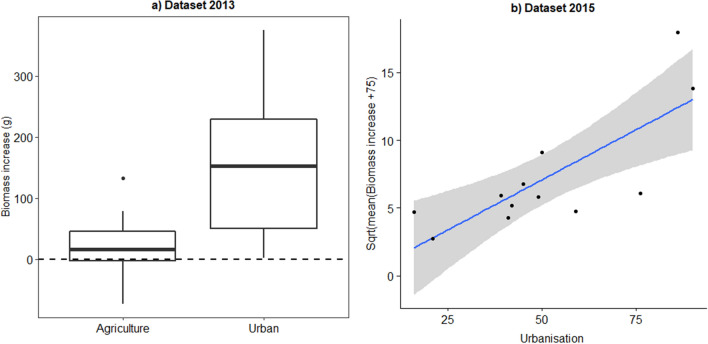
Wild bees are in decline on a local to global scale. The presence of managed honey bees can lead to competition for resources with wild bee species, which has not been investigated so far for human-modified landscapes. In this study we assess if managed honey bee hive density influence nest development (biomass) of bumble bees, an important trait affecting fitness. We hypothesize that domesticated honey bees can negatively affect Bombus terrestris nest development in human-modified landscapes. In Flanders, Belgium, where such landscapes are dominantly present, we selected 11 locations with landscape metrics ranging from urban to agricultural. The bee hive locations were mapped and each location contained one apiary dense (AD) and one apiary sparse (AS) study site (mean density of 7.6 ± 5.7 managed honey bee hives per km in AD sites). We assessed the effect of apiary density on the reproduction of reared B. terrestris nests. Reared B. terrestris nests had more biomass increase over 8 weeks in apiary sparse (AS) sites compared to nests located in apiary dense (AD) sites. This effect was mainly visible in urban locations, where nest in AS sites have 99.25 ± 60.99 g more biomass increase compared to nest in urban AD sites. Additionally, we found that managed bumble bee nests had higher biomass increase in urban locations. We conclude that the density of bee hives is a factor to consider in regard to interspecific competition between domesticated honey bees and bumble bees.

摘要

野生蜜蜂在局部到全球范围内都在减少。由于管理不善的蜜蜂可能会与野生蜜蜂物种争夺资源,因此到目前为止,还没有对人类改造的景观进行调查。在这项研究中,我们评估了管理不善的蜜蜂蜂箱密度是否会影响熊蜂的巢穴发育(生物量),这是一个影响适应度的重要特征。我们假设家养蜜蜂会对人类改造景观中的熊蜂巢穴发育产生负面影响。在比利时的佛兰德地区,这种景观占主导地位,我们选择了 11 个具有从城市到农业的景观特征的地点。记录了蜜蜂蜂巢的位置,每个位置都包含一个密集(AD)和一个稀疏(AS)的养蜂场研究点(AD 点的平均管理蜜蜂蜂巢密度为 7.6±5.7 个/公里)。我们评估了养蜂场密度对饲养的熊蜂巢穴繁殖的影响。在养蜂场稀疏(AS)地点,饲养的熊蜂巢穴在 8 周内的生物量增加量比在养蜂场密集(AD)地点的巢穴多。这种影响主要在城市地区可见,AS 地点的巢穴比城市 AD 地点的巢穴多增加了 99.25±60.99 克生物量。此外,我们发现管理不善的熊蜂巢穴在城市地区的生物量增加更高。我们得出结论,蜂箱密度是考虑家养蜜蜂和熊蜂之间种间竞争的一个因素。
https://cdn.ncbi.nlm.nih.gov/pmc/blobs/5378/7881143/236f9b33526c/41598_2021_82540_Fig4_HTML.jpg
https://cdn.ncbi.nlm.nih.gov/pmc/blobs/5378/7881143/238cdc3b3db3/41598_2021_82540_Fig1_HTML.jpg
https://cdn.ncbi.nlm.nih.gov/pmc/blobs/5378/7881143/4ce5e470be32/41598_2021_82540_Fig2_HTML.jpg
https://cdn.ncbi.nlm.nih.gov/pmc/blobs/5378/7881143/eac03acf3906/41598_2021_82540_Fig3_HTML.jpg
https://cdn.ncbi.nlm.nih.gov/pmc/blobs/5378/7881143/236f9b33526c/41598_2021_82540_Fig4_HTML.jpg
https://cdn.ncbi.nlm.nih.gov/pmc/blobs/5378/7881143/238cdc3b3db3/41598_2021_82540_Fig1_HTML.jpg
https://cdn.ncbi.nlm.nih.gov/pmc/blobs/5378/7881143/4ce5e470be32/41598_2021_82540_Fig2_HTML.jpg
https://cdn.ncbi.nlm.nih.gov/pmc/blobs/5378/7881143/eac03acf3906/41598_2021_82540_Fig3_HTML.jpg
https://cdn.ncbi.nlm.nih.gov/pmc/blobs/5378/7881143/236f9b33526c/41598_2021_82540_Fig4_HTML.jpg

相似文献

1
Reduced nest development of reared Bombus terrestris within apiary dense human-modified landscapes.在人工密集的蜜源环境中饲养的熊蜂蜂巢发育减少。
Sci Rep. 2021 Feb 12;11(1):3755. doi: 10.1038/s41598-021-82540-6.
2
Floral Resource Competition Between Honey Bees and Wild Bees: Is There Clear Evidence and Can We Guide Management and Conservation?蜜蜂与野生蜜蜂之间的花卉资源竞争:是否有明确证据以及我们能否指导管理与保护?
Environ Entomol. 2018 Aug 11;47(4):822-833. doi: 10.1093/ee/nvy077.
3
The abundance and pollen foraging behaviour of bumble bees in relation to population size of whortleberry (Vaccinium uliginosum).与越橘( Vaccinium uliginosum )种群大小有关的熊蜂数量和花粉觅食行为。
PLoS One. 2012;7(11):e50353. doi: 10.1371/journal.pone.0050353. Epub 2012 Nov 27.
4
The global stock of domesticated honey bees is growing slower than agricultural demand for pollination.全球家养蜜蜂的存量增长速度低于农业对授粉的需求。
Curr Biol. 2009 Jun 9;19(11):915-8. doi: 10.1016/j.cub.2009.03.071. Epub 2009 May 7.
5
Land conversion and pesticide use degrade forage areas for honey bees in America's beekeeping epicenter.土地转换和农药使用使美国养蜂业中心的蜜蜂饲料区退化。
PLoS One. 2021 May 13;16(5):e0251043. doi: 10.1371/journal.pone.0251043. eCollection 2021.
6
The Potential Influence of Bumble Bee Visitation on Foraging Behaviors and Assemblages of Honey Bees on Squash Flowers in Highland Agricultural Ecosystems.高地农业生态系统中大黄蜂访花对南瓜花上蜜蜂觅食行为及群落的潜在影响
PLoS One. 2016 Jan 14;11(1):e0144590. doi: 10.1371/journal.pone.0144590. eCollection 2016.
7
Using ITS2 metabarcoding and microscopy to analyse shifts in pollen diets of honey bees and bumble bees along a mass-flowering crop gradient.利用ITS2宏条形码技术和显微镜分析蜜蜂和熊蜂在大规模开花作物梯度上花粉食谱的变化。
Mol Ecol. 2020 Dec;29(24):5003-5018. doi: 10.1111/mec.15675. Epub 2020 Nov 1.
8
Landscape factors influencing honey bee colony behavior in Southern California commercial apiaries.影响南加州商业养蜂场蜜蜂群体行为的景观因素。
Sci Rep. 2020 Mar 19;10(1):5013. doi: 10.1038/s41598-020-61716-6.
9
Limitation of complementary resources affects colony growth, foraging behavior, and reproduction in bumble bees.补充资源的限制会影响熊蜂的群体生长、觅食行为和繁殖。
Ecology. 2020 Mar;101(3):e02946. doi: 10.1002/ecy.2946.
10
Honey bee (Apis mellifera) colonies benefit from grassland/ pasture while bumble bee (Bombus impatiens) colonies in the same landscapes benefit from non-corn/soybean cropland.蜜蜂(Apis mellifera)种群受益于草地/牧场,而同一景观中的熊蜂(Bombus impatiens)种群则受益于非玉米/大豆耕地。
PLoS One. 2021 Sep 20;16(9):e0257701. doi: 10.1371/journal.pone.0257701. eCollection 2021.

引用本文的文献

1
Urban habitat fragmentation and floral resources shape the occurrence of gut parasites in two bumblebee species.城市栖息地破碎化和花卉资源影响两种熊蜂肠道寄生虫的出现。
Ecol Evol. 2023 Jul 12;13(7):e10299. doi: 10.1002/ece3.10299. eCollection 2023 Jul.
2
Environmental differences explain subtle yet detectable genetic structure in a widespread pollinator.环境差异解释了广泛分布的传粉媒介中微妙但可检测的遗传结构。
BMC Ecol Evol. 2022 Feb 1;22(1):8. doi: 10.1186/s12862-022-01963-5.

本文引用的文献

1
Wild pollinator activity negatively related to honey bee colony densities in urban context.在城市环境中,野生传粉者的活动与蜜蜂种群密度呈负相关。
PLoS One. 2019 Sep 12;14(9):e0222316. doi: 10.1371/journal.pone.0222316. eCollection 2019.
2
Lower bumblebee colony reproductive success in agricultural compared with urban environments.与城市环境相比,农业环境中熊蜂的蜂群繁殖成功率较低。
Proc Biol Sci. 2018 Jun 27;285(1881):20180807. doi: 10.1098/rspb.2018.0807.
3
Honeybee spillover reshuffles pollinator diets and affects plant reproductive success.
蜜蜂蜜蜂溢出重新洗牌传粉者的饮食和影响植物生殖成功。
Nat Ecol Evol. 2017 Sep;1(9):1299-1307. doi: 10.1038/s41559-017-0249-9. Epub 2017 Jul 31.
4
Big city : using natural history and land-use history to find significant environmental drivers in bumble-bee declines in urban development.大城市:利用自然历史和土地利用历史来寻找城市发展中导致熊蜂数量下降的重要环境驱动因素。
R Soc Open Sci. 2017 May 17;4(5):170156. doi: 10.1098/rsos.170156. eCollection 2017 May.
5
Resource overlap and possible competition between honey bees and wild bees in central Europe.中欧蜜蜂与野生蜜蜂之间的资源重叠及潜在竞争
Oecologia. 2000 Feb;122(2):288-296. doi: 10.1007/s004420050034.
6
Taxonomic and functional trait diversity of wild bees in different urban settings.不同城市环境中野生蜜蜂的分类和功能性状多样性。
PeerJ. 2017 Mar 7;5:e3051. doi: 10.7717/peerj.3051. eCollection 2017.
7
The Neonicotinoid Insecticide Thiacloprid Impacts upon Bumblebee Colony Development under Field Conditions.噻虫啉新烟碱类杀虫剂对田间条件下熊蜂种群发展的影响。
Environ Sci Technol. 2017 Feb 7;51(3):1727-1732. doi: 10.1021/acs.est.6b04791. Epub 2017 Jan 26.
8
Experimental evidence that honeybees depress wild insect densities in a flowering crop.蜜蜂会降低开花作物中野生昆虫密度的实验证据。
Proc Biol Sci. 2016 Nov 30;283(1843). doi: 10.1098/rspb.2016.1641.
9
Local bumble bee decline linked to recovery of honey bees, drought effects on floral resources.当地大黄蜂数量减少与蜜蜂数量回升、干旱对花卉资源的影响有关。
Ecol Lett. 2016 Oct;19(10):1247-55. doi: 10.1111/ele.12659. Epub 2016 Aug 19.
10
Seed coating with a neonicotinoid insecticide negatively affects wild bees.种衣剂中加入新烟碱类杀虫剂会对野生蜜蜂产生负面影响。
Nature. 2015 May 7;521(7550):77-80. doi: 10.1038/nature14420. Epub 2015 Apr 22.