Department of Psychology and Neuroscience, University of North Carolina at Chapel Hill, CB#3270, Chapel Hill, NC, 27599-3270, USA.
Mol Neurobiol. 2021 Jun;58(6):2963-2973. doi: 10.1007/s12035-021-02322-z. Epub 2021 Feb 13.
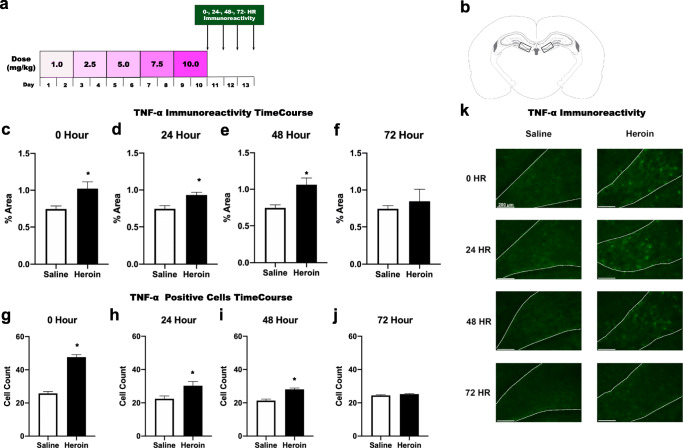
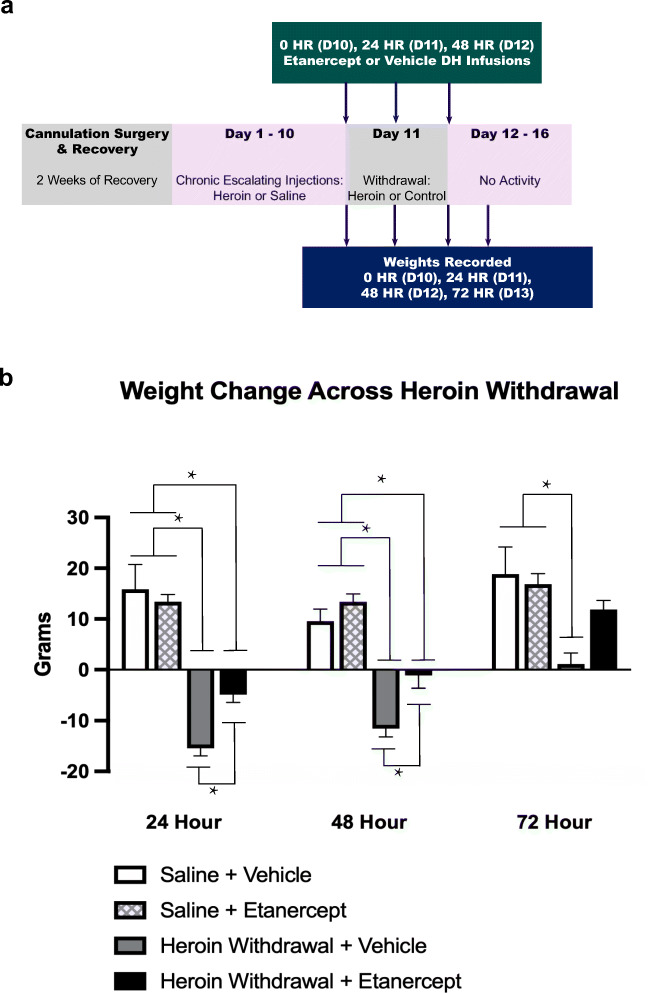
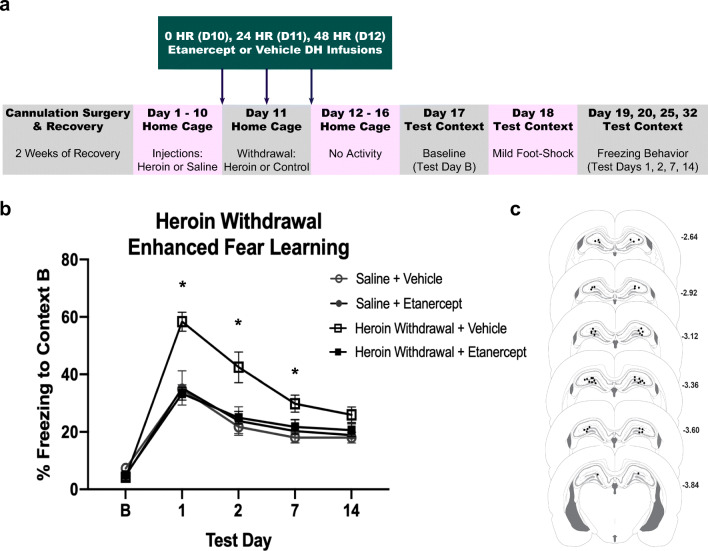
There is significant comorbidity of opioid use disorder (OUD) and post-traumatic stress disorder (PTSD) in clinical populations. However, the neurobiological mechanisms underlying the relationship between chronic opioid use and withdrawal and development of PTSD are poorly understood. Our previous work identified that chronic escalating heroin administration and withdrawal can produce enhanced fear learning, an animal model of hyperarousal, and is associated with an increase in dorsal hippocampal (DH) interleukin-1β (IL-1β). However, other cytokines, such as TNF-α, work synergistically with IL-1β and may have a role in the development of enhanced fear learning. Based on both translational rodent and clinical studies, TNF-α has been implicated in hyperarousal states of PTSD, and has an established role in hippocampal-dependent learning and memory. The first set of experiments tested the hypothesis that chronic heroin administration followed by withdrawal is capable of inducing alterations in DH TNF-α expression. The second set of experiments examined whether DH TNF-α expression is functionally relevant to the development of enhanced fear learning. We identified an increase of TNF-α immunoreactivity and positive cells at 0, 24, and 48 h into withdrawal in the dentate gyrus DH subregion. Interestingly, intra-DH infusions of etanercept (TNF-α inhibitor) 0, 24, and 48 h into heroin withdrawal prevented the development of enhanced fear learning and mitigated withdrawal-induced weight loss. Overall, these findings provide insight into the role of TNF-α in opioid withdrawal and the development of anxiety disorders such as PTSD.
在临床人群中,阿片类药物使用障碍(OUD)和创伤后应激障碍(PTSD)的共病率很高。然而,慢性阿片类药物使用和戒断与 PTSD 发展之间关系的神经生物学机制尚不清楚。我们之前的工作表明,慢性递增海洛因给药和戒断会导致恐惧学习增强,这是一种过度警觉的动物模型,并且与背侧海马(DH)白细胞介素-1β(IL-1β)增加有关。然而,其他细胞因子,如 TNF-α,与 IL-1β协同作用,并且可能在增强的恐惧学习发展中发挥作用。基于转化啮齿动物和临床研究,TNF-α已被牵连到 PTSD 的过度警觉状态中,并且在海马依赖性学习和记忆中具有既定的作用。第一组实验检验了以下假设:慢性海洛因给药后戒断能够诱导 DH TNF-α表达的改变。第二组实验检查了 DH TNF-α表达是否与增强的恐惧学习的发展有关。我们发现,在戒断的 0、24 和 48 小时,在齿状回 DH 亚区中 TNF-α免疫反应性和阳性细胞增加。有趣的是,在海洛因戒断期间,DH 内注射依那西普(TNF-α抑制剂)0、24 和 48 小时可预防增强的恐惧学习的发展,并减轻戒断引起的体重减轻。总体而言,这些发现为 TNF-α在阿片类药物戒断和焦虑障碍(如 PTSD)发展中的作用提供了新的认识。