Almaguel Frankis A, Sanchez Tino W, Ortiz-Hernandez Greisha L, Casiano Carlos A
Center for Health Disparities and Molecular Medicine, Department of Basic Sciences, Loma Linda University School of Medicine, Loma Linda, CA, United States.
Loma Linda University Cancer Center, Loma Linda, CA, United States.
Front Genet. 2021 Jan 28;11:614726. doi: 10.3389/fgene.2020.614726. eCollection 2020.
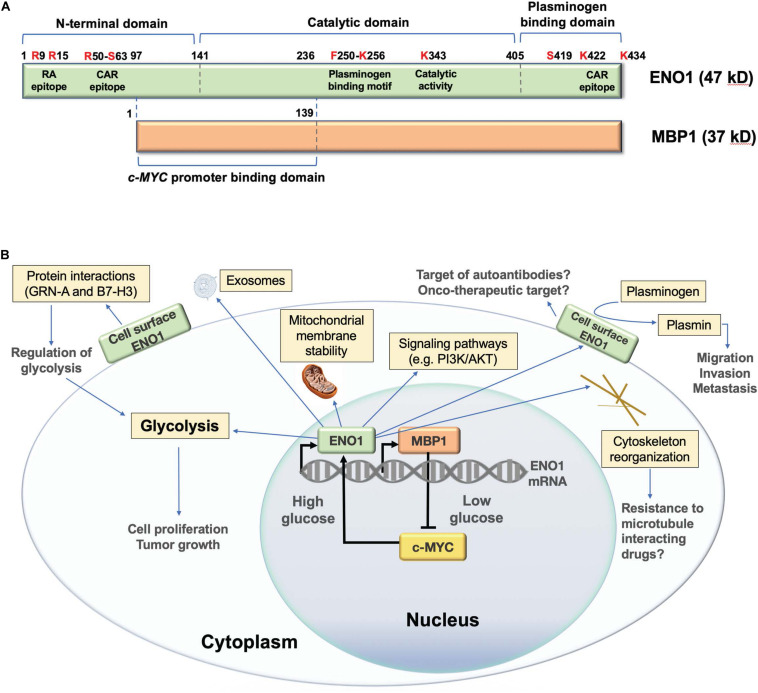
Alpha-enolase, also known as enolase-1 (ENO1), is a glycolytic enzyme that "moonlights" as a plasminogen receptor in the cell surface, particularly in tumors, contributing to cancer cell proliferation, migration, invasion, and metastasis. ENO1 also promotes other oncogenic events, including protein-protein interactions that regulate glycolysis, activation of signaling pathways, and resistance to chemotherapy. ENO1 overexpression has been established in a broad range of human cancers and is often associated with poor prognosis. This increased expression is usually accompanied by the generation of anti-ENO1 autoantibodies in some cancer patients, making this protein a tumor associated antigen. These autoantibodies are common in patients with cancer associated retinopathy, where they exert pathogenic effects, and may be triggered by immunodominant peptides within the ENO1 sequence or by posttranslational modifications. ENO1 overexpression in multiple cancer types, localization in the tumor cell surface, and demonstrated targetability make this protein a promising cancer biomarker and therapeutic target. This mini-review summarizes our current knowledge of ENO1 functions in cancer and its growing potential as a cancer biomarker and guide for the development of novel anti-tumor treatments.
α-烯醇化酶,也称为烯醇化酶-1(ENO1),是一种糖酵解酶,在细胞表面(特别是在肿瘤中)作为纤溶酶原受体发挥“兼职”功能,促进癌细胞的增殖、迁移、侵袭和转移。ENO1还促进其他致癌事件,包括调节糖酵解的蛋白质-蛋白质相互作用、信号通路的激活以及对化疗的抗性。ENO1在多种人类癌症中均有过表达,且常与不良预后相关。在一些癌症患者中,这种表达增加通常伴随着抗ENO1自身抗体的产生,使得该蛋白成为一种肿瘤相关抗原。这些自身抗体在癌症相关性视网膜病变患者中很常见,在其中发挥致病作用,可能由ENO1序列内的免疫显性肽或翻译后修饰触发。ENO1在多种癌症类型中的过表达、在肿瘤细胞表面的定位以及已证实的可靶向性,使得该蛋白成为一种有前景的癌症生物标志物和治疗靶点。这篇小型综述总结了我们目前对ENO1在癌症中的功能及其作为癌症生物标志物的潜力不断增长的认识,以及对新型抗肿瘤治疗开发的指导作用。