Mazza Angelo, Di Giorgio Angelo, Martelli Laura, Pelliccia Ciretta, Pinotti Moira Alessandra, Quadri Vera, Verdoni Lucio, Decio Alice, Ruggeri Maurizio, D'Antiga Lorenzo
Paediatric Pulmonology, Paediatric Department, Hospital Papa Giovanni XXIII, Bergamo, Italy.
Paediatric Gastroenterology, Paediatric Department, Hospital Papa Giovanni XXIII, Bergamo, Italy.
Front Pediatr. 2021 Jan 28;9:629040. doi: 10.3389/fped.2021.629040. eCollection 2021.
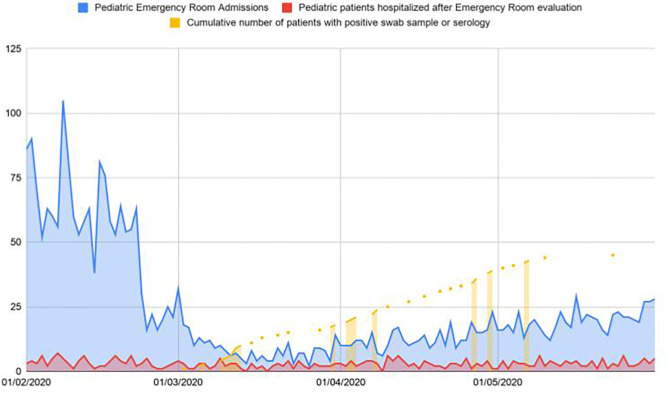
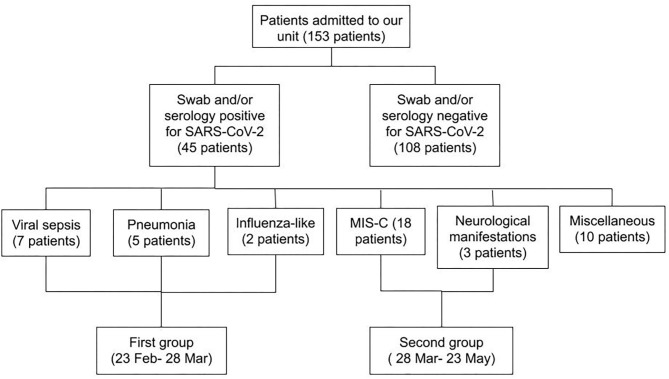
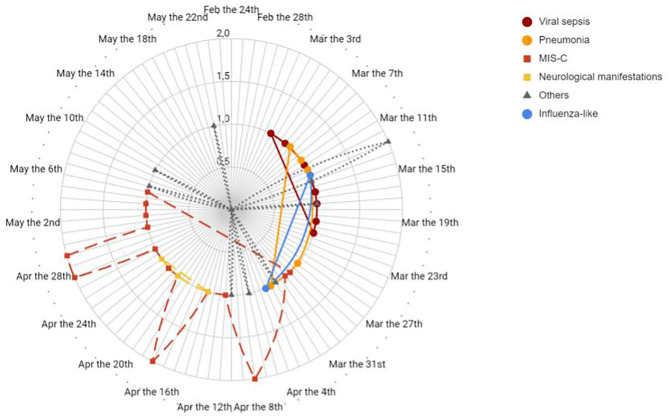
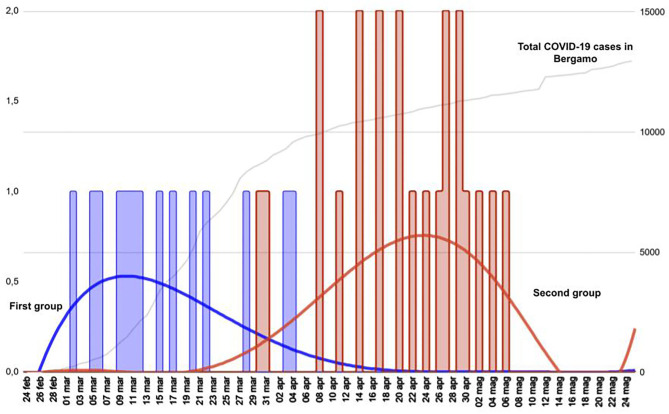
COVID-19, a disease caused by the new coronavirus SARS-CoV-2, spread worldwide, and Bergamo was one of the most affected areas in Europe. Following the first outbreak, more than half of the population of the Bergamo province had been infected. We aimed to describe the patients admitted to our unit shortly after the first outbreak. we retrospectively reviewed the notes of all pediatric patients diagnosed with COVID-19. We enrolled patients with positive swabs or serology and classified them based on the pattern and the timing of presentation after the first outbreak. This setting was considered a reliable reflection of the consequences of unmitigated SARS-CoV-2 circulation. We diagnosed 35 patients over a 3-month period and we identified six patterns presenting in two temporal phases: Early phase, Group 1 (median of 20 days from epidemic start, IQR: 15-27): neonatal sepsis (.7), pneumonia (.5), flu-like symptoms (.2). Late phase, Group 2 (59:51-66 days, < 0.001): MIS-C (.18), neurological manifestations (.3). Group 1 differed from Group 2 for younger age (1 vs. 8 years, = 0.02), lower C-reactive protein (0.9 vs. 16.6 mg/dl, = 0.008), procalcitonin (0.16 vs. 7.9 ng/ml, = 0.008) and neutrophil count (3,765 vs. 6,780/μl, = 0.006), higher rate of positive swabs (14/14 vs. 9/21, < 0.001), higher lymphocyte count (3,000 vs. 930/μl, = 0.006) and platelet count (323,000 vs. 210,000/μl, = 0.009). Following an outbreak of unmitigated SARS-CoV-2 diffusion, infected children may present with clinical patterns suggesting two temporal clusters, the first characterized by markers of direct viral injury, the second suggesting an immune-mediated disease.
新型冠状病毒SARS-CoV-2引发的疾病COVID-19在全球范围内传播,贝加莫是欧洲受影响最严重的地区之一。首次疫情爆发后,贝加莫省一半以上的人口被感染。我们旨在描述首次疫情爆发后不久入住我们科室的患者情况。我们回顾性地查阅了所有被诊断为COVID-19的儿科患者的病历。我们纳入了拭子或血清学检测呈阳性的患者,并根据首次疫情爆发后的表现模式和时间对他们进行分类。这种情况被认为是未加控制的SARS-CoV-2传播后果的可靠反映。在3个月的时间里,我们诊断出35例患者,并确定了在两个时间段出现的六种模式:早期,第1组(从疫情开始起中位数为20天,四分位距:15 - 27天):新生儿败血症(.7)、肺炎(.5)、流感样症状(.2)。晚期,第2组(59:51 - 66天,<0.001):儿童多系统炎症综合征(MIS-C)(.18)、神经表现(.3)。第1组与第2组在年龄上存在差异(1岁对8岁,=0.02),C反应蛋白水平较低(0.9对16.6毫克/分升,=0.008)、降钙素原水平较低(0.16对7.9纳克/毫升,=0.008)以及中性粒细胞计数较低(3765对6780/微升,=0.006),拭子阳性率较高(14/14对9/21,<0.001),淋巴细胞计数较高(3000对930/微升,=0.006)以及血小板计数较高(323000对210000/微升,=0.009)。在未加控制的SARS-CoV-2扩散疫情爆发后,受感染儿童可能会出现提示两个时间集群的临床模式,第一个集群以直接病毒损伤的标志物为特征,第二个集群提示免疫介导的疾病。